

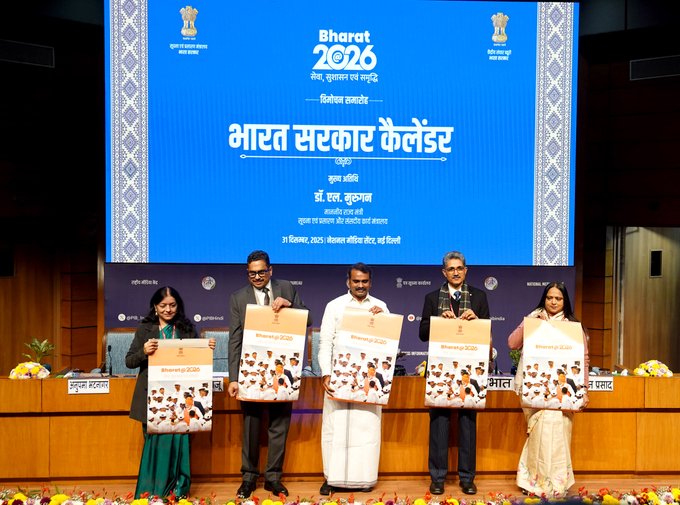
The Government of India today unveiled the official Calendar for 2026, presenting it as a reflection of the nation’s transformation journey and governance priorities rather than merely a record of dates. The calendar carries the theme “Bharat at 2026 Sewa Sushasan and Samriddhi,” underscoring the government’s focus on service delivery, good governance and inclusive prosperity as India advances towards the goal of becoming a developed nation by 2047.
Unveiling the calendar, the Union Minister of State for Information and Broadcasting and Parliamentary Affairs said the annual publication captures the spirit of India’s growing national confidence, people-centric governance and long-term developmental vision. The calendar, the Minister noted, mirrors how reforms and institutional strengthening are translating into improved ease of living, stronger service delivery systems and greater trust between citizens and the state.
Referring to key policy initiatives undertaken during 2025, the Minister highlighted that structural reforms have enhanced India’s economic resilience while ensuring that growth remains broad-based. Measures such as tax relief under the new tax regime, rationalisation under GST 2.0, implementation of the four Labour Codes and focused employment generation programmes were cited as initiatives that have strengthened productivity, simplified compliance and supported inclusive prosperity.
The Secretary, Ministry of Information and Broadcasting, described the Government of India Calendar as a powerful communication tool that clearly spells out national priorities and values. He said the 2026 edition reflects India’s phase of confident consolidation, driven by reforms, inclusion and rising aspirations across society.
The calendar features twelve carefully curated monthly themes, each highlighting a key pillar of national progress. January focuses on self-reliance and confidence through “Atmanirbharta se Atmavishwas,” while February underscores the role of farmers through “Samriddh Kisan Samriddh Bharat.” March celebrates women-led development under “Nari Shakti for New India,” and April highlights governance reforms through “Saralikaran se Sashaktikaran.”
May honours the courage and sacrifices of the armed forces through “Veerta se Vijay Tak Operation Sindoor.” June and July focus on wellbeing and dignity for all through “Swasth Bharat Samriddh Bharat” and “Vanchiton ka Samman.” August and September capture the energy of youth and infrastructure expansion through “Yuva Shakti Rashtra Shakti” and “Gati Shakti Pragati.” October and November reaffirm India’s civilisational ethos and inclusive approach through “Parampara se Pragati Tak” and “Sabka Saath Sabka Samman,” while December highlights India’s role on the global stage through “Vishva Bandhu Bharat.”
The Director General of the Central Bureau of Communication highlighted that the calendar has been published in 13 Indian languages, reinforcing inclusivity and ensuring that the government’s message reaches citizens across linguistic and cultural backgrounds. Senior officials from the Ministry of Information and Broadcasting and allied media organisations were present at the launch.
The occasion also served as an opportunity to extend New Year greetings, with speakers expressing confidence that 2026 would mark another significant step towards a prosperous, inclusive and self-assured India.