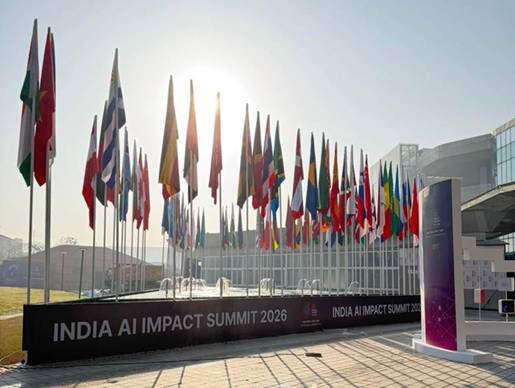

A high level session on human centric artificial intelligence at the India AI Impact Summit 2026 set the tone for India’s evolving Skill India strategy, underscoring the centrality of talent, trust and technology in shaping the country’s AI future.
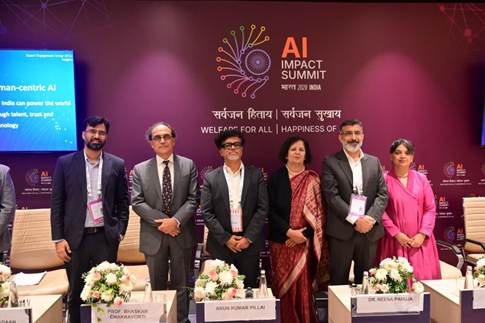
Organised by the Ministry of Skill Development and Entrepreneurship on the sidelines of the summit, the interactive session titled Human Centric AI How India Can Power the World through Talent Trust and Technology formed part of the Expert Engagement Group discussions. The session brought together global thought leaders, industry experts and policymakers to deliberate on India’s role in building a responsible, inclusive and talent driven AI ecosystem.
The keynote address was delivered by Bhaskar Chakravorti, Dean of Global Business at The Fletcher School, Tufts University, who spoke on Human Flourishing in the Age of AI and outlined the vision for a Global South coalition focused on transition infrastructure. He argued that AI leadership in the coming decade will depend not only on technological sophistication but also on robust trust frameworks, resilient digital public infrastructure and strong national talent pipelines. He observed that India’s experience in building inclusive, population scale digital systems positions it uniquely to design AI solutions that are equitable, accessible and widely trusted.
The panel discussion was moderated by Sidharth Madaan, Partner and Managing Director at BCG, and featured Yolynd Lobo, Director and Head of Global Affairs and Public Policy at Google Cloud India; Arunkumar Pillai, Chief Executive Officer of National Skill Development Corporation; Rakesh Kaul, Technology Consulting Partner at EY; and Neena Pahuja, Former Executive Member of National Council for Vocational Education and Training.
The discussion focused on how AI is reshaping skilling ecosystems, institutional preparedness and workforce pathways. Arunkumar Pillai emphasised that AI is not merely a subject to be taught but an enabler of skill delivery, functioning as trainer, assessor and career guide. Through AI awareness programmes, the SOAR initiative and AI enabled capabilities within the Skill India Digital Hub, learners are benefiting from personalised learning pathways, real time labour market insights and outcome based assessments.
Neena Pahuja presented a structured three tier capability framework described as AI for All, AI for Many and AI for Few, aimed at building competencies from foundational digital literacy to advanced specialisation. She noted that SOAR registrations have crossed two lakh learners and highlighted the rollout of nano credentials, stackable pathways and modular qualifications aligned with the National Credit Framework. She also stated that Industrial Training Institutes are integrating short duration AI modules to enhance productivity across traditional trades.
Rakesh Kaul underscored that the central question is not whether AI will transform work, but how institutions anticipate and manage that transformation through responsible innovation and risk preparedness. Yolynd Lobo emphasised the importance of expanding domestic compute capacity, deepening cross sector partnerships and connecting AI solutions across value chains, from agriculture to creative industries, to ensure inclusive growth.
The session concluded with a live demonstration by Sunil Kumar, Lead Engineer Machine Learning at Google, on Scaling Creative with GCP GenMedia. The demonstration showcased how GenMedia models can generate production ready assets, enable immersive AI driven creative workflows and convert conceptual ideas into scalable real world applications.
The session was also attended by Debashree Mukherjee, Secretary, Ministry of Skill Development and Entrepreneurship, who engaged with participants and shared perspectives on aligning AI skilling initiatives with national development priorities. She emphasised the need to build a talent ecosystem rooted in trust, inclusivity and industry relevance. During her visit to the Skill India Pavilion, she interacted with exhibitors showcasing innovations in digital learning and AI enabled training solutions, and held detailed discussions with industry partners and training providers on outcome driven skill development.
The deliberations reinforced the view that India’s AI strategy must remain human centric, focusing on skill development, institutional capacity and ethical frameworks alongside technological advancement. Participants collectively called for deeper collaboration between government, academia and industry to ensure that India’s AI journey is inclusive, globally competitive and anchored in public trust.