
India marked a significant milestone in artificial intelligence enabled healthcare as an indigenously developed Tele Robotic Ultrasonography system successfully conducted a live ultrasound examination from AIIMS New Delhi to the Maitri Research Station in Antarctica, over 12,000 kilometres away.
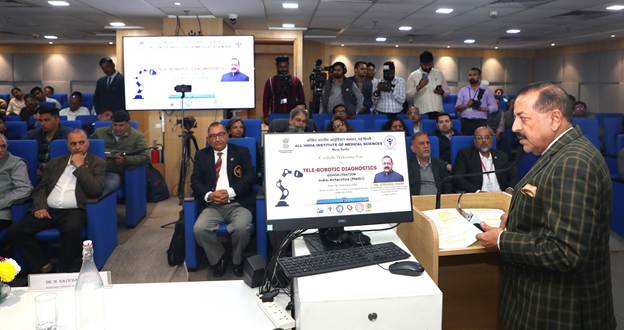
Union Minister of State Independent Charge for Science and Technology and Earth Sciences, Minister of State PMO, Personnel, Public Grievances, Pensions, Atomic Energy and Space, Dr Jitendra Singh, witnessed the live demonstration, describing it as a transformative step in remote healthcare delivery and a new dimension in value addition through AI.
The system, developed jointly by AIIMS New Delhi and IIT Delhi in collaboration with the National Centre for Polar and Ocean Research under the Ministry of Earth Sciences, enables a radiologist in Delhi to perform real time ultrasound imaging on a patient located in Antarctica. The robotic arm, fitted with an ultrasound probe, provides six degrees of freedom, replicating the precise hand movements of a trained sonographer.
Equipped with force sensing safety features and delivering diagnostically reliable imaging with less than one second latency, the platform supports emergency focused examinations including FAST scans, abdominal organ evaluation, cardiac assessment and trauma screening.
Dr Jitendra Singh noted that the demonstration, taking place amid ongoing national discussions on artificial intelligence, illustrates the convergence of AI, robotics and real time medical expertise. He said the innovation expands the reach of specialist healthcare beyond geographical barriers and heralds a new era in remote diagnostics.
Designed for extreme and isolated environments, the technology is particularly relevant for polar expeditions, where emergency evacuation is both costly and logistically complex. The system assists clinicians in determining whether a patient can be managed locally or requires evacuation, thereby improving clinical decision making and reducing operational risks.
The Minister said the initiative reflects the Prime Minister Shri Narendra Modi’s vision of a whole of science and whole of government approach, bringing together institutions across ministries towards a common national objective. He emphasised that India’s polar missions and ocean research programmes are evolving beyond geoscientific exploration to become platforms for innovation with direct societal application.
Dr Jitendra Singh also addressed the persistent rural urban healthcare divide, highlighting the difficulty of ensuring specialist availability in remote regions despite adequate national human resources. He said emerging technologies such as telemedicine, AI driven diagnostics and robotic intervention can bridge this gap and redefine clinical practice in the coming years.
He further linked the development to India’s broader scientific governance framework, citing advances in deep ocean research, Arctic policy, the Antarctica Act and digital health infrastructure as indicators of an integrated and forward looking approach.
Dr M Ravichandran, Secretary, Ministry of Earth Sciences, stated that the tele robotic system could significantly reduce the need for emergency evacuations from Antarctica and strengthen India’s scientific operations in polar regions. He described the initiative as a model of inter institutional and inter ministerial collaboration.
The system has been developed with affordability, robustness and scalability in mind, enabling potential deployment across border areas, disaster zones, rural health centres and mobile medical units. Officials indicated that the technology could be adapted for use in geographically challenging regions across India, ensuring specialist intervention without physical presence.
Dr Jitendra Singh said innovations emerging from India’s scientific ecosystem are expanding the frontiers of accessibility, making high quality healthcare possible from Antarctica to the remotest villages. He added that such advancements reinforce India’s trajectory towards becoming a developed nation powered by science, technology and integrated governance.