
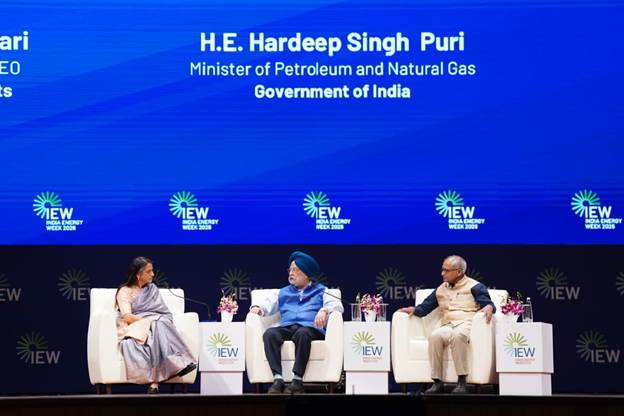
India reinforced its position at the centre of the global energy landscape as India Energy Week 2026 concluded in Goa, with a strong message of preparedness, resilience and strategic autonomy amid sustained geopolitical volatility. The four-day global energy conclave was held from 27 January to 30 January 2026.
Addressing the Closing Ceremony, Union Minister of Petroleum and Natural Gas Shri Hardeep Singh Puri said India has demonstrated the capacity to navigate repeated global disruptions while safeguarding national interests and consumer welfare. He underlined that India’s energy policy is firmly anchored in diversification of supply, resilience against external shocks and a calibrated transition towards cleaner fuels.
Shri Puri said India has successfully converted successive global crises into opportunities by expanding sourcing options and accelerating its transition to greener energy pathways. He emphasised that India today stands as the world’s third-largest energy consumer, the fourth-largest refiner and among the leading exporters of petroleum products. He reiterated that India will continue to ensure availability, affordability and sustainability of energy even in an uncertain global environment.
Highlighting policy continuity, the Union Minister said traditional fuels will remain essential to meet growing demand, while cleaner alternatives will steadily expand their footprint. He pointed to rapid progress in ethanol blending, compressed biogas, biofuels and green hydrogen as evidence of India’s commitment to a balanced and pragmatic transition. He added that indigenous clean-energy technologies are being actively promoted alongside sustained investment in conventional energy systems.
On consumer protection during global price volatility, Shri Puri said India has insulated its citizens from international shocks. He noted that global turmoil has not been passed on to consumers and that India continues to maintain among the lowest energy prices globally. He credited timely interventions by oil marketing companies for ensuring uninterrupted supply and affordable prices of fuels, including LPG, even during periods of global disruption.
Speaking after the Union Minister, Dr Neeraj Mittal, Secretary, Ministry of Petroleum and Natural Gas, outlined the government’s roadmap to meet rising energy demand driven by projected economic growth of over seven percent. He said India’s strategy rests on strengthening domestic exploration and production while positioning the country as a reliable global supplier of refined petroleum products.
Dr Mittal said accelerated drilling and upstream activity are being pursued to enhance self-reliance and reduce import dependence. He also highlighted the integration of refining and petrochemicals to maximise value addition within the country and improve global competitiveness. According to him, India is building scale domestically while remaining firmly embedded in global energy markets.
On the energy transition, Dr Mittal stressed the growing role of technology and digitalisation. He said artificial intelligence, logistics optimisation and digital tools are improving operational efficiency, lowering costs and strengthening resilience across the energy value chain. He also noted that India is progressing steadily towards its compressed biogas targets, with a national goal of achieving five percent blending by 2030, supported by strong participation from states and farmer-led biomass supply chains.
The closing session reaffirmed India Energy Week 2026 as a critical platform for global dialogue on energy security, affordability and sustainability. The event concluded with India projecting itself as a steady, credible and pragmatic energy leader capable of balancing growth imperatives with transition goals in a rapidly evolving global energy order.
India Energy Week is the country’s flagship global energy platform, bringing together government leaders, industry executives and innovators to accelerate progress towards a secure, sustainable and affordable energy future through investment, policy alignment and technological collaboration.