
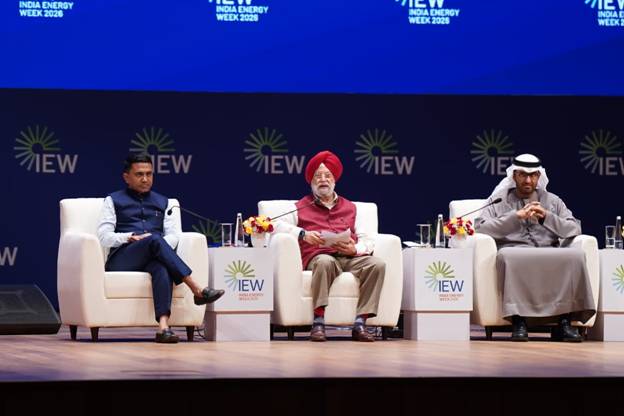
India Energy Week 2026 commenced on 27 January 2026 with high-level keynote addresses that set a strong tone for global cooperation, sustained investment and pragmatic action to advance a secure, affordable and sustainable energy future. The opening session featured keynote addresses by Union Minister for Petroleum and Natural Gas Hardeep Singh Puri and Sultan Ahmed Al Jaber, Minister of Industry and Advanced Technology of the United Arab Emirates and Managing Director and Group CEO of ADNOC, along with a welcome address by Chief Minister of Goa Pramod Sawant.
The speakers underlined the role of India Energy Week as a premier international platform that translates dialogue into action, innovation into implementation and ambition into measurable outcomes, at a time when the global energy system is undergoing unprecedented transformation.
Delivering the keynote address, Union Minister Hardeep Singh Puri highlighted India’s steady and resilient progress towards energy security, self-reliance and climate justice under the leadership of Prime Minister Narendra Modi. He said India Energy Week has rapidly evolved into a trusted global forum that brings together policymakers, producers, consumers, technology providers and investors to navigate volatility and structural change in global energy markets.
Emphasising that the global energy transition is fundamentally about energy addition rather than replacement, the Minister stressed the need for sustained and balanced investment across oil and gas, biofuels, green hydrogen, LNG and clean cooking fuels to ensure energy security, affordability and sustainability. He outlined India’s reforms-driven approach, noting the opening up of large sedimentary basins for exploration, successive Open Acreage Licensing Policy and Discovered Small Fields bidding rounds, and continuous policy reforms aimed at attracting long-term global investment.
The Minister also highlighted India’s rapid expansion of LPG coverage, clean cooking access and a diversified energy mix as key pillars of inclusive growth and equitable access to energy for all sections of society.
Addressing the inaugural session, Sultan Ahmed Al Jaber said global energy demand is entering a phase of large-scale transformation driven by emerging markets, digitalisation and the integration of diverse energy systems. He noted that India lies at the centre of these megatrends and will be a decisive driver of global energy demand in the decades ahead.
Stressing that underinvestment poses the greatest risk to the global energy system, he called for balanced investment across all forms of energy to ensure reliability, affordability and sustainability. Highlighting the depth of the UAE–India energy partnership, he said ADNOC remains a reliable supplier of crude oil, LNG and LPG to India and reaffirmed the UAE’s commitment to long-term, trust-based partnerships that deliver certainty, resilience and shared value in a rapidly evolving global energy landscape.
Welcoming delegates from across the world, Chief Minister of Goa Pramod Sawant said India Energy Week has emerged as a global platform that converts ideas into action. As the host state, Goa showcased its vision for sustainable development, including a long-term roadmap to achieve 100 per cent renewable energy by 2050. He also underlined the importance of balancing the green economy with the blue economy, ensuring environmental sustainability alongside responsible utilisation of ocean resources.
The inaugural session of India Energy Week 2026 reinforced India’s positioning as a responsible global energy leader offering practical, scalable and inclusive solutions. Strong emphasis was placed on international cooperation, innovation and investment mobilisation as critical enablers for accelerating the global energy transition while safeguarding energy security and economic growth.
India Energy Week is India’s flagship global energy platform that brings together government leaders, industry executives and innovators to advance progress towards a secure, sustainable and affordable energy future. As a neutral international forum, it plays a key role in driving investment, policy alignment and technological collaboration shaping the global energy landscape.