
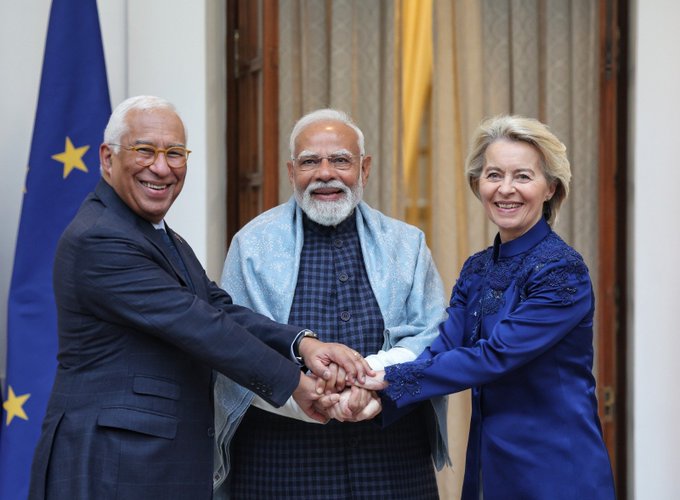
India and the European Union have concluded the India–European Union Free Trade Agreement, marking a historic breakthrough in India’s global trade engagement and establishing one of the most comprehensive and forward-looking trade partnerships in the world. The landmark announcement was made jointly by Prime Minister Narendra Modi and European Commission President Ursula von der Leyen at the 16th India–EU Summit held in India on 27 January 2026.
The conclusion of the agreement positions India, the world’s fourth largest economy, and the European Union, the second largest economy, as trusted partners committed to open markets, predictability and inclusive growth. Together, India and the EU account for nearly 25 percent of global GDP and about one third of global trade, making this partnership one of the most consequential trade arrangements globally.
The Free Trade Agreement follows intensive negotiations since their re-launch in 2022 and represents the culmination of years of sustained dialogue and political commitment on both sides. It establishes a balanced, modern and rules-based framework covering trade in goods and services, customs and trade facilitation, rules of origin, trade remedies, digital trade, small and medium enterprises, and emerging regulatory areas.
Unprecedented market access has been secured under the agreement, with over 99 percent of Indian exports by trade value receiving preferential access to the EU market. India’s exports worth approximately INR 6.41 lakh crore, or USD 75 billion, are expected to gain significantly, including nearly USD 33 billion of labour-intensive exports in sectors such as textiles, apparel, leather, footwear, marine products, gems and jewellery, handicrafts, engineering goods and automobiles, with tariffs of up to 10 percent eliminated upon entry into force.
The agreement is expected to create substantial employment opportunities for women, artisans, youth, professionals and MSMEs, while strengthening India’s integration into global value chains and reinforcing the Make in India initiative. Carefully calibrated and reciprocal market access in the automobile sector will allow EU manufacturers to introduce high-end models in India while opening future export opportunities for India-made automobiles in the EU market, benefiting consumers through greater choice and advanced technologies.
India’s agricultural and processed food exports are set to receive a major boost, with enhanced market access for products such as tea, coffee, spices, fresh fruits and vegetables, and processed foods. At the same time, India has safeguarded sensitive sectors including dairy, cereals, poultry, soymeal and select fruits and vegetables, ensuring domestic priorities remain protected with no market access commitments in these areas.
The agreement delivers ambitious and commercially meaningful outcomes in services, which are a dominant and fast-growing component of both economies. Indian service providers will receive predictable access across 144 EU subsectors including IT and IT-enabled services, professional services, education, research and development, financial services, tourism and construction. In return, the EU will gain access to 102 Indian service subsectors, facilitating high-technology services and increased investment flows.
A future-ready mobility framework forms a core pillar of the agreement, enabling the temporary movement of skilled and semi-skilled professionals, business visitors and intra-corporate transferees. The framework also includes entry and work rights for dependents of intra-corporate transferees, commitments for contractual service suppliers and independent professionals across multiple sectors, provisions for student mobility and post-study work opportunities, and a structured pathway to engage on social security agreements over a five-year horizon. India has also secured access for practitioners of Indian traditional medicine to work under home title in EU member states where such practices are not regulated.
The agreement addresses non-tariff barriers through enhanced regulatory cooperation, greater transparency, streamlined customs procedures, and strengthened sanitary and phytosanitary and technical barriers to trade disciplines. Forward-looking provisions on the Carbon Border Adjustment Mechanism ensure constructive engagement, including most-favoured-nation assurances, technical cooperation on carbon pricing, recognition of verifiers, and targeted financial and technical support to assist Indian exporters in meeting emerging carbon requirements.
Intellectual property provisions reaffirm commitments under the TRIPS Agreement, the Doha Declaration, and recognise the importance of India’s Traditional Knowledge Digital Library, while also facilitating cooperation in emerging areas such as artificial intelligence, clean technologies and semiconductors.
Union Minister for Commerce and Industry Piyush Goyal described the agreement as a defining achievement in India’s global economic engagement, stating that it goes far beyond a conventional trade deal and reflects a comprehensive strategic partnership that will drive job creation, innovation and competitiveness across sectors.
The India–EU Free Trade Agreement is expected to substantially scale up bilateral trade, enhance export competitiveness, and deepen economic integration between India and the 27-member EU bloc. It becomes India’s 22nd free trade agreement and, alongside recent agreements with the UK and the European Free Trade Association, effectively opens up the entire European market for Indian businesses and entrepreneurs.
Aligned with the vision of Viksit Bharat 2047, the agreement lays the foundation for inclusive, resilient and future-ready growth, reinforcing shared values, fostering innovation and positioning India as a dynamic and trusted global partner.