
The Government of India has taken two significant and coordinated steps to strengthen its climate action and air quality management framework by expanding the coverage of the Indian Carbon Market and intensifying enforcement actions to curb air pollution across the National Capital Region.
In a major policy move, the Government has notified Greenhouse Gas Emission Intensity targets for 208 additional carbon-intensive industrial units under the Carbon Credit Trading Scheme. The notification, issued on 13 January 2026, brings Petroleum Refineries, Petrochemicals, Textiles and Secondary Aluminium sectors under the compliance mechanism of the Indian Carbon Market. With this expansion, the compliance framework now covers 490 obligated entities across India’s most emission-intensive industries.
Earlier, in October 2025, Greenhouse Gas Emission Intensity targets had been notified for the Aluminium, Cement, Chlor-Alkali, and Pulp and Paper sectors, covering 282 entities. The phased expansion reflects the Government’s calibrated approach to aligning industrial growth with India’s long-term climate commitments and its net-zero pathway.
The Carbon Credit Trading Scheme, notified in 2023, provides the overarching framework for the functioning of the Indian Carbon Market. Its objective is to reduce or avoid greenhouse gas emissions across the Indian economy by assigning a price to emissions through a regulated carbon credit certificate trading mechanism. The scheme operates through a Compliance Mechanism and an Offset Mechanism. Under the Compliance Mechanism, designated emission-intensive industries are required to meet assigned Greenhouse Gas Emission Intensity targets. Entities that outperform their targets earn carbon credit certificates, which can be traded with entities that are unable to meet their assigned benchmarks.
This expansion of sectoral coverage is the outcome of sustained engagement with industry, rigorous technical assessments and coordinated efforts across institutions and stakeholders. As the compliance mechanism matures and deepens, the Indian Carbon Market is expected to play a central role in integrating climate responsibility into industrial decision-making while supporting India’s developmental priorities.
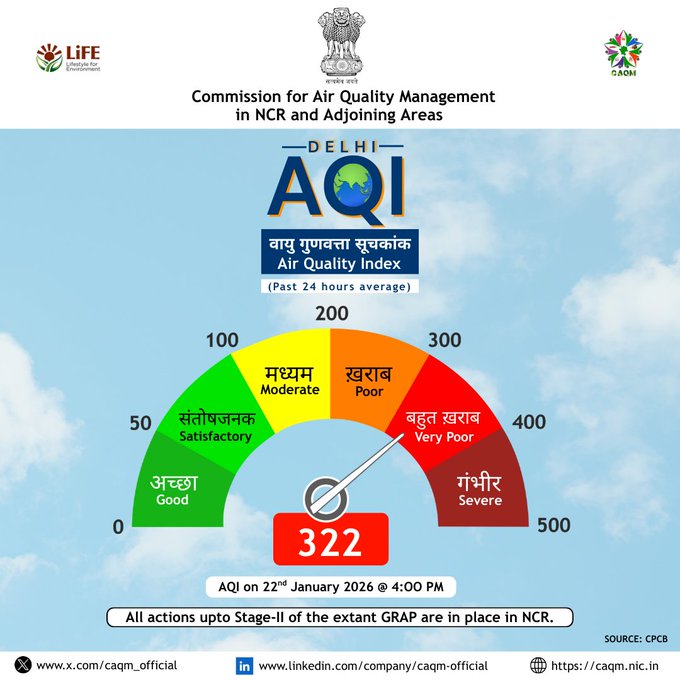
Parallel to these policy measures, the Commission for Air Quality Management in NCR and Adjoining Areas has intensified on-ground enforcement to address air pollution challenges in the National Capital Region. The 124th meeting of the Enforcement Task Force of the Commission, held on 21 January 2026, reviewed inspection and enforcement activities conducted between 7 January and 19 January 2026.
During this period, the Commission’s flying squads carried out 330 inspections across key pollution sources, including industries, diesel generator sets, construction and demolition sites, road dust hotspots and instances of biomass and municipal solid waste burning. Of these inspections, 241 were conducted at industrial units, 22 at diesel generator sets, five at construction and demolition sites, and 62 road stretches were inspected for dust and waste accumulation. A total of 90 violations were identified, comprising 66 in the industrial sector, two involving diesel generator sets, four at construction sites and 18 related to road dust.
Based on these inspections, enforcement actions such as closures, sealing of diesel generator sets and issuance of show-cause notices were recommended in 72 cases. The Commission also reviewed recommendations for closure of nine ready-mix concrete plants.
Special inspection drives were conducted on 8 January and 13 January 2026, covering 150 road stretches, including 23 in Noida and 127 under the Municipal Corporation of Faridabad. Among these, 20 stretches were found to have high levels of visible dust, 34 had moderate dust levels and 75 had low dust levels. For non-compliance with dust control measures, a notice was issued to the Deputy Commissioner of the Municipal Corporation of Delhi on 13 January 2026, and Action Taken Reports have been received from five municipal zones.
In a focused drive in North Delhi on 14 January 2026, flying squads inspected 65 locations to check biomass and municipal solid waste burning and dumping. The inspection recorded 47 incidents of biomass or waste burning and 18 instances of waste dumping. The reports have been forwarded to the concerned agencies for detailed action taken reports.
Cumulatively, as of 21 January 2026, 25,232 units, projects and entities have been inspected by the Commission. These inspections have resulted in 1,643 closure directions, of which 1,261 resumption orders have been issued after verification of compliance. In 108 cases, matters have been transferred to the respective State Pollution Control Boards or the Delhi Pollution Control Committee for final decisions, while resumption orders in the remaining cases are under examination.
The Commission has reiterated that sustained enforcement, strict compliance by stakeholders and coordinated action among all agencies are critical for effective abatement of air pollution in the NCR. Together, the expansion of the Indian Carbon Market and intensified enforcement on air quality underline the Government’s integrated approach to climate action, industrial regulation and environmental protection.