
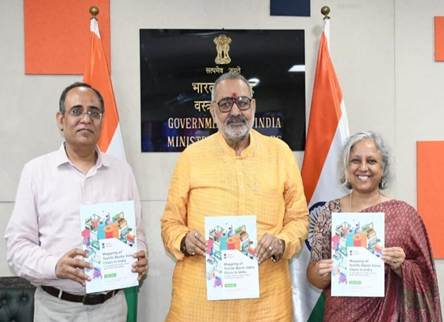
India generates about 70.73 lakh tonnes of textile waste annually, with more than 70 percent of it already being recovered through recycling, reuse and other resource recovery pathways, according to a comprehensive national study released by Giriraj Singh.
The report titled Mapping of Textile Waste Value Chain in India was released at Udyog Bhawan in New Delhi and presents a detailed assessment of textile waste generation, recycling systems, recovery pathways and opportunities to strengthen circular production across the country’s textile sector.
Giriraj Singh said India’s textile industry, one of the largest in the world, has significant potential to lead the global transition toward sustainable and circular manufacturing systems. He noted that as the industry expands, growth must be aligned with sustainability goals and responsible resource use.
The report provides a data driven framework for transforming textile waste into a valuable economic resource while outlining pathways for recycling, upcycling and resource recovery within the textile ecosystem.
According to the study, India produces around 70.73 lakh tonnes of textile waste every year. Of this total, approximately 42 percent originates from pre consumer sources such as manufacturing waste generated during production processes, while the remaining 58 percent arises from post consumer waste generated after textiles are discarded by users.
More than 70 percent of this waste is currently recovered and diverted into recycling, upcycling, downcycling or reuse streams. The report highlights that recovery networks in the textile manufacturing sector are particularly strong, with around 95 percent of pre consumer textile waste successfully recovered.
The spinning segment has emerged as a benchmark for circular production within the textile industry. The report notes that nearly 100 percent of spinning waste is reintegrated directly into production processes. Soft waste generated during spinning is immediately reused due to uniform waste streams, proximity between waste generation and processing and established quality standards for recycled fibre inputs.
The study also examines post consumer textile waste management. It estimates that about 55 percent of post consumer textile waste in India is diverted away from landfills through an extensive informal collection and sorting network.
This informal ecosystem plays a critical role in sustaining livelihoods across the country. The report estimates that the sector supports approximately 40 to 45 lakh livelihoods, with a large proportion of workers being women from marginalised communities engaged in the collection, sorting and redistribution of used textiles.
Cluster level analysis in the report highlights Panipat as one of the country’s major hubs for mechanical textile recycling. Textile waste from multiple production clusters is transported to the city where it is processed into recycled yarns and materials.
The report suggests that expanding recycling infrastructure within textile clusters could significantly improve efficiency by enabling recycling closer to the point where waste is generated.
It also highlights emerging opportunities in recycling technologies. Mechanical recycling currently remains the most widely adopted method for processing textile waste, while chemical recycling technologies are gaining attention for their potential to recover fibres at the molecular level and enable textile to textile recycling.
According to projections included in the study, India’s textile recycling market could reach a value of about 3.5 billion US dollars by 2030. The sector also has the potential to create nearly one lakh green jobs as recycling infrastructure, technology adoption and circular production systems expand.
Officials said the findings of the report will support policy development, industry collaboration and investments aimed at strengthening circularity in the textile value chain while reinforcing India’s position as a global hub for sustainable textile production.