
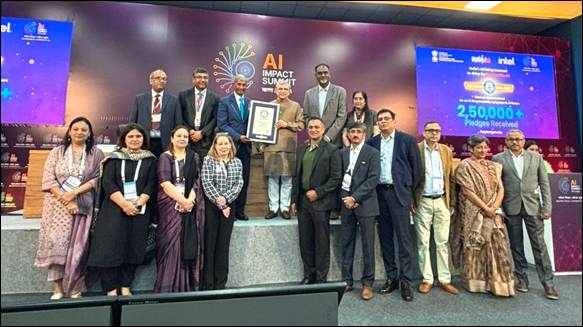
India has secured a Guinness World Records title for receiving the highest number of pledges for an AI responsibility campaign within 24 hours, with 250,946 valid commitments recorded between 16 and 17 February 2026 at the India AI Impact Summit 2026.
The record, announced on the third day of the Summit at Bharat Mandapam, far exceeded the initial target of 5,000 pledges. The achievement underscores a nationwide commitment to ethical, inclusive and accountable use of Artificial Intelligence.
The AI Responsibility Pledge campaign was launched under the IndiaAI Mission in collaboration with Intel India. It invited citizens to commit to responsible AI practices and offered participants a digital badge along with access to curated AI learning pathways. The initiative linked symbolic affirmation with structured education, reinforcing the importance of informed AI adoption.
Addressing the media, Ashwini Vaishnaw described the recognition as a proud moment for the country. He highlighted the vision of Prime Minister Narendra Modi to engage young Indians in responsible technology use. Colleges across India were mobilised to host discussions on ethical AI, encouraging students to treat AI not as a shortcut but as a tool for societal benefit. He commended the more than 250,000 participants and reiterated that India’s AI journey is anchored in responsibility.
The Summit, being held from 16 to 20 February 2026, has drawn students, educators, innovators and policymakers from across India and abroad. With over 65 percent of India’s population under the age of 35, the campaign tapped into the country’s demographic strength. Discussions at the venue extended beyond algorithms and infrastructure to include AI literacy, ethics and long-term capability building.
A major highlight of the Summit was the announcement of winners of the YUVAi Global Youth Challenge. The competition, conducted under the IndiaAI Mission, received over 2,500 applications from 38 countries. Young innovators aged 13 to 21 developed AI solutions aligned with the themes of People, Planet and Progress. The top 70 teams are showcasing working prototypes at the Summit, addressing public health, agriculture, climate resilience, accessibility, smart mobility and digital trust.
The YUVAi programme, launched in November 2022 by the National e Governance Division under MeitY, equips students from Classes 8 to 12 with AI and social skills training across eight thematic areas. Complementing it is YUVA AI for All, a free national AI literacy course available in eleven Indian languages through DIKSHA, iGOT Karmayogi and FutureSkills Prime. The programme aims to build foundational AI proficiency among one crore citizens, bridging urban and rural divides.
At the Summit, the Atal Innovation Mission under NITI Aayog presented the AI Tinkerpreneur Showcase, featuring 50 student teams selected from over 12,000 participants in Atal Tinkering Labs nationwide. Their projects addressed healthcare, crop management, climate adaptation and accessible education. The showcase demonstrated how grassroots innovation is feeding into national AI priorities.
The broader ecosystem supporting these efforts includes expanded infrastructure and skilling initiatives. India will add 20,000 Graphics Processing Units to its existing base of 38,000, strengthening computational capacity for research and innovation. The Union Budget 2026 to 27 has allocated support for emerging technologies, including AI aligned Content Creator Labs in 15,000 schools and 500 colleges through the Indian Institute of Creative Technologies in Mumbai. The initiative is expected to create employment opportunities for nearly 20 lakh individuals in animation, gaming and digital content sectors.
Centres of Excellence in healthcare, agriculture and sustainable cities are operational, with a fourth Centre of Excellence for education announced. Five National Centres of Excellence for Skilling are preparing youth with industry relevant AI capabilities. The Skilling for AI Readiness initiative launched in July 2025 provides structured modules for students and educators, while the Craftsmen Training Scheme has introduced 31 new age courses including artificial intelligence and industrial robotics across Industrial Training Institutes and National Skill Training Institutes.
Within government, the AI Competency Framework for Government Officials is strengthening institutional capacity for AI informed policymaking and governance. Under the IndiaAI Mission, fellowships and infrastructure support are being extended to 500 PhD scholars, 5,000 postgraduate students and 8,000 undergraduate students. More than 200 fellowships have already been awarded, with 73 institutes onboarding doctoral candidates. Thirty one Data and AI laboratories have been launched in Tier two and Tier three cities in collaboration with NIELIT and industry partners, while 174 Industrial Training Institutes and polytechnics have been nominated for additional labs.
The Guinness recognition marks a milestone, but the broader narrative is one of sustained investment in infrastructure, research, skilling and ethical frameworks. As the Summit continues, India’s message remains clear: AI must be powerful yet responsible, scalable yet inclusive, and firmly aligned with human values.