

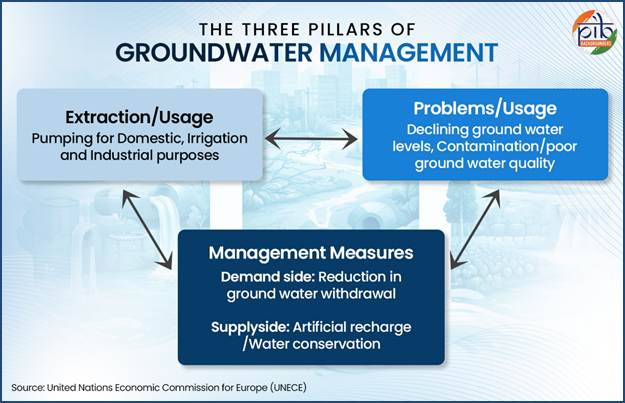
India has significantly intensified its efforts to strengthen groundwater management as part of a comprehensive strategy to secure long-term water sustainability, climate resilience, and inclusive development. With groundwater accounting for nearly 99 percent of the country’s liquid freshwater resources and meeting a substantial share of irrigation, rural drinking water, and urban supply needs, effective management has emerged as a national priority.
As of January 2026, India has established a vast groundwater management and monitoring infrastructure, comprising 43,228 groundwater level monitoring stations, 712 Jal Shakti Kendras, and 53,264 Atal Jal Water Quality Monitoring Stations. These systems form the backbone of evidence-based planning and real-time assessment of groundwater conditions across diverse hydrogeological regions.
Groundwater plays a critical role in sustaining agriculture, livelihoods, ecosystems, and urban growth. However, rapid population expansion, intensified agricultural practices, industrialisation, and urbanisation have placed unprecedented pressure on aquifers. Unregulated extraction has led to declining water tables in several regions, while contamination from industrial effluents, mining activity, agricultural chemicals, and naturally occurring elements such as arsenic and fluoride has raised serious public health and environmental concerns.
Recognising these challenges, the Government of India, led by the Ministry of Jal Shakti, has adopted a multi-pronged approach that combines policy reform, scientific assessment, community participation, and large-scale infrastructure creation. While water governance remains a State subject, the Centre plays a facilitative role by providing technical guidance, financial assistance, and institutional coordination to ensure uniform and sustainable groundwater management practices nationwide.
A key regulatory milestone in this effort is the Model Groundwater Regulation and Management Bill, which provides a framework for controlling indiscriminate extraction and promoting sustainable practices such as rainwater harvesting and artificial recharge. The Model Bill has been adopted by 21 States and Union Territories, including Bihar, Punjab, Haryana, and Himachal Pradesh. The Centre continues to engage with States through conferences of State Water Ministers, Chief Secretaries, and deliberations under the National Interdepartmental Steering Committee on Groundwater to encourage prudent regulation and coordinated action.
Community participation has been placed at the heart of groundwater conservation through flagship initiatives such as the Jal Shakti Abhiyan Catch the Rain, launched on 22 March 2021. The campaign promotes nationwide awareness and collective action around water conservation, focusing on five key interventions:
Water conservation and rainwater harvesting
Identification, geo-tagging, and scientific planning of water bodies
Establishment of Jal Shakti Kendras in all districts
Afforestation and green cover enhancement
Large-scale public awareness and behavioural change
A major thrust under this campaign has been the revival of abandoned and defunct borewells to enhance groundwater recharge, supported by complementary conservation measures implemented across urban and rural landscapes.
Building on this momentum, the Jal Sanchay Jan Bhagidari initiative was launched in September 2024 to strengthen community-led recharge efforts. The programme promotes rainwater harvesting, aquifer recharge, borewell recharge, and recharge shafts, supported by advanced monitoring systems. As of 22 January 2026, a cumulative total of 39,60,333 artificial groundwater recharge and storage works have been completed under Jal Sanchay Jan Bhagidari phases 1.0 and 2.0.
Scientific assessment and data-driven planning are being strengthened through the National Aquifer Mapping and Management Programme. The first phase of NAQUIM focused on characterising aquifers, assessing groundwater availability and quality, and preparing detailed aquifer maps. NAQUIM 2.0, currently underway, builds on this foundation by providing high-granularity groundwater data up to the Panchayat level and delivering issue-based scientific inputs for water-stressed, coastal, urban, industrial, mining, and poor-quality groundwater areas.
To complement conservation and regulation, the Master Plan for Artificial Recharge to Groundwater 2020 provides terrain-specific solutions tailored to regional challenges. The plan promotes surface spreading and subsurface recharge in rural areas, rooftop rainwater harvesting in urban regions, and targeted interventions in hilly and coastal zones. It outlines the creation of approximately 1.42 crore recharge structures to facilitate an estimated 185 billion cubic metres of groundwater recharge across the country.
At the community level, Atal Bhujal Yojana continues to play a pivotal role in water-stressed regions. Launched in December 2019, the scheme supports sustainable groundwater management in Gujarat, Haryana, Karnataka, Madhya Pradesh, Maharashtra, Rajasthan, and Uttar Pradesh. With a total outlay of ₹6,000 crore, the programme links financial incentives to measurable outcomes such as reduced groundwater decline, efficient water use, and strengthened local institutions. As of January 2026, the scheme has delivered measurable improvements in groundwater trends, expanded efficient irrigation practices, and strengthened digital monitoring through thousands of installed water level recorders and indicators.
Mission Amrit Sarovar further reinforces groundwater recharge by promoting the creation and rejuvenation of ponds across all districts. Each Amrit Sarovar is designed with a minimum area of one acre and storage capacity of around 10,000 cubic metres, contributing to water conservation, irrigation expansion, and natural aquifer recharge.
Supporting these initiatives is a robust national infrastructure for monitoring and knowledge dissemination. The Central Ground Water Board conducts systematic groundwater level monitoring through its observation well network, while Jal Shakti Kendras function as district-level technical hubs, guiding stakeholders on rainwater harvesting, recharge techniques, and sustainable water use practices.
Together, these integrated efforts underscore India’s transition towards scientifically informed, participatory, and outcome-oriented groundwater governance. By aligning policy reform, technology, community engagement, and large-scale infrastructure, the country is laying a durable foundation for long-term water security, climate resilience, and sustainable development in line with national priorities and global commitments.