
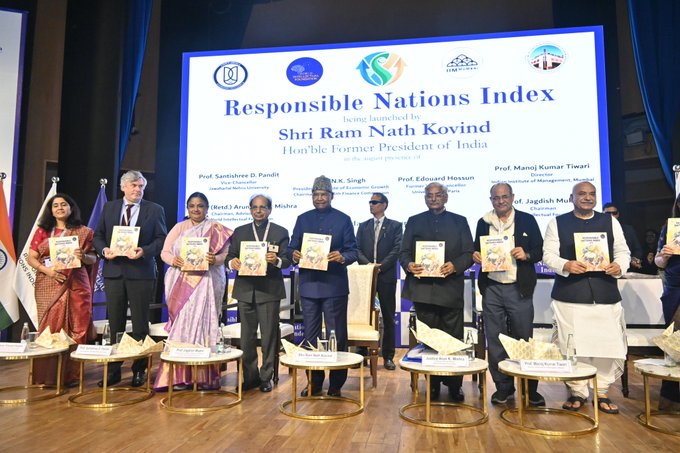
India on Monday marked a major intellectual and policy milestone with the launch of the Responsible Nations Index, a new global framework that seeks to assess countries beyond traditional measures of economic power and geopolitical influence. The index was formally unveiled at the Dr Ambedkar International Centre in New Delhi under the aegis of the World Intellectual Foundation.
The Responsible Nations Index introduces a responsibility centric approach to evaluating nations, focusing on ethical governance, inclusive development, environmental stewardship and a country’s obligations to the international community. The framework aims to reshape global discourse on progress by placing responsibility at the core of nationhood.
The launch event brought together policymakers, jurists, economists, academicians, diplomats and institutional leaders, reflecting the multidimensional scope of the initiative. The keynote address emphasised the role of moral responsibility, inclusive growth and ethical governance in building sustainable national and global futures.
The index is the outcome of a three year academic and policy exercise led by the World Intellectual Foundation. Rooted in India’s civilisational ethos of dharma and global well being, the initiative seeks to offer an alternative lens for evaluating national performance in the twenty first century. Leading academic institutions, including Jawaharlal Nehru University and the Indian Institute of Management Mumbai, contributed to the intellectual foundations and methodological framework of the index.
The formal launch was preceded by a high level expert panel discussion on rethinking responsibility, prosperity and peace in the modern world. The discussion examined the transition from narrow economic indicators to broader measures of human well being and global stewardship, and highlighted the need for internationally consistent benchmarks of responsible governance.
Senior academicians and economists shared perspectives on macroeconomic stability, social equity, institutional credibility and long term sustainability. Speakers underlined that prosperity divorced from responsibility is inherently fragile, and that global stability depends on ethical leadership and accountable institutions.
Addresses during the inaugural session also focused on the role of universities, policy institutions and think tanks in shaping future governance frameworks. Insights from an earlier closed door expert roundtable were presented, linking legal, economic and philosophical dimensions of responsibility based nationhood.
The ceremony concluded with the release of the Responsible Nations Index report, formally initiating what organisers described as a long term global dialogue on responsible governance and sustainable development. The index is expected to serve as a reference point for policymakers, researchers and international institutions seeking to balance growth with ethics and global responsibility.