
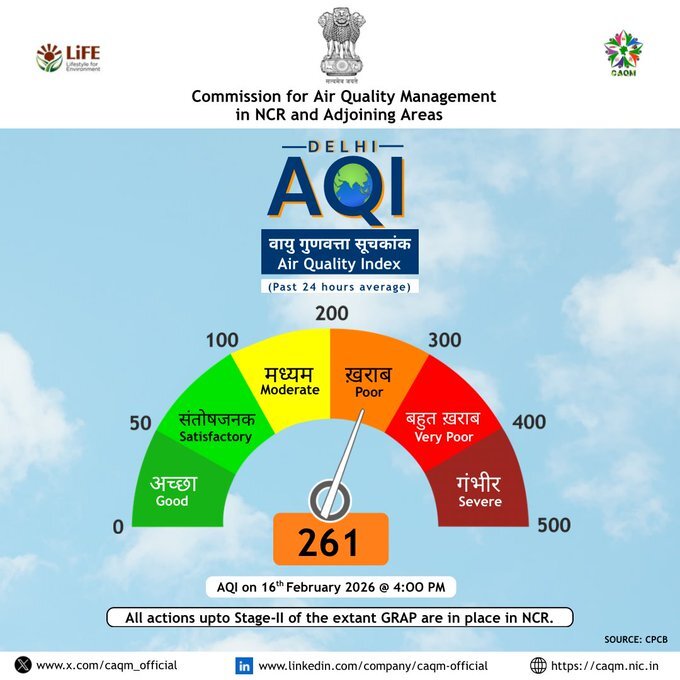
In a decisive move to curb seasonal air pollution in the National Capital Region and adjoining areas, the Commission for Air Quality Management in NCR and Adjoining Areas has issued a comprehensive statutory direction mandating coordinated and time bound implementation of State Action Plans to eliminate wheat stubble burning during the 2026 harvesting season.
The Direction has been issued to the Governments of Punjab, Haryana and Uttar Pradesh, with complementary efforts expected from the Government of NCT of Delhi and the Government of Rajasthan. The Commission has emphasised structured preparedness during the wheat harvesting window to prevent agricultural residue burning, which contributes significantly to localised and regional deterioration in air quality.
Data Driven Intervention
Citing satellite based monitoring under the standard protocol developed by ISRO and IARI, the Commission noted that during the wheat harvesting season from 1 April to 31 May 2025, 10,207 fire incidents were recorded in Punjab, 1,832 in Haryana and 259 in NCR districts of Uttar Pradesh. The April to May 2025 data underscored the need for targeted interventions during the wheat season in addition to existing measures focused on paddy residue burning.
The issue was deliberated in the 26th meeting of the Commission held on 22 December 2025 and subsequently in meetings with the State Governments of Punjab, Haryana and Uttar Pradesh on the same date. During these deliberations, the States presented their respective action plans, following which the Commission advised them to update and refine their strategies in line with the broader framework already issued for crop residue management.
Direction No 96 Mandates Time Bound Execution
Through Direction No 96, the Commission has directed Punjab, Haryana and Uttar Pradesh to implement their State specific Action Plans in letter and spirit to eliminate and control wheat stubble burning, with specific facilitative measures ensuring viable alternatives to open burning.
The Commission has instructed the States to map each farm in every village to determine the proposed mode of wheat stubble management, including crop diversification, in situ management, ex situ management or use as fodder. Each district is required to tag specific nodal officers to groups of farmers, with a maximum of 100 farmers assigned to each nodal officer to enable close monitoring and accountability.
States have been directed to ensure optimum utilisation and timely availability of Crop Residue Management machines during peak harvesting, supported by mobile application based coordination. For small and marginal farmers, rent free availability of CRM machines through Custom Hiring Centres has been mandated.
The directive also requires adequate and appropriate storage facilities for wheat straw to minimise fire related losses and the establishment of a robust and continuous supply chain for ex situ applications, including fodder use. Each district must formulate a District Level Supply Chain Management Plan to align year round demand and supply.
Dedicated Enforcement And Monitoring Mechanism
A key enforcement measure under the directive is the constitution of a dedicated Parali Protection Force at the district or block level. The force will comprise police officers, Agriculture Department officials, administrative authorities, nodal and cluster officers and representatives of other stakeholder departments to monitor, oversee and prevent incidents of open wheat stubble burning.
Enforcement agencies have been instructed to intensify patrolling, particularly during late evening hours, when burning incidents are more likely to occur. The Commission has also directed States to ensure implementation of an appropriate environmental compensation mechanism in cases of violations.
Awareness And Behavioural Change
Recognising the importance of farmer participation, the Commission has called for extensive Information Education and Communication campaigns. States are required to conduct awareness programmes highlighting adverse environmental impacts of stubble burning, best agricultural practices and available schemes supporting residue management.
Complementary Efforts By Delhi And Rajasthan
The Government of NCT of Delhi and the Government of Rajasthan have been advised to undertake all possible measures to prevent wheat stubble burning within their jurisdictions during the forthcoming harvest season.
States have been directed to submit monthly progress reports to the Commission to enable continuous monitoring and timely corrective action where required.
The Commission’s latest statutory direction signals a shift towards structured seasonal preparedness, integrated supply chain management and strengthened enforcement, aimed at addressing wheat residue burning as a significant contributor to regional air pollution.