
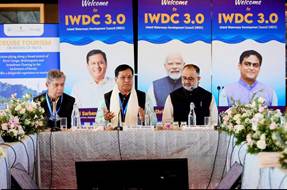
The third meeting of the Inland Waterways Development Council concluded with the approval of a comprehensive set of projects exceeding ₹1,500 crore, marking a significant step in expanding India’s inland water transport network and reinforcing Centre–State collaboration to harness the economic potential of rivers.
Chaired by Union Minister of Ports, Shipping and Waterways Sarbananda Sonowal, the meeting was attended by Mukesh Agnihotri, Deputy Chief Minister of Himachal Pradesh; Sharwan Kumar, Minister of Transport, Government of Bihar; K. G. Kenye, Minister of Power and Parliamentary Affairs, Government of Nagaland; Ojing Tasing, Minister of Rural Development, Government of Arunachal Pradesh; Daya Shankar Singh, Minister of Transport, Government of Uttar Pradesh; and Barinder Kumar Goyal, Minister of Water Resources, Government of Punjab, along with senior officials from the Centre and States.
The council identified projects worth more than ₹1,500 crore aimed at accelerating green mobility, strengthening multimodal cargo movement and promoting river tourism. Foundation stones were laid for projects exceeding ₹150 crore, including river cruise jetties in Kerala, Gujarat, Karnataka, Odisha and Telangana, supporting the expansion of cruise tourism circuits across the country.
Major cargo and passenger infrastructure initiatives were also reviewed and approved. These include the development of Ro-Ro and cargo terminals at Muktyala and Harishchandrapuram on the Krishna River in Andhra Pradesh, and onshore passenger facilities on the Jhelum River in Jammu and Kashmir. Ten hybrid electric vessels will be deployed on the Jhelum to support clean and efficient passenger transport.
To enhance navigability, safety and year-round operations, asset procurement worth over ₹465 crore was approved. This includes survey vessels in Kerala; Ro-Pax berthing jetties in Bihar, Jharkhand and West Bengal; floating pontoons and quick-opening mechanisms in Uttar Pradesh, Bihar and West Bengal; hybrid survey vessels; amphibian and cutter suction dredgers; and tug-barge units.
The council was also apprised of new inland waterway projects worth over ₹900 crore. These include a slipway facility at Kochi, construction of 110 jetties across Odisha and the Northeast, implementation of the National River Traffic and Navigation System in Maharashtra, development of a cruise terminal at Uzan Bazar Ghat in Guwahati, and an approach road connectivity project to the Bogibeel River Port in Dibrugarh on the Brahmaputra.
Addressing the meeting, Sarbananda Sonowal said that inland waterways have emerged as a strategic pillar of India’s transport and logistics transformation under the leadership of Prime Minister Narendra Modi. He noted that focused investments in waterways are easing congestion on roads, reducing logistics costs and strengthening ease of doing business, while transforming rivers into economic lifelines driving growth, sustainability and connectivity.
Kerala featured prominently in the discussions, with a series of initiatives announced to strengthen inland water transport in the state. The Jal Vahak cargo promotion scheme is being explored for expansion to additional national waterways, including Kerala, with reimbursement of up to 35 per cent of operating expenditure on cargo movement. Fixed-day scheduled cargo sailing services on commercially viable stretches will also commence to demonstrate the readiness of waterways as a reliable logistics option. The Kerala package further includes river cruise jetties and the induction of a survey vessel to strengthen passenger movement, tourism and safe navigation.
Special emphasis was placed on the Northeast region, where 85 jetties are planned with an investment exceeding ₹500 crore to boost connectivity, trade, tourism and livelihoods of riverine communities. The council noted that waterways development in the region would integrate local economies with national markets and unlock new growth opportunities.
The meeting reviewed the rapid expansion of the sector over the past decade. Cargo movement on national waterways has risen from 18 million tonnes in 2013–14 to 145.84 million tonnes in 2024–25. Operational national waterways have increased from three to 32, while the number of luxury river cruise vessels has grown from five to 25. Operational terminals have expanded from 15 to 25 and floating jetties from 30 to 100.
The council reaffirmed priorities for the next phase, including deployment of green and hybrid vessels, expansion of digital navigation and traffic management systems, development of modern inland terminals, strengthening shipbuilding and repair facilities, and promotion of maritime skills. Regulatory issues raised by states were reviewed with a focus on faster execution through coordinated action.
IWDC 3.0 concluded with a shared commitment by the Centre and states to scale up inland water transport, promote cleaner mobility, strengthen regional connectivity and position rivers as engines of sustainable economic growth. With 111 national waterways across 23 states and four union territories, inland waterways are increasingly emerging as a preferred, future-ready mode of transport for cargo, passengers and tourism.