
Prime Minister Narendra Modi performed the Bhoomi Pujan of the Kaziranga Elevated Corridor Project, a landmark national highway initiative worth over ₹6,950 crore, at Kaliabor in Assam on 18 January 2026. The project involves the four-laning of the Kaliabor–Numaligarh section of National Highway 715 and is designed to significantly improve connectivity in Upper Assam while safeguarding the globally significant biodiversity of Kaziranga National Park.
Addressing a large gathering, the Prime Minister expressed gratitude to the people of Assam for their warm reception and recalled his earlier visit to Kaziranga, describing it as one of the most memorable experiences of his life. He said Kaziranga is not merely a national park but the soul of Assam and a priceless jewel of India’s natural heritage, recognised by UNESCO as a World Heritage Site. Protecting Kaziranga, he said, is both an environmental responsibility and a commitment to the future of Assam and coming generations.
The Prime Minister underlined the philosophy guiding the project, stating that India is demonstrating to the world that economic progress and ecological conservation can advance together. For decades, it was believed that development and nature were in conflict, but India is now proving that preservation of nature can create new opportunities alongside growth.
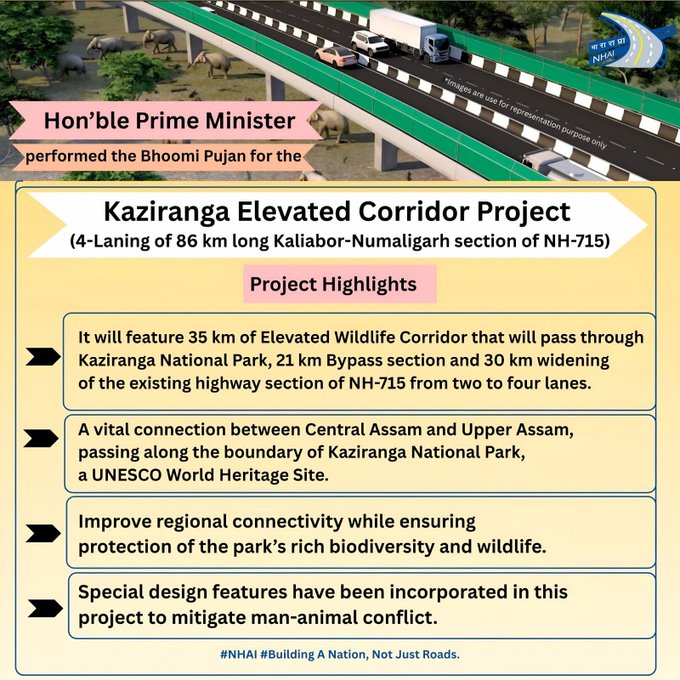
The Kaziranga Elevated Corridor Project spans 86 kilometres and includes a 35-kilometre elevated wildlife corridor through the Kaziranga landscape, a 21-kilometre bypass section, and widening of 30 kilometres of existing highway from two to four lanes. The elevated corridor has been designed keeping in view traditional movement routes of wildlife such as one-horned rhinoceros, elephants and tigers, allowing animals to move freely underneath while vehicles pass overhead. This will reduce human-wildlife conflict, improve road safety and ensure uninterrupted ecological connectivity.
The project will pass through Nagaon, Karbi Anglong and Golaghat districts and is expected to significantly enhance connectivity to Upper Assam, including Dibrugarh and Tinsukia. Bypasses at Jakhalabandha and Bokakhat will decongest urban areas, improve traffic flow and enhance the quality of life for local residents. The corridor will also strengthen connectivity between Assam and Arunachal Pradesh and support growing passenger and freight traffic.
Highlighting the economic impact of conservation, the Prime Minister noted that tourism in Kaziranga has steadily increased in recent years. This growth has created new livelihood opportunities for local youth through homestays, guide services, transport, handicrafts and small enterprises, demonstrating that protecting nature can directly support inclusive economic development.
The Prime Minister also praised Assam’s efforts in wildlife protection, recalling that rhino poaching was once a major concern. He said strengthened security, modern surveillance, enhanced resources for forest personnel and initiatives such as women forest protection groups have yielded results, with no reported cases of rhino poaching in 2025.
On connectivity, the Prime Minister said the North East is no longer on the margins of development but is now closer to the nation’s heart and to Delhi. He highlighted substantial increases in investment in rail, road, air and water connectivity in the region over the past decade. He announced the launch of new rail services from Kaliabor, including a Vande Bharat Sleeper Train connecting Guwahati and Kolkata and two Amrit Bharat Express services linking Assam with major destinations across northern India, benefiting passengers, traders, students and businesses.
The Prime Minister emphasised that improved connectivity is strengthening confidence in the region’s future and advancing the Act East Policy. He said Assam’s development is opening new doors for the progress of the entire North East and positioning the region as a key growth engine for the country.
The event was attended by the Governor of Assam, the Chief Minister of Assam, Union Ministers and other senior leaders, reflecting the importance of the project for the state and the nation. The Kaziranga Elevated Corridor Project is expected to stand as a national model for infrastructure development that balances connectivity, conservation and community prosperity.