
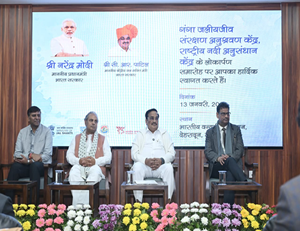
India’s commitment to river rejuvenation and freshwater biodiversity conservation received a significant boost as the Union Minister for Jal Shakti inaugurated a series of landmark aquatic conservation initiatives under the Namami Gange Mission at the Wildlife Institute of India in Dehradun on January 14, 2026. The initiatives mark a decisive shift towards treating rivers not merely as water channels but as living ecosystems whose health is reflected in the survival and growth of aquatic species.
Addressing a gathering of scientists, conservationists, students and officials, the Minister underlined that aquatic biodiversity is the most reliable indicator of river health and emphasised that sustainable river management must integrate cleanliness, uninterrupted flow and biodiversity conservation. Senior representatives from the Wildlife Institute of India, the National Mission for Clean Ganga and the Uttarakhand State Disaster Management Authority were present during the programme.
A major highlight of the event was the inauguration of the Aqua Life Conservation Monitoring Centre for the Ganga and other rivers. Developed through a partnership between the Namami Gange Mission and the Wildlife Institute of India, the centre has been established as a dedicated institutional framework for research, monitoring and policy support in aquatic biodiversity conservation. Equipped with laboratories for ecotoxicology, aquatic ecology and spatial ecology, along with a specialised microplastics laboratory, the centre will enable scientific sampling, identification of ecological hotspots and data driven conservation planning. The facility is expected to play a critical role in shaping long term policies and strategies for freshwater ecosystem protection across the country.
Strengthening species specific conservation efforts, a Dolphin Rescue Ambulance was also inaugurated to provide rapid and scientifically equipped emergency response for Ganga dolphins in distress. The Minister described the Ganga dolphin as a sensitive indicator of river health and noted that the rescue service reflects a proactive approach to safeguarding India’s national aquatic animal. The initiative has been developed under the aegis of the National Mission for Clean Ganga and is expected to significantly enhance dolphin rescue and rehabilitation capacity along the river.
The programme also highlighted the role of education and capacity building in conservation. Under the Namami Gange framework, the Wildlife Institute of India has launched a two year Master’s programme in Freshwater Ecology and Conservation, aimed at training future conservation professionals through a combination of scientific study, fieldwork and policy exposure. The Minister interacted with students enrolled in the programme and commended them for choosing specialised careers dedicated to river restoration and sustainable water management.
In keeping with the integrated ecosystem approach, the Indian Skimmer Conservation Project was formally launched in collaboration with the Bombay Natural History Society. The project seeks to conserve rare riverine bird species along the Ganga, reinforcing the understanding that river conservation extends beyond water quality and aquatic fauna to include the entire river dependent ecosystem.
The success of the first phase of the Turtle Conservation Project implemented by TSAFI was also reviewed. The project has achieved national milestones through the reintroduction and monitoring of endangered turtle species. Fifteen captive reared Narrow headed Softshell Turtles were released into the middle Yamuna, with ten fitted with radio transmitters for continuous monitoring. In another first, twenty Red crowned Roofed Turtles were reintroduced into the Upper Ganga near the Haiderpur Wetland Complex, marking the first monitored return of the species to its historic range in three decades.
The Minister also reviewed the overall outcomes of biodiversity conservation projects implemented by the Wildlife Institute of India under the Namami Gange Mission and expressed satisfaction with the scientific and community driven results. Interacting with Ganga Praharis, he highlighted the importance of public participation and youth engagement, noting that the reported increase in the Ganga dolphin population to over 6,000 reflects the combined impact of government action and community stewardship.
Two publications were released on the occasion, including a comprehensive report on the population status and conservation action plan for the critically endangered gharial in the Ganga basin, and a publication linking biodiversity conservation with food and nutrition security through millets.
The initiatives launched at the Wildlife Institute of India represent a significant advance in India’s approach to river rejuvenation, combining scientific research, institutional collaboration and grassroots participation. By reinforcing the protection of aquatic life alongside river cleanliness and flow, the Namami Gange Mission continues to strengthen a holistic model aimed at securing healthy, resilient and life supporting river ecosystems for future generations.