
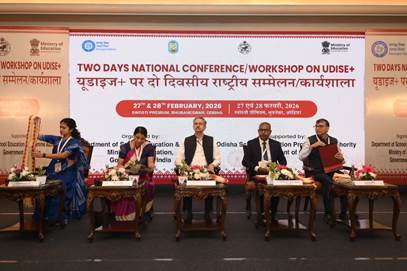
The Department of School Education and Literacy under the Ministry of Education, in collaboration with the Department of School and Mass Education, Government of Odisha, organised a two day National Conference on Unified District Information System for Education Plus in Bhubaneswar from February 27 to February 28, 2026. The conference brought together senior officials from the Department of School Education and Literacy, education boards across India, and representatives of key state education departments and institutions to deliberate on strengthening data driven educational governance.
Inaugurating the conference, Dheeraj Sahu, Additional Secretary, Ministry of Education, underscored the importance of reliable and timely educational data in ensuring transparency, accountability and effective policy formulation. He emphasised the need to widen the scope of UDISE Plus by incorporating mechanisms to track student learning outcomes and monitor dropout students through the APAAR ID system. He also urged States and districts to undertake deeper analysis of the causes of student dropouts within the school ecosystem and design corrective strategies based on data insights.
In his welcome address, Pankaj K P Shreyaskar, Deputy Director General, Department of School Education and Literacy, highlighted the strategic role of UDISE Plus in supporting major national initiatives, including the National Education Policy 2020. He stressed the importance of data harmonisation, data quality and data security, and called for integration of multiple educational portals with UDISE Plus through Application Programming Interfaces to reduce the reporting burden on schools and improve efficiency.
The conference was attended by Vikas Gupta, Commissioner, Kendriya Vidyalaya Sangathan; A Srija, Economic Advisor, Department of School Education and Literacy; and Ananya Das, State Project Director, OSEPA, Government of Odisha, among other senior officials.
During a panel discussion, representatives from Kendriya Vidyalaya Sangathan, Navodaya Vidyalaya Samiti, Indian Air Force, Navy Educational Society and National Institute of Open Schooling deliberated on the significance of the UDISE Plus database, its operational benefits and expectations for further enhancements beyond the existing framework. School Education Departments of Odisha, Haryana and Andhra Pradesh presented best practices adopted to strengthen their school data ecosystems and improve evidence based decision making.
On the second day, February 28, 2026, School Education Departments from Uttar Pradesh, Kerala, Karnataka, Manipur, Telangana and Maharashtra shared their best practices, demonstrated state level dashboards and outlined initiatives undertaken to enhance data accuracy and expand UDISE Plus coverage. Subsequent sessions featured panelists from the Central Board of Secondary Education, National Institute of Open Schooling, Board of Secondary and Higher Secondary Education Goa and Odisha. Discussions focused on integrating diverse datasets related to school education, including examination board data, and ensuring the sanctity and reliability of consolidated datasets.
The Department of School Education and Literacy presented key features of UDISE Plus, recent upgrades and potential areas for leveraging Artificial Intelligence within the ecosystem. Proposed AI enabled interventions included automated data flagging, smart verification queues, AI based helpdesks for data entry support and automated generation of school report cards to improve accuracy and usability.
In the closing remarks, N Thirumala Naik, Secretary, Department of School and Mass Education, Government of Odisha, emphasised the critical role of the UDISE Plus database in shaping informed policy interventions. He highlighted the need for continuous enrichment of the system to meet emerging educational challenges and to strengthen its function as a comprehensive decision support platform.
The workshop comprised technical sessions, panel discussions and open house interactions. Educational institutions, examination boards and State Governments shared insights, innovative technological initiatives and best practices aimed at strengthening data management, integration, validation and utilisation within the UDISE Plus framework.
Key takeaways from the two day conference included the need to strengthen data integrity to streamline collection processes and ensure credible real time information on school infrastructure, student enrolment and teacher profiles; collaborative resolution of implementation challenges at the State and Union Territory levels, including closer alignment with updated UDISE Plus modules and validation protocols; and development of a shared vision for strategic expansion of UDISE Plus into an AI compliant decision support system capable of supporting future ready educational governance.
The conference concluded with a vote of thanks to all participating institutions and stakeholders for their contributions toward advancing a robust and integrated school education data ecosystem.