
India on February 28, 2026 launched a nationwide Human Papillomavirus vaccination programme aimed at preventing cervical cancer, the second most common cancer among women in the country. The programme was formally launched by Narendra Modi in Ajmer, Rajasthan, with States and Union Territories simultaneously holding parallel launch events to mark the start of implementation across the country.
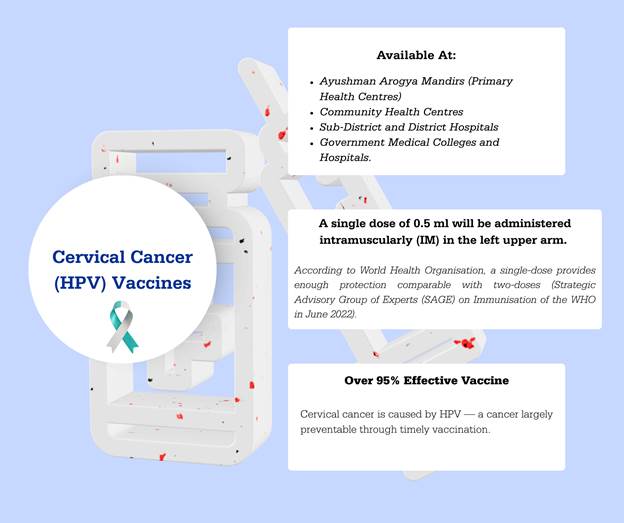
Under the initiative, approximately 1.15 crore girls aged 14 years will receive the HPV vaccine free of cost at government health facilities. Girls who turn 15 within 90 days of the launch are also eligible under a special three month intensive campaign designed to ensure maximum coverage in the initial phase. The focused 90 day drive will run daily, after which the vaccine will continue to be administered on designated routine immunisation days under the national immunisation schedule.
Cervical cancer remains a major public health challenge globally and in India. According to global estimates for 2022, cervical cancer is the fourth most common cancer among women worldwide, with around 660,000 new cases and approximately 350,000 deaths recorded during the year. The disease is caused by persistent infection with the Human Papillomavirus, particularly high risk types 16 and 18.
In India, cervical cancer is the second most common cancer among women, with over 1,20,000 new cases and nearly 80,000 deaths annually as per GLOBOCAN 2022 data. India accounts for nearly 25 percent of global cervical cancer deaths, and one in five women globally who suffers from cervical cancer is from India. The disease also has a profound social impact, disproportionately affecting younger women and families, with an estimated 20 percent of children who lose their mother to cancer doing so because of cervical cancer.
Scientific evidence shows that almost all cases of cervical cancer are linked to persistent infection with high risk HPV types. In India, types 16 and 18 are responsible for more than 80 percent of cervical cancer cases. Cervical cancer is the only cancer that can be effectively prevented through timely vaccination against the causative virus.
The national programme is using Gardasil 4, a quadrivalent HPV vaccine that offers protection against HPV types 16 and 18, which are responsible for cervical cancer, as well as types 6 and 11, which cause other HPV related conditions. A single dose of the vaccine has been shown to provide 93 to 100 percent effectiveness against the HPV types it covers. The vaccine has been approved by the national drug regulator and meets stringent quality, safety and cold chain standards.
To ensure uninterrupted supply and quality assurance, procurement is being carried out through a transparent mechanism in partnership with GAVI the Vaccine Alliance. In February 2023, GAVI and the Government of India entered into a three year partnership to strengthen immunisation systems and reach children who had not received routine vaccines. Under this collaboration, GAVI committed 250 million US dollars in funding to support immunisation strengthening, introduction of the HPV vaccine and the Typhoid Conjugate Vaccine into the national schedule, and to enhance outreach to zero dose children.
GAVI the Vaccine Alliance is a public private partnership that brings together governments, the World Health Organization, UNICEF, the World Bank, the vaccine industry, civil society and the Gates Foundation to expand access to life saving vaccines.
Vaccination under the HPV programme will be conducted only at government health facilities equipped with functional Cold Chain Points to maintain vaccine potency. Each vaccination site will have a designated medical officer trained to manage Adverse Events Following Immunisation and will be linked to the nearest 24 hour government health facility to ensure immediate medical support if required.
Session timings are generally scheduled between 9 am and 2 pm and may also be organised on public holidays and weekends to improve accessibility. Beneficiaries are advised not to be on an empty stomach at the time of vaccination and will be kept under observation for 30 minutes after receiving the dose to monitor for any immediate adverse reactions.
Registration and monitoring are being managed through digital platforms to ensure transparency and traceability. Beneficiaries can self register on the U WIN portal, seek assistance from health workers for pre registration or opt for on site registration at vaccination centres. Vaccine stocks and logistics are tracked through the Electronic Vaccine Intelligence Network. Digital vaccination certificates can be downloaded from the U WIN portal, which also provides details of the nearest 24 hour Adverse Events Following Immunisation facility and helpline number. Hard copies of certificates are available on request. During the initial three month campaign, the left index finger of each vaccinated beneficiary will be marked to prevent duplication.
Certain categories of girls are excluded from vaccination. These include those with moderate or severe illness until full recovery, those with a known allergy to yeast or a history of severe allergic reaction to any vaccine component, pregnant girls, girls outside the 14 year target age group and those who have previously received any HPV vaccine such as Gardasil, Gardasil 9, Cervarix or Cervavac.
Globally, more than 500 million doses of HPV vaccines have been administered since 2006, making them among the most extensively studied and monitored vaccines in public health. With the launch of the programme, India joins over 160 countries that have incorporated HPV vaccination into their national immunisation schedules. More than 90 countries are implementing single dose HPV schedules to improve coverage, affordability and programme efficiency.
Modelling estimates suggest that achieving global cervical cancer elimination targets could avert 74 million new cases and prevent 62 million deaths by 2120. The launch of the nationwide HPV vaccination programme marks a major step towards reducing the burden of cervical cancer in India and advancing the vision of Swasth Nari Sashakt Parivar by placing prevention, protection and equity at the core of women’s healthcare.