
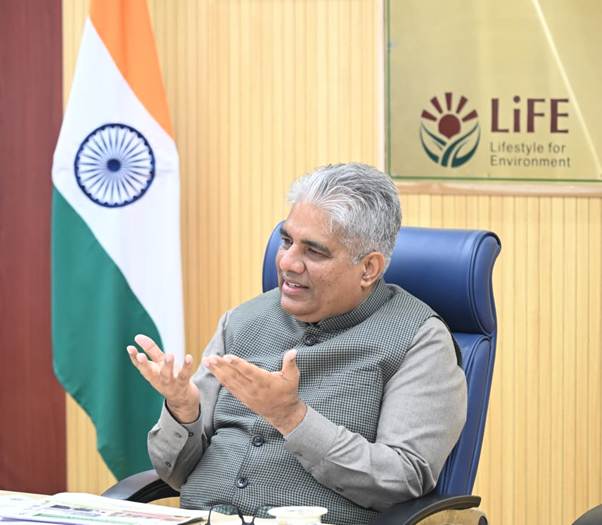
The Union Minister for Environment Forest and Climate Change chaired a high level meeting on January 12 2026 to strengthen coordination among institutions under the National Institute for Research and Application of Natural Resources to Transform Adapt and Build Resilience, a flagship collaborative platform of the Ministry of Environment Forest and Climate Change.
Chairing the meeting, Bhupender Yadav emphasised that natural resources have become a central pillar of contemporary geopolitics and national strength. He underlined that India’s true strategic advantage lies in its rich repository of bioresources, noting that while the country has made significant advances in manufacturing data software and industrial capabilities, the four essentials of life food medicine energy and oil ultimately originate from nature.
The Minister stressed the need for a carefully calibrated approach to resource utilisation, calling for a balanced policy framework that simultaneously safeguards environmental protection and supports industrial development. He said that sustainable and judicious use of natural resources must guide India’s development trajectory, particularly at a time when economic growth and ecological responsibility must move in tandem.
Highlighting the role of the NIRANTAR platform, the Minister said its four verticals are designed to address research generation assessment of outcomes and effective utilisation of scientific knowledge. He noted that NIRANTAR has the potential to become a key enabler in ensuring the sustainable use of India’s bioresources for long term development, innovation and resilience building.
Referring to the growing impacts of climate change, the Minister pointed to the rapid retreat of glaciers and warned that development in ecologically sensitive regions such as the Himalayas must be pursued with caution. He said that specialised institutions like the G B Pant National Institute for Himalayan Ecology and the National Institute for Sustainable Coastal Management can play a critical role in addressing region specific environmental challenges through stronger inter institutional cooperation and knowledge sharing.
The Minister underlined that the Ministry of Environment Forest and Climate Change must act as an active contributor to national development while simultaneously preventing over exploitation of natural resources. He observed that policies related to conservation preservation and sustainable use have far reaching implications for economic growth livelihoods and long term national security.
Outlining priorities for the NIRANTAR platform, the Minister said the focus should be on strengthening high quality research enhancing its contribution to evidence based policymaking and clearly defining the way forward for institutional collaboration. He stressed the importance of institution building through committed and capable human resources, noting that even a small but dedicated group of scientists could significantly improve coordination and bridge existing gaps across institutions.
Concluding the meeting, the Minister called for a Whole of Government approach to environmental governance. He said meaningful outcomes from the NIRANTAR platform would require sustained coordination cooperation and shared ownership among all participating institutions, ensuring that environmental stewardship and developmental aspirations reinforce each other rather than remain in conflict.