
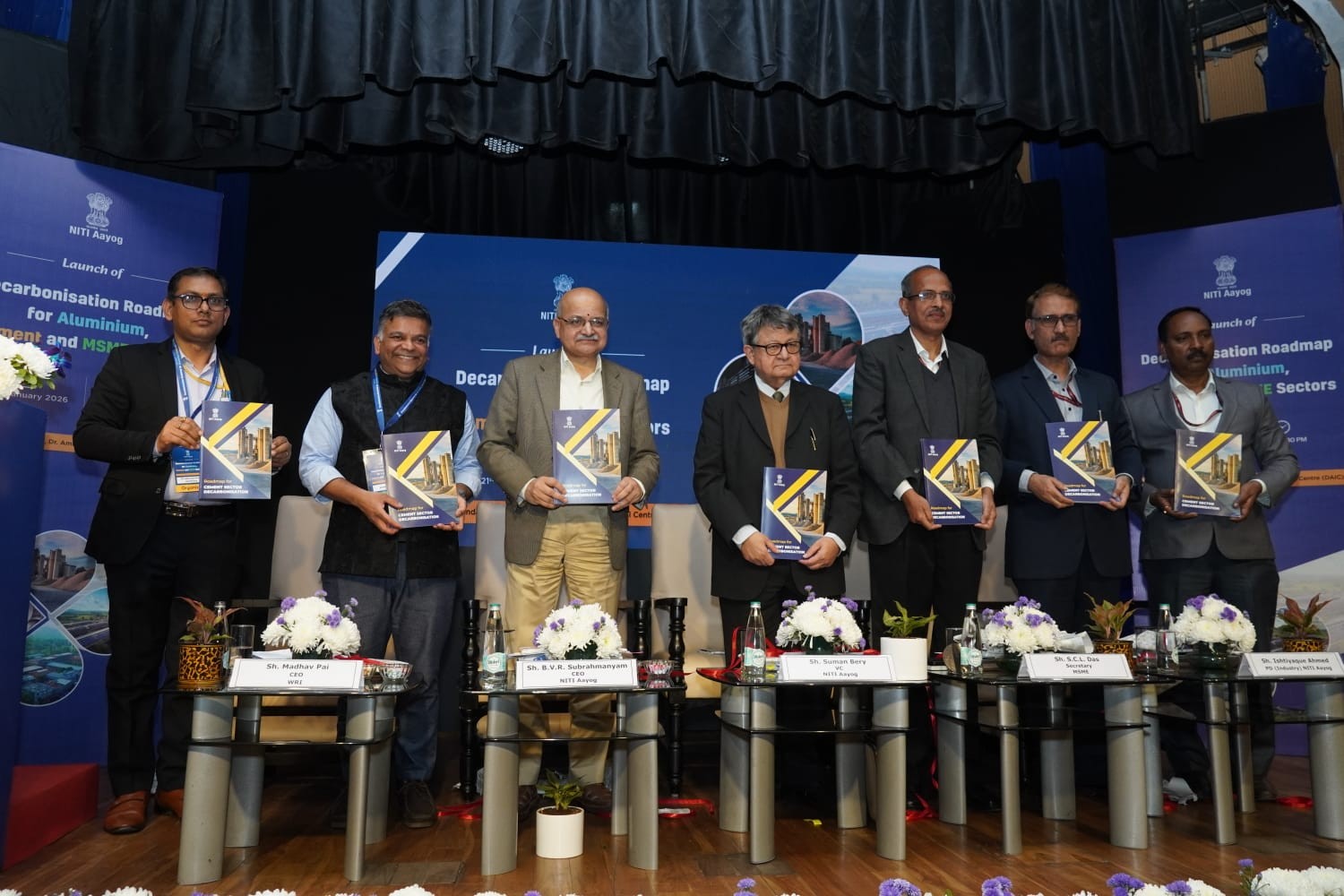
NITI Aayog on Wednesday released three comprehensive reports outlining sector-specific decarbonisation roadmaps for the cement, aluminium and micro, small and medium enterprises sectors, aligning India’s industrial growth ambitions with its climate commitments and the vision of Viksit Bharat by 2047.
The reports come at a time when India is targeting a USD 30 trillion economy by 2047, driven by rapid industrial expansion and large-scale infrastructure development. Increasing the share of manufacturing in GDP from 17 percent to 25 percent remains a key national objective, alongside India’s commitment to achieve net-zero greenhouse gas emissions by 2070. Recognising the scale of this dual challenge, NITI Aayog identified the need for industry-specific green transition pathways and developed the three roadmaps in consultation with line ministries, industry stakeholders, research institutions and knowledge partners.
The cement sector roadmap notes that cement production is projected to rise nearly sevenfold from 391 million tonnes in 2023 to around 2,100 million tonnes by 2070. To support this growth sustainably, the sector must reduce its carbon intensity from 0.63 tonnes of CO₂ equivalent per tonne of cement to about 0.09–0.13 tonnes by 2070. The report recommends prioritising the use of refuse-derived fuels, increasing clinker substitution, scaling up carbon capture utilisation and storage, and effective implementation of the Carbon Credit Trading Scheme to enable deep decarbonisation.
For the aluminium sector, production is expected to expand from 4 million tonnes in 2023 to 37 million tonnes by 2070. The roadmap proposes a phased decarbonisation approach, beginning with a transition to round-the-clock renewable energy and improved grid connectivity in the short term, adoption of nuclear power in the medium term, and long-term integration of carbon capture utilisation and storage technologies.
The roadmap for MSMEs focuses on enabling a green transition across a sector that contributes nearly 30 percent to India’s GDP, employs over 250 million people and accounts for about 46 percent of national exports. It identifies three key levers for decarbonisation: deployment of energy-efficient equipment, adoption of alternative fuels and increased integration of green electricity, with a strong emphasis on cluster-based implementation.
Vice Chairperson of NITI Aayog Suman Bery said MSMEs are critical to both domestic and global supply chains and stressed the need to prioritise technology adoption, access to affordable finance, skilling, regulatory reforms and greater participation of the female workforce to enhance overall competitiveness. NITI Aayog Chief Executive Officer B V R Subrahmanyam said the roadmaps would serve as practical reference manuals to help India pursue industrial growth and decarbonisation simultaneously on its path to becoming a developed nation.
Secretary of the Ministry of MSME S C L Das welcomed the broad and pragmatic focus of the reports, noting that the cluster-based framework would aid effective implementation. Madhav Pai, CEO of WRI India, described the release of the roadmaps as timely, given India’s development aspirations and climate commitments. Ishtiyaque Ahmed, Programme Director at NITI Aayog, highlighted that the cement, aluminium and MSME sectors can be decarbonised through a combination of energy efficiency, round-the-clock renewables, carbon capture utilisation and storage, and nuclear energy.
Together, the three reports provide a structured and sector-specific blueprint for steering India’s industrial expansion towards a low-carbon, competitive and sustainable future.