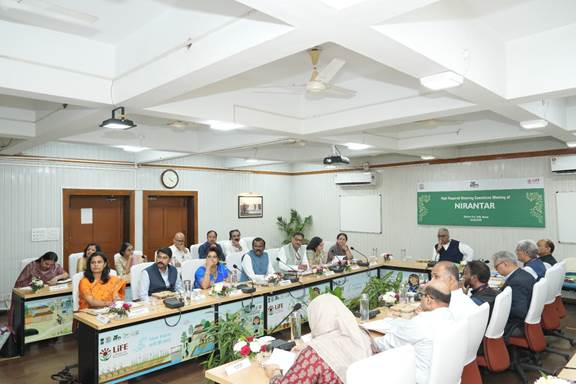

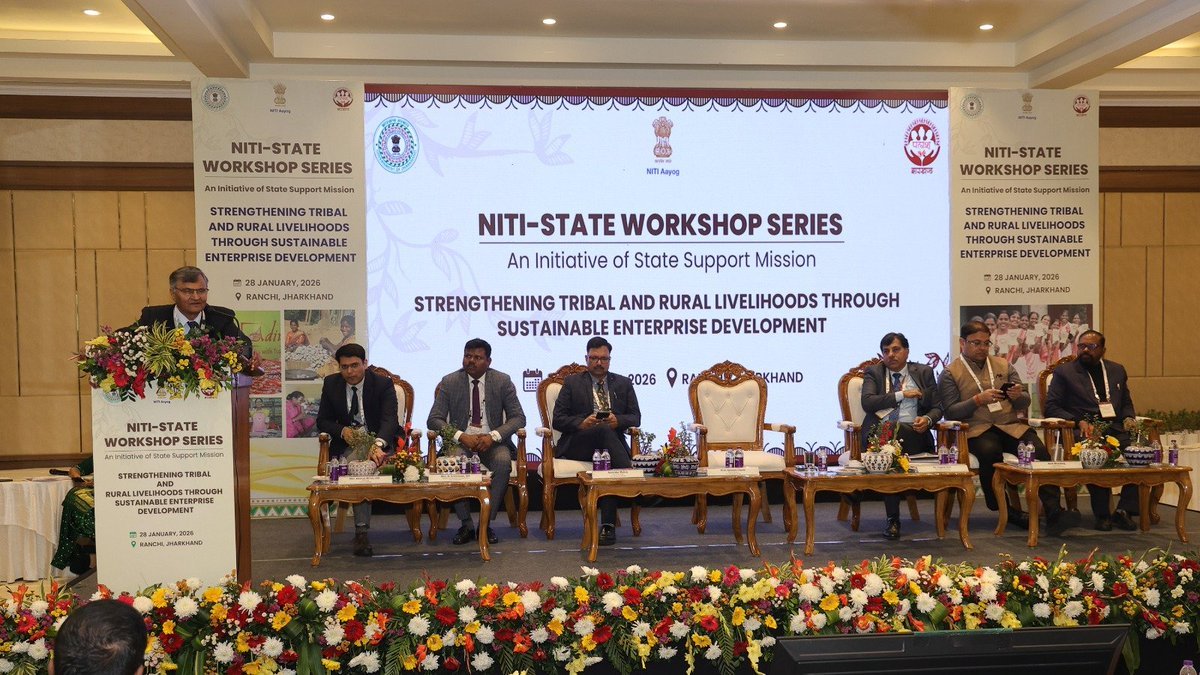
Under the NITI State Workshop Series, NITI Aayog, in collaboration with the Jharkhand State Livelihood Promotion Society and the Department of Rural Development, Government of Jharkhand, organised a high-level workshop on strengthening tribal and rural livelihoods through sustainable enterprise development in Ranchi on 28 January 2026. The workshop brought together policymakers, State officials, practitioners and development partners to deliberate on enterprise-led growth models tailored to Jharkhand’s tribal and rural context.
Delivering the keynote address, Prof Ramesh Chand, Member, NITI Aayog, underscored that inclusive and balanced development requires a shift from a job-seeking mindset to job creation, supported by planned urbanisation and strong rural enterprise ecosystems. He emphasised that empowering tribal and rural communities as entrepreneurs and producers is essential for long-term economic resilience and equitable growth.
Shri Ananya Mittal, Chief Executive Officer, Jharkhand State Livelihood Promotion Society, highlighted that the workshop was a timely platform to strengthen women-led livelihood and enterprise initiatives across tribal and rural regions of the State. He noted that community institutions, when supported with skills, finance and market access, can become powerful drivers of local economic transformation.
Setting the context and objectives of the workshop, Shri Surendra Mehra, Programme Director, Rural Development and Panchayati Raj, NITI Aayog, stated that the focus was on identifying key challenges and adaptable best practices from other States that could be implemented in Jharkhand through convergence and cross-learning. He stressed the importance of inter-departmental and inter-scheme convergence to build sustainable pathways for tribal enterprises, while also pointing to the need for further improvements in education, skilling and livelihood quality.
Speaking on the enabling environment for women entrepreneurs, Shri K Srinivasan, Secretary, Department of Rural Development, Government of Jharkhand, emphasised the critical role of access to land, institutional finance and stronger market linkages. He highlighted the significant potential of Non-Timber Forest Produce-based livelihoods and drew attention to key State initiatives such as Brand Palash and Adiva, which are supporting value addition and market integration for tribal products.
The dignitaries also visited an exhibition area featuring 22 stalls that showcased community-led innovations, skill-based enterprises and market-linked livelihood models rooted in local resources and traditional knowledge. The exhibits reflected the diversity and entrepreneurial potential of tribal and rural communities in Jharkhand.
The post-lunch session featured two focused panel discussions. The first explored emerging enterprise opportunities in rural and tribal Jharkhand, while the second examined ways to co-create a convergent ecosystem involving government, academia, industry and civil society to strengthen sustainable enterprise development. The discussions highlighted the importance of innovation, local value chains and partnerships in scaling up successful livelihood models.
In the concluding session, Shri Amit Bhardwaj, Deputy Advisor, NITI Aayog, outlined the way forward, emphasising policy convergence, institutional strengthening and the promotion of scalable enterprise models to enhance rural and tribal livelihoods. He reiterated the Government of India’s commitment to supporting State-led initiatives that foster inclusive growth and sustainable development in Jharkhand.