

Astronomers have uncovered the physical mechanism behind the mysterious rhythmic flickers observed in black hole systems, offering a compelling explanation for long-puzzling quasi-periodic oscillations seen in high-energy cosmic sources. The findings emerge from advanced numerical simulations conducted by scientists at the Aryabhatta Research Institute of Observational Sciences under the Department of Science and Technology, Government of India, in collaboration with national and international researchers.
Black holes, among the most compact and gravitationally intense objects in the universe, are studied indirectly through radiation emitted by matter spiralling into them. This matter forms a temporary structure known as an accretion disc, whose behaviour governs how energy and radiation are released. While smoothly rotating discs emit predominantly thermal radiation, discs with strong inward infall velocities generate non-thermal radiation, often accompanied by quasi-periodic oscillations. These oscillations cause black hole systems to flicker rhythmically instead of shining steadily.
Using a sophisticated numerical simulation code developed by the Numerical and Theoretical Astrophysics Group at ARIES, the research team investigated how viscous accretion flows evolve over time. The simulations employed a relativistic equation of state suitable for electron-proton plasma and were designed to conserve energy, mass and momentum, allowing an accurate depiction of matter racing toward a black hole at near-light speeds.
The study was carried out by Mr Sanjit Debnath, Dr Indranil Chattopadhyay and Mr Priyesh Kumar Tripathi of ARIES, Dr M Saleem Khan of MJPRU Bareilly, Dr Raj Kishore Joshi of the Nicolaus Copernicus Astronomical Center, Polish Academy of Sciences, and Prof Philippe Laurent of IRFU Service d’Astrophysique, France. Their work has been published in The Astrophysical Journal.
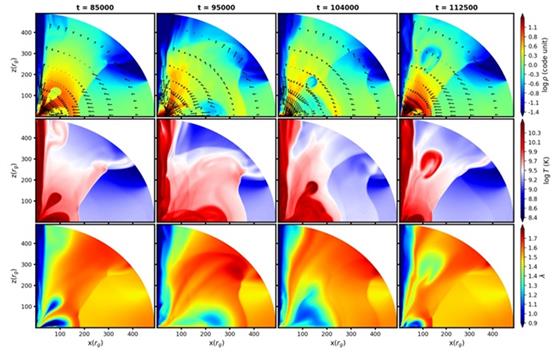
The researchers found that under certain physical conditions, accreting matter does not plunge smoothly into the black hole. Instead, it forms shocks, abrupt transitions where the flow slows down, heats up and becomes denser, similar to shock waves produced by supersonic jets. When the accretion disc possesses sufficient viscosity and cools by emitting radiation, these shocks become unstable and begin to oscillate, shifting back and forth over time.
These oscillating shocks lead to time-dependent variations in high-energy radiation, naturally producing quasi-periodic oscillations. The study also examined how density, temperature and angular momentum evolve in such discs. At higher viscosity levels, turbulent bubble-like regions form in the inner disc after the shock. These regions oscillate and occasionally erupt, enhancing bipolar outflows or jets perpendicular to the disc. The simulations showed that, under high-viscosity conditions, the average speed of the outflowing matter can exceed 25 percent of the speed of light.
According to the researchers, this is likely the first two-dimensional numerical simulation of viscous, transonic accretion flows onto black holes using a relativistic equation of state for electron-proton plasma. The results provide a robust physical explanation for low-frequency C-type quasi-periodic oscillations, ranging from less than one hertz to several tens of hertz, commonly observed in stellar-mass black hole systems.
The findings mark a significant advance in understanding how extreme gravity, fluid dynamics and radiation processes interact near black holes, bringing scientists closer to decoding the complex signals emitted from some of the most enigmatic objects in the cosmos.


Interesting read