
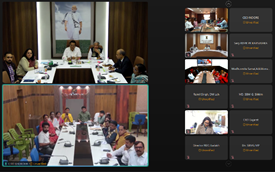
Union Jal Shakti Minister C R Patil on 6 January 2026 chaired a virtual interaction with states and union territories to review innovative and community led faecal sludge management models being implemented under the Swachh Bharat Mission Grameen, with a focus on scalable and sustainable rural sanitation solutions.
The interaction, organised by the Ministry of Jal Shakti, brought together district collectors, chief executive officers of zilla panchayats, state mission directors, senior officials of nodal departments, self help group members and panchayat representatives from across the country. Minister of State for Jal Shakti V Somanna, Secretary of the Department of Drinking Water and Sanitation Ashok K K Meena and Joint Secretary and Mission Director SBM Grameen Aishvarya Singh also participated.
The objective of the review was to share successful faecal sludge management practices from different regions, promote cross learning among states and districts, and reinforce the importance of safe sanitation systems beyond toilet construction by addressing the entire sanitation value chain.
States including Gujarat, Sikkim, Madhya Pradesh, Karnataka, Odisha, Ladakh and Tripura presented a range of field level experiences and models covering in situ treatment, community driven solutions, effective operation and maintenance of faecal sludge treatment plants with the involvement of self help groups and panchayats, and urban rural linkages for faecal sludge management. The discussions also highlighted safe collection, transportation, treatment and reuse of treated faecal sludge and wastewater, along with the generation of local employment opportunities.
A notable model was presented from Khordha district in Odisha, where a transgender led self help group is managing the operation and maintenance of a faecal sludge treatment plant. The initiative demonstrated inclusive and sustainable sanitation service delivery while creating dignified livelihoods and strengthening economic empowerment for marginalised communities.
Other models showcased included large scale adoption of twin pit toilets in remote tribal areas of Dang district in Gujarat, retrofitting of single pit to twin pit toilets in Mangan district of Sikkim, and India’s first rural faecal sludge treatment plant at Kalibillod Gram Panchayat in Indore district of Madhya Pradesh, where treated effluent is being used for pisciculture alongside a material recovery facility to enhance financial sustainability. Karnataka presented a cluster based faecal sludge treatment plant model from Dakshina Kannada with strong self help group involvement, while Ladakh highlighted ecosan toilets developed for extreme cold and high altitude conditions in Leh district. Tripura showcased mobile bio toilets deployed for public events and fairs in Gomati district, managed through self sustaining self help group led operations.
Community members implementing these models interacted directly with the Minister and shared their experiences in local languages, encouraging open and enthusiastic participation.
C R Patil praised the states and communities for developing innovative sanitation models that contribute to cleanliness while also generating income and livelihoods. He noted that many initiatives have emerged in difficult geographical conditions, demonstrating that challenges can drive lasting solutions. Emphasising that faecal sludge management is critical for sustainable rural sanitation, he said it is essential for protecting public health, ensuring a clean environment and achieving complete sanitation. He stressed the importance of community participation, involvement of self help groups and panchayats, and adoption of context specific technologies to ensure that solutions are inclusive, viable and durable.
The Ministry of Jal Shakti reaffirmed its commitment to supporting states and union territories through technical assistance, capacity building and promotion of innovative, community led faecal sludge management models under Swachh Bharat Mission Grameen.