
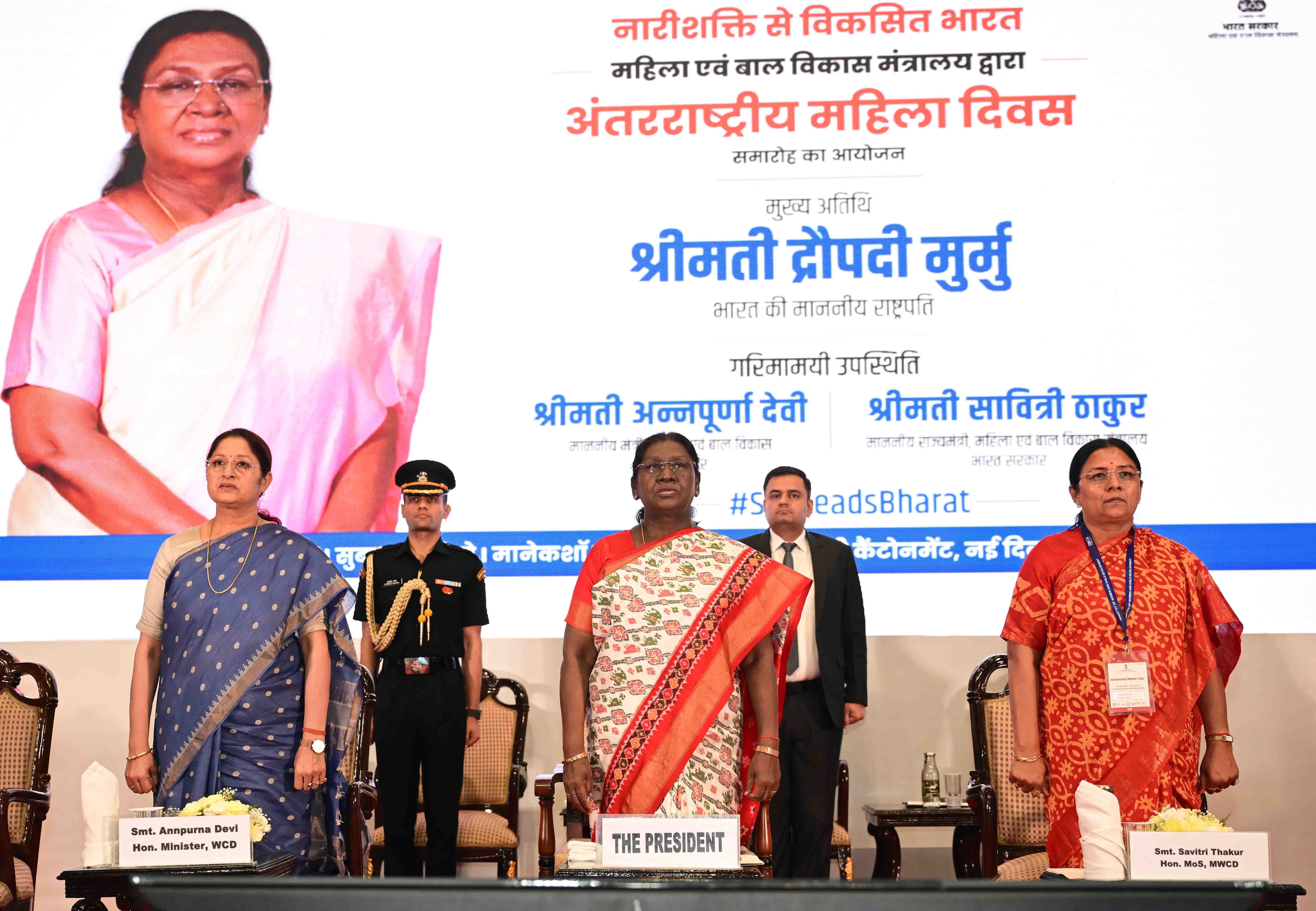
President Droupadi Murmu on 8 March 2026 emphasised the importance of ensuring equal participation of women in all sectors of society, stating that inclusive progress is essential for achieving comprehensive national development. Addressing a national event organised by the Ministry of Women and Child Development in New Delhi to mark International Women’s Day, the President highlighted the growing role of women across diverse fields and reiterated the need to strengthen gender equality, safety and empowerment.
The event was organised to celebrate the achievements and contributions of women in multiple sectors including education, governance, science, entrepreneurship, sports and social development. It also served as a platform to reaffirm the country’s commitment to advancing gender equality and expanding opportunities for women in all areas of public life.
In her address, Droupadi Murmu said that women are increasingly assuming leadership roles in a wide range of professions. She noted that women today are contributing significantly in fields such as education, administration, the judiciary, the military, medicine, science, technology, arts and entrepreneurship. Their achievements demonstrate that when provided with equal opportunities and institutional support, women are capable of excelling and leading in every sphere of national life.
The President highlighted the growing contribution of women in rural development through self help groups and local governance institutions. According to her, women associated with self help groups are achieving financial independence and playing a vital role in strengthening rural economies. Women leaders in local panchayats are also helping drive development initiatives and community welfare programmes at the grassroots level.
She noted that women entrepreneurs are increasingly participating in industry, startup ecosystems and corporate leadership roles. Many women are leveraging innovation and business opportunities to create enterprises that generate employment and contribute to economic growth.
Droupadi Murmu also referred to the growing success of women athletes who are bringing international recognition to India. Their achievements, she said, serve as powerful examples for younger generations and demonstrate the potential of women when provided with opportunities and encouragement.
Highlighting broader national trends, the President said that India is steadily moving toward a model of women led development. Over the past decade, several policy initiatives and institutional reforms have helped remove structural barriers that historically limited women’s participation in education and economic activity.
She pointed out that India has achieved gender parity in school education. In higher education, female students now have a higher Gross Enrolment Ratio compared to male students in several disciplines. Participation of women in Science, Technology, Engineering and Mathematics education is also rising steadily.
To further support women pursuing higher education in technical fields, the Union Budget for 2026–27 has proposed the establishment of women’s hostels in every district. These facilities are expected to help female students continue their studies, particularly in STEM disciplines, by providing safe and accessible accommodation.
According to the President, these measures are preparing young women to take leadership roles in the emerging knowledge economy and contribute to India’s technological and economic advancement.
Droupadi Murmu also highlighted the growing role of women as job creators rather than only job seekers. She noted that more than half of the start ups receiving support under the Start up India initiative have at least one female director. This reflects the increasing presence of women in entrepreneurship and innovation driven industries.
She further noted that more than two lakh women owned micro small and medium enterprises are currently registered on the Government e Marketplace platform. These enterprises are gaining wider market access through digital procurement platforms and are contributing to local economic development.
The President also referred to the SHE Mart initiative introduced in the Union Budget 2026–27. The initiative aims to provide improved market access for products manufactured by self help groups and rural women entrepreneurs, enabling them to reach broader domestic and international markets.
In addition, the labour codes implemented in the previous year aim to create safer, more inclusive and supportive work environments for women workers. These reforms seek to strengthen workplace protections and promote greater participation of women in the formal workforce.
Despite these advancements, the President cautioned that several social and structural challenges still affect women’s progress. Issues such as discrimination, unequal pay for equal work and domestic violence continue to affect many women.
She emphasised that legislation alone cannot eliminate these challenges. A transformation in social attitudes and collective thinking is equally essential. Society must move beyond gender based discrimination and ensure that women receive respect, equality and security in all aspects of life.
Droupadi Murmu stressed that women constitute nearly half of India’s population and their equal participation is essential for national progress. She said that the country’s goal of becoming a developed nation by 2047 can only be achieved if women are empowered to fully realise their potential.
She called upon citizens to create an environment where women can pursue their aspirations without fear or discrimination. Ensuring education, safety, respect and equal opportunities for every girl and woman is fundamental for building an inclusive and progressive society.
On the occasion of International Women’s Day, the President urged citizens across the country to renew their commitment to empowering women and eliminating all forms of discrimination. By ensuring that women are supported at every stage of their journey, she said, India can set a global example of inclusive development and women’s empowerment.