
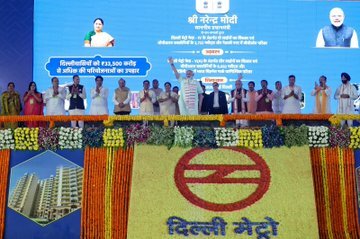
Major infrastructure and urban development projects worth about ₹33,500 crore were inaugurated and launched in the national capital as part of a large scale effort to strengthen connectivity, improve public services and enhance the quality of life for residents. Narendra Modi inaugurated several completed projects and laid the foundation stone for new initiatives aimed at modernising the city’s infrastructure and supporting its growing population.
Addressing the gathering at the launch event, Narendra Modi said the projects would provide a fresh momentum to the development of the national capital and reinforce the vision of building a modern and developed Delhi. He said the expansion of infrastructure and public facilities would improve daily life for citizens while strengthening the city’s position as the national capital and an international symbol of India’s democratic identity.
The projects announced include the expansion of the metro network, construction of modern residential complexes for government employees, improvements in transport services and initiatives aimed at supporting small businesses and urban livelihoods. According to officials, the combined investment represents one of the largest coordinated infrastructure pushes in the capital in recent years.
One of the key highlights of the programme was the inauguration of a new metro section aimed at improving connectivity in the eastern and north eastern parts of Delhi. Narendra Modi said the new corridor would benefit lakhs of daily commuters by reducing travel time and improving access to employment and services across the city.
He noted that the metro network in Delhi has expanded significantly over the years and now covers approximately 375 kilometres, making it one of the largest urban rail systems in the world. The newly inaugurated section is expected to further strengthen the city’s public transport network and reduce pressure on road traffic.
Narendra Modi emphasised that modernising the capital’s infrastructure is important not only for the city but also for the country’s global image. He said Delhi represents the identity of Indian democracy and therefore its infrastructure must reflect the confidence and progress of the nation.
The event also highlighted improvements in the city’s public transport system. Narendra Modi said that the government has been upgrading transport facilities to provide clean, comfortable and modern travel for citizens who depend on public transport every day.
More than 4,000 electric buses provided by the central government are already operating in the capital, and an additional 1,800 buses have been introduced in the past year. These include hundreds of Devi buses designed to strengthen last mile connectivity in residential neighbourhoods and colonies across the city.
The Prime Minister said the government is working in mission mode to address long standing challenges facing the capital. Among these is the diversion of heavy traffic through the Peripheral Expressway, which has significantly reduced the number of vehicles entering the city.
He also highlighted ongoing initiatives aimed at cleaning and rejuvenating the Yamuna River. According to him, several projects worth hundreds of crores are already underway to restore the river and improve environmental conditions in the city.
Narendra Modi said improving the quality of life for residents remains a key focus of the government’s development agenda. He pointed to the establishment of several Ayushman Arogya Mandirs in the city and said the implementation of the Ayushman scheme in Delhi has helped both poor and middle class families access free medical treatment and healthcare benefits.
During the programme, the Prime Minister also referred to the inauguration of modern residential complexes for government employees at Sarojini Nagar. Thousands of newly constructed flats have been provided to employees as part of an initiative to improve living conditions for public servants who work in the capital.
He said government employees who work toward the nation’s development deserve safe, clean and modern housing facilities. The newly constructed residential complexes are expected to provide improved living conditions while optimising the use of urban land in the capital.
Narendra Modi also highlighted welfare initiatives aimed at supporting small businesses and street vendors. He said the PM SVANidhi scheme has helped nearly two lakh street vendors in Delhi receive financial assistance of more than ₹350 crore.
Under the scheme, street vendors who previously depended on informal loans now have access to formal credit through banks. The government has also launched a campaign to provide PM SVANidhi credit cards to vendors, enabling them to access credit more easily for their business needs.
He said the initiative represents an important step in expanding financial inclusion and supporting the livelihoods of urban workers.
The Prime Minister also spoke about women’s empowerment while marking International Women’s Day. He said women are playing an increasingly important role in fields such as politics, administration, science, sports and social development.
He noted that more than 10 crore women across the country are now associated with Self Help Groups and that government initiatives have helped create more than three crore Lakhpati Didis. These women entrepreneurs have benefited from access to credit, training and financial services that support economic independence.
Narendra Modi said the success of women entrepreneurs has inspired a new national goal of creating three crore more Lakhpati Didis in the coming years.
During his address, the Prime Minister also expressed concern about recent developments in West Bengal and criticised the alleged mismanagement of an event attended by Droupadi Murmu at a traditional Santal tribal festival. He described the incident as an insult to the constitutional position of the President and said such actions undermine democratic values.
Concluding the programme, Narendra Modi described Delhi as a historic city entering a new phase of development driven by the confidence of a transforming nation. He said the ongoing projects will strengthen infrastructure, improve connectivity and contribute to a better quality of life for citizens.
He expressed confidence that the development initiatives launched during the programme would help create a more prosperous future for families in the national capital while reinforcing the vision of a developed India.