
Indian Railways has accelerated infrastructure development and operational reforms in recent years, completing several major railway projects across the country and improving train punctuality through technological upgrades and capacity expansion.
Information presented in the Rajya Sabha on March 13 by Ashwini Vaishnaw, Union Minister for Railways, Information and Broadcasting and Electronics and Information Technology, stated that capacity enhancement of the railway network has been undertaken on a large scale over the past eleven years to strengthen passenger connectivity, improve freight efficiency and support socio economic development.
During the period 2014 to 2025, Indian Railways commissioned 34,428 kilometres of new track compared with 7,599 kilometres during 2009 to 2014. The average pace of track commissioning increased from 4.2 kilometres per day in the earlier period to 8.6 kilometres per day, more than doubling the earlier rate.
New Track Commissioning Across Indian Railways
Period New Track Commissioned Average Commissioning
2009–2014 7,599 km 4.2 km per day
2014–2025 34,428 km 8.6 km per day
Several major railway projects covering more than 1,900 kilometres have recently been completed, significantly enhancing connectivity across regions.
Recently Completed Railway Infrastructure Projects
S No Project Name Length km
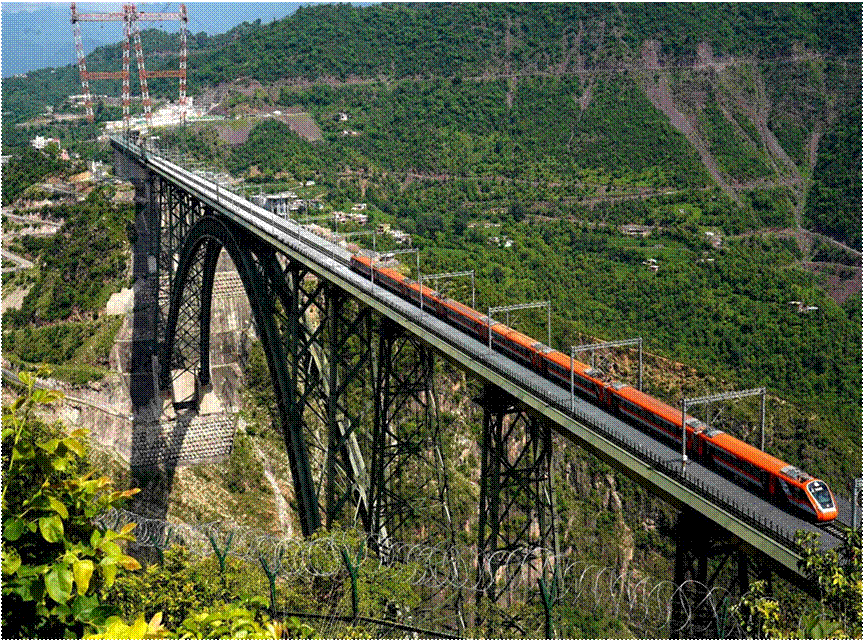
1 Udhampur Srinagar Baramulla new line 272
2 Bairabi Sairang new line 51
3 Deoband Roorkee new line 27
4 Churu Ratangarh doubling 43
5 Tori Shivpur third line 44
6 Araria Galgalia new line 110
7 Himmatnagar Khedbrahma gauge conversion 55
8 Bahraich Nanpara Nepalganj gauge conversion 56
9 Domingarh Gorakhpur Kusumi third line and Gorakhpur Nakaha doubling 21
10 Vijapur Ambaliyasan gauge conversion 43
11 Pune Miraj Londa doubling 467
12 Manmad Jalgaon third line 160
13 Phephna Indara Mau Shahganj doubling 150
14 Adraj Moti Vijapur gauge conversion 40
15 Katni Bina third line 279
16 Gandhidham Adipur quadrupling 21
17 Khatuwas Narnaul doubling 24
18 Penukonda Dharmavaram doubling 42
Railway infrastructure projects contribute to regional socio economic development by improving connectivity, enabling faster movement of goods and services, increasing logistics efficiency and reducing transportation costs. These projects also enhance line capacity, reduce operational bottlenecks, generate employment opportunities and stimulate tourism and industrial growth in the regions they serve.
The sanction of railway projects depends on several factors including projected traffic demand, financial viability of the route, connectivity to missing links, augmentation of congested lines, demands raised by state governments and public representatives, operational requirements of Indian Railways and socio economic considerations.
Implementation of railway projects also depends on factors such as land acquisition, forest clearances, shifting of utilities, statutory approvals, geological and topographical conditions, law and order conditions and the number of working months available at project sites.
To ensure faster implementation, the government has taken several measures including increased budget allocation, delegation of powers at the field level, close monitoring of project progress and regular coordination with state governments and authorities for land acquisition and environmental clearances.
During the last five years, Indian Railways has sanctioned 308 projects including new lines, gauge conversion and doubling works at an estimated cost of about 2,93,000 crore rupees to further expand the capacity of the railway network.
Major Railway Infrastructure Projects Sanctioned
SN Project Name Cost ₹ Crore
1 Chopan Chunar doubling 102 km 1,553
2 Guntur Bibinagar doubling 239 km 3,238
3 Mudkhed Medchal and Mahbubnagar Dhone doubling 418 km 5,655
4 Samakhiali Gandhidham quadrupling 53 km 1,571
5 Merta City Ras and bypass at Merta Road new line 56 km 1,038
6 Lumding Furkating doubling 140 km 2,334
7 Ajmer Chanderiya doubling 178 km 1,813
8 Motumari Vishnupuram with RoR doubling 100 km 1,746
9 Bikramshila Katareah new line with new bridge on river Ganga 26 km 2,549
10 Gunupur Therubali new line 74 km 1,326
11 Malkangiri Pandurangapuram new line 174 km 4,109
12 Badampahar Kendujhargarh new line 82 km 2,106
13 Junagarh Nabarangpur new line 116 km 3,274
14 Buramara Chakulia new line 60 km 1,639
15 Ajanta Caves rail connectivity 174 km 7,105
16 Bangriposi Gorumahisani new line 86 km 2,549
17 Chandil Anara Damodar third line 121 km 2,170
18 Bargarh Road Nawapara Road new line 138 km 2,926
19 Sardega Bhalumuda new double line 37 km 1,360
20 Varanasi Pt Deen Dayal Upadhyaya multitracking with rail cum road bridge on river Ganga 15 km 2,642
21 Jalgaon Manmad fourth line 160 km 2,773
22 Bhusawal Khandwa third and fourth line 131 km 3,514
23 Sambalpur Jarapada third and fourth line 127 km 3,916
24 Jharsuguda Sason third and fourth line 35 km 1,181
25 Gondia Ballarshah doubling 240 km 4,819
26 Kharsia Naya Raipur Parmalkasa fifth and sixth line 278 km 8,741
27 Wardha Balharshah quadrupling 135 km 2,381
28 Ballari Chikjajur doubling 185 km 3,342
29 Koderma Barkakana doubling 133 km 3,063
30 Itarsi Nagpur fourth line 297 km 5,451
31 Dangoaposi Jaroli third and fourth line 43 km 1,752
32 Secunderabad Wadi third and fourth line 173 km 5,012
33 Furkating New Tinsukia doubling 194 km 3,634
34 Bakhtiyarpur Rajgir Tilaiya doubling 104 km 2,192
35 Gondia Dongargarh fourth line 84 km 2,223
36 Wardha Bhusawal third and fourth line 314 km 9,197
37 Hosapete Bellary quadrupling 65 km 2,372
38 Kasara Manmad third and fourth line 131 km 10,154
39 Punarakh Kiul third and fourth line 50 km 2,668
40 Gamharia Chandil third and fourth line 55 km 1,168
41 Sainthia Pakhur fourth line 81 km 1,569
42 Santragachi Kharagpur fourth line 111 km 2,905
43 Nergundi Barang and Khurda Road Vizianagaram third line 385 km 5,618
44 Son Nagar Andal multitracking 375 km 13,606
45 Gorakhpur Cantt Valmiki Nagar doubling 96 km 1,270
46 Jaipur Sawai Madhopur doubling 131 km 1,269
47 Luni Samdari Bhildi doubling 272 km 3,531
48 Narkatiaganj Raxaul Sitamarhi Darbhanga and Sitamarhi Muzaffarpur doubling 256 km 4,553
49 Prayagraj Iradatganj Manikpur third line 84 km 1,640
50 Tirupati Pakala Katpadi doubling 104 km 1,332
51 Ratlam Nagda third and fourth line 41 km 1,018
52 Aluabari Road New Jalpaiguri third and fourth line 57 km 1,786
53 Aurangabad Chhatrapati Sambhajinagar Parbhani new line 177 km 2,179
54 Bhagalpur Dumka Rampurhat doubling 177 km 3,169
55 Itarsi Bina fourth line 237 km 4,329
56 Vadodara Ratlam third and fourth line 259 km 8,885
57 Devbhumi Dwarka Okha Kanalus doubling 141 km 1,457
58 Badlapur Karjat third and fourth line 32 km 1,324
59 Delhi Ambala Cantt third and fourth line 194 km 5,983
60 Gondia Jabalpur doubling 231 km 5,236
61 Manmad Indore new line 360 km 18,529
62 Errupelam Amaravati Nambur new line 57 km 2,245
63 Vadhavan Port and New Palghar station new double line 22 km 1,507
64 Deshalpar Hajipir Luna and Vayor Lakhpat new line 145 km 2,526
Alongside infrastructure expansion, Indian Railways has introduced technological systems to improve punctuality and operational efficiency. Train operations are monitored through integrated digital platforms including the Integrated Coaching Management System and Control Office Application, linked with the National Train Enquiry System.
Real time monitoring is supported through GPS based systems such as Real Time Train Information System and Remote Monitoring and Management of Locomotives and Trains along with station signalling data loggers that automatically record train arrival and departure timings.
Indian Railways has also replaced older ICF coaches with modern lightweight LHB coaches equipped with advanced technology. More than 50,000 LHB coaches have been produced since April 2018. The network is also expanding services such as Vande Bharat, Namo Bharat Rapid Rail and Amrit Bharat trains which provide quicker acceleration and improved operational performance.
Scientific timetable rationalisation has been undertaken with assistance from IIT Mumbai using traffic simulation models. The process also introduced fixed integrated maintenance blocks across sections to reduce detention and improve punctuality.
To ensure safer train operations during winter fog, Indian Railways has provided 29,848 GPS based portable Fog Safe Devices to loco pilots. These devices display upcoming signals, level crossing gates and speed restrictions in advance during low visibility conditions. The Modified Semi Automatic Stop Signal system has also been introduced to reduce delays during fog and adverse weather.
Due to these measures, Indian Railways recorded an overall punctuality of more than 77 percent during the financial year 2025 to 2026 up to February 2026.
Division wise punctuality performance
Number of Divisions Punctuality Level
24 Divisions More than 90 percent punctuality
19 Divisions Between 80 percent and 90 percent punctuality
All Divisions Combined More than 77 percent punctuality
Indian Railways currently operates around 25,000 trains daily including suburban, passenger and freight services. Challenges affecting punctuality include foggy weather, heavy traffic load, mixed traffic operations with trains of different speeds, maintenance requirements, alarm chain pulling, agitations and other unforeseen disruptions.
To address congestion and improve freight movement, dedicated freight corridors including the Eastern Dedicated Freight Corridor and Western Dedicated Freight Corridor are being developed to provide exclusive freight paths.
As of April 1, 2025, Indian Railways has sanctioned 431 infrastructure projects including new lines, gauge conversions and doubling works covering a total length of 35,966 kilometres at an estimated cost of about 6.75 lakh crore rupees.
Summary of sanctioned railway infrastructure projects
Category Number of Projects Total Length km Length Commissioned till March 2025 km Total Expenditure till March 2025 ₹ crore
New Lines 154 16,142 3,036 1,45,318
Gauge Conversion 33 4,180 2,997 22,753
Doubling and Multitracking 244 15,644 6,736 1,22,858
Total 431 35,966 12,769 2,90,929
The government stated that continued expansion of rail infrastructure and adoption of digital monitoring systems will further improve train punctuality, strengthen logistics capacity and support economic growth across regions.