
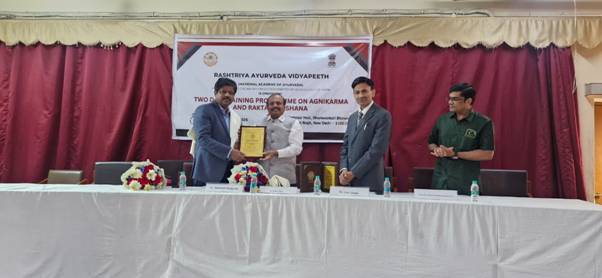
Rashtriya Ayurveda Vidyapeeth conducted a two day national level intensive hands on training programme on Agnikarma and Rakta Mokshana in New Delhi, reinforcing its commitment to strengthening clinical competence in classical para surgical Ayurvedic therapies.
The programme was held on 26 and 27 February 2026 at the AIAC Seminar Hall, Dhanwantari Bhawan, West Punjabi Bagh. It brought together leading experts, senior academicians and practicing clinicians from prominent institutions in the field of Ayurveda and Indian Systems of Medicine.
Among the distinguished participants were Mukul Patel, President of the Medical Assessment and Rating Board for Indian System of Medicine under the National Commission for Indian System of Medicine, Hemant Panigrahi, Incharge Director of the Central Ayurveda Research Institute, Ravi Gogia, Medical Officer at MCD Gianchand Joshi Ayurvedic Panchkarma Hospital, Chandramouleeswaran P., Principal of Government Ayurveda College and Hospital, Coimbatore, and Santosh Bhatted, Head of the Department of Panchkarma at the All India Institute of Ayurveda.
The training programme was structured to provide intensive practical exposure with live clinical demonstrations and guided procedural practice. Participants were trained in the theoretical foundations, indications, contraindications, instruments and procedural nuances of Agnikarma and Rakta Mokshana, both of which are considered specialized para surgical interventions within classical Ayurvedic practice.
Agnikarma, a therapeutic cauterization technique, is traditionally indicated for conditions such as musculoskeletal disorders and chronic pain syndromes. Rakta Mokshana, a bloodletting procedure, is used in selected inflammatory and dermatological conditions. The sessions focused on safe execution, patient selection, aseptic protocols and post procedural care, ensuring alignment with contemporary clinical standards while preserving classical principles.
Faculty members conducted live demonstrations and interactive discussions, enabling participants to clarify clinical doubts and refine their procedural skills. Emphasis was laid on bridging traditional knowledge with evidence based practice and institutional standards of training.
The programme witnessed active participation from practitioners and scholars seeking to enhance their hands on capabilities in these specialized therapies. By combining structured lectures with supervised practical sessions, the initiative aimed to ensure that participants gained confidence and competence in delivering these treatments in clinical settings.
The successful conduct of the training programme underscores the role of Rashtriya Ayurveda Vidyapeeth in advancing quality education, skill upgradation and capacity building in Ayurveda. It also reflects the growing emphasis on strengthening practical training and standardization in Indian Systems of Medicine.