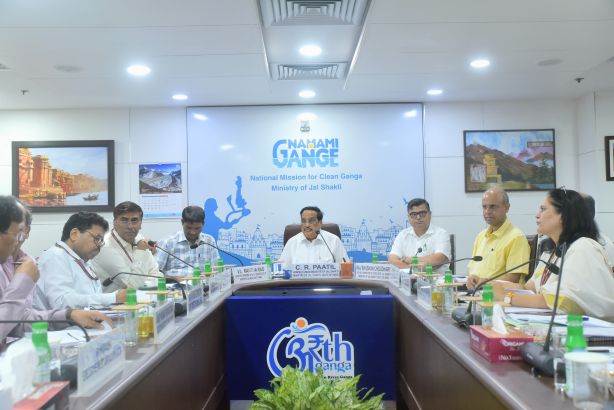

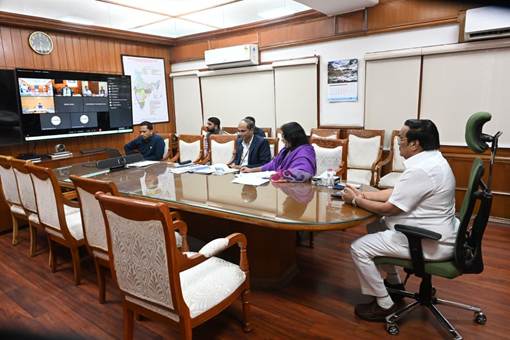
Union Minister of Jal Shakti C. R. Paatil and Chief Minister Bhajan Lal Sharma chaired a comprehensive statewide review of Jal Sanchay Jan Bhagidari 2.0 implementation in Rajasthan, directing district administrations and urban local bodies to intensify groundwater recharge and water conservation efforts ahead of the monsoon.
The review meeting, organised by the National Water Mission under the Department of Water Resources, River Development and Ganga Rejuvenation in collaboration with the Government of Rajasthan, brought together all District Collectors and Municipal Commissioners of the State. The objective was to assess district-level progress, identify best practices and accelerate implementation under JSJB 2.0.
The meeting was attended by V Srinivas, Chief Secretary, Government of Rajasthan; Abhay Kumar, Additional Chief Secretary, Government of Rajasthan; Archana Verma, Additional Secretary and Managing Director, National Water Mission; along with senior officers from the State and Central Governments.
District Collectors of Bhilwara and Dungarpur presented detailed reports on local initiatives undertaken under JSJB 2.0. The presentation from Dungarpur, a predominantly tribal district, highlighted sustained community participation in water conservation and river rejuvenation activities, demonstrating the effectiveness of Jan Bhagidari in delivering measurable outcomes.
Rajasthan secured the third position nationally under JSJB 1.0 and emerged as one of the leading States in implementing large-scale groundwater recharge and water conservation initiatives. The State has consistently demonstrated leadership in traditional and community-based water management systems.
During the review, replicable models were highlighted, including the Alwar school model, where schools have actively participated in constructing recharge structures and promoting water literacy among students. Another key initiative discussed was the revival and construction of traditional tankas in districts such as Barmer, strengthening decentralised water storage and improving resilience in arid regions.
These examples underscored that low-cost, locally adapted and community-driven interventions can significantly enhance groundwater recharge and long-term water security.
Bhajan Lal Sharma reaffirmed the State Government’s commitment to strengthening implementation under JSJB 2.0 and maintaining Rajasthan’s leadership in water conservation. He assured that all districts and urban local bodies would work to improve performance and contribute to the national objective of sustainable groundwater management.
Addressing officials, C. R. Paatil emphasised the urgency of creating adequate rainwater recharge capacity before the onset of the monsoon. He stated that Jal Sanchay Jan Bhagidari has evolved into a nationwide people’s movement under the leadership of Narendra Modi, transforming water conservation into a mass campaign.
The Union Minister highlighted that funds under MGNREGA have been earmarked for water conservation activities and urged districts to proactively undertake works under the scheme before the monsoon to ensure timely execution and optimal resource utilisation. He called for convergence with other schemes, enhanced community participation and close monitoring of progress.
Congratulating Rajasthan for its strong performance under JSJB 1.0, C. R. Paatil expressed confidence that the State would further consolidate its leadership under JSJB 2.0 and continue to set benchmarks in community-driven water conservation and sustainable groundwater management.