
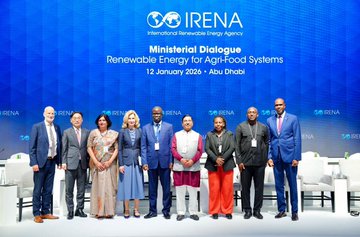
India has positioned renewable energy as a central pillar of climate resilient agriculture and rural transformation, with decentralised clean energy systems reshaping agrifood value chains and strengthening farmer livelihoods, Union Minister for New and Renewable Energy Pralhad Joshi said on January 12 2026 while addressing an inter ministerial dialogue in Abu Dhabi.
The dialogue on scaling renewable energy in agrifood systems was jointly convened by the International Renewable Energy Agency and the Food and Agriculture Organization on the sidelines of the sixteenth IRENA Assembly. The forum brought together global policymakers and institutions to examine how clean energy can simultaneously advance food security climate action and rural livelihoods.
Addressing the gathering the Minister said that when India speaks on global platforms it represents nearly one sixth of humanity and some of the largest food security programmes in the world alongside one of the fastest growing renewable energy markets. He noted that India’s agrarian ethos is undergoing a fundamental transformation as farmers traditionally revered as Annadata are increasingly becoming Urjadata contributing both food and clean energy through decentralised renewable systems.
The Minister underlined that renewable energy offers a unifying solution to multiple global challenges including energy access climate resilience agricultural productivity and income security. He said India’s approach is grounded in ambition matched by implementation supported by stable policy frameworks decentralised deployment inclusive design and strong coordination across ministries and levels of government.
Highlighting flagship programmes the Minister detailed the progress of the PM KUSUM scheme launched in 2019 to integrate solar energy into agriculture. The scheme covers standalone solar pumps solarisation of grid connected pumps and decentralised solar power plants near farms. As of late 2025 nearly one million standalone solar pumps had been installed and over 1.1 million grid connected pumps solarised contributing more than 10200 megawatts of installed capacity. The initiative has reduced diesel dependence stabilised irrigation costs lowered emissions and shifted public support from recurring subsidies to durable asset creation.
The Minister said decentralised renewable energy is creating new income streams for farmers by enabling the sale of surplus solar power while also strengthening rural energy security. He added that programmes such as the National Bioenergy Programme are converting agricultural residues into clean energy helping address waste management challenges and reduce open burning. The PM Surya Ghar Muft Bijli Yojana for rooftop solar was also cited as a key initiative expanding household energy access and lowering electricity bills in rural and semi urban areas.
Looking ahead the Minister announced preparations for PM KUSUM 2.0 with a renewed focus on decentralised solutions and agri photovoltaic systems that allow crops and solar generation to coexist. He said well designed agri PV can moderate micro climates maintain or enhance crop yields generate clean electricity and diversify farmer incomes making agriculture more resilient to climate variability.
Concluding his address the Minister reaffirmed India’s readiness to deepen international partnerships and scale proven solutions. With abundant solar resources and more than 146 million small landholdings he said India is uniquely positioned to emerge as a global leader in renewable energy enabled agrifood systems that combine productivity sustainability and rural prosperity.
On the sidelines of the IRENA Assembly the Minister held several high level bilateral engagements to strengthen clean energy cooperation. He met senior representatives of the Government of Iceland to explore technical collaboration in scaling geothermal energy deployment in India as part of its diversified clean energy transition. Discussions focused on knowledge exchange capacity building and long term cooperation.
In another meeting with senior officials of the European Commission the Minister reviewed progress under the India European Union Clean Energy and Climate Partnership with emphasis on delivering tangible outcomes on renewable deployment energy efficiency and clean technology manufacturing. A separate interaction with the leadership of the United Arab Emirates focused on strengthening investment partnerships in renewable energy and clean infrastructure supported by India’s expanding non fossil capacity domestic manufacturing ecosystem and predictable policy environment.
The Minister also visited the Louvre Abu Dhabi describing it as a powerful symbol of cultural dialogue and shared human heritage and noting the presence of India’s artistic traditions that reflect the country’s deep civilisational legacy.