

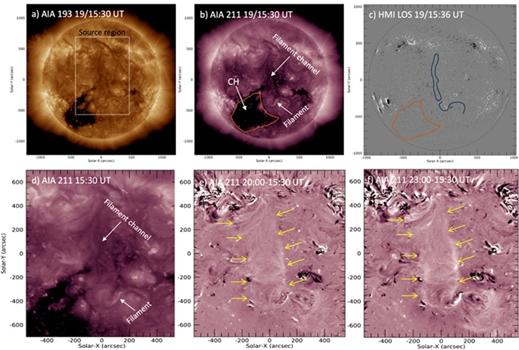
Astronomers have uncovered how a subtle and largely undetectable solar eruption triggered an intense geomagnetic storm on Earth, highlighting major challenges in forecasting space weather events that lack conventional warning signs. The findings stem from a detailed investigation of a stealth Coronal Mass Ejection that erupted from the Sun on 19 March 2023 and impacted Earth roughly three days later.
Coronal Mass Ejections are massive expulsions of plasma and magnetic fields from the Sun that can disrupt satellites, communication systems, navigation networks and power grids on Earth. Typically, intense geomagnetic storms are linked to clearly observable solar events such as strong flares or radio bursts. However, nearly 10 percent of severe geomagnetic storms arise from weak or stealth CMEs that leave little or no visible signature on the solar surface, making them extremely difficult to detect with existing observation systems.
The study focused on one such stealth CME that travelled from the Sun to Earth through a coronal hole, a region of open magnetic field lines that allows high-speed solar wind to escape. This environment played a critical role in sustaining the CME during its journey through interplanetary space, enabling it to retain enough structure and energy to cause a strong geomagnetic disturbance on Earth.
The research was carried out by scientists at the Indian Institute of Astrophysics, an autonomous institute under the Department of Science and Technology, Government of India. Lead author P Vemareddy explained that weak CMEs often leave no detectable signatures on the Sun, making them exceptionally elusive with current observational sensitivity. The team used coordinated observations from multiple spacecraft, including NASA’s Solar Dynamics Observatory, Solar Orbiter, STEREO-A and WIND, to reconstruct the CME’s evolution from the Sun to near-Earth space.
The stealth CME originated from the eruption of a longitudinal filament channel near the centre of the Sun’s disk. Unlike typical strong CMEs, the event was not accompanied by X-ray flares or radio emissions. Extreme ultraviolet images revealed the presence of a nearby coronal hole, which likely aided the CME’s propagation by allowing it to be carried by high-speed solar wind streams instead of dissipating close to the Sun.
As the CME evolved into an interplanetary coronal mass ejection, spacecraft observations showed no clear shock or sheath ahead of it, a feature normally associated with strong space weather events. Instead, the ICME displayed complex internal evolution, including expansion of its magnetic cloud, a decrease in propagation speed, and a significant increase in its radial size as it moved away from the Sun. Measurements indicated growth from about 0.08 astronomical units near Solar Orbiter to around 0.18 astronomical units near STEREO-A.
The magnetic field within the ICME showed clear rotation and right-handed helicity, consistent with its solar source region. Enhanced plasma density was observed near the boundaries of the magnetic cloud, a key factor that intensified the geomagnetic storm once the structure interacted with Earth’s magnetosphere.
The researchers also modelled the resulting geomagnetic storm using solar wind parameters such as velocity, density, magnetic field orientation and electric fields. The simulated storm intensity closely matched observed geomagnetic indices, particularly when variations in solar wind density and electric fields were included. This confirmed that even weak CMEs, if carrying southward magnetic fields and enhanced density, can produce strong geomagnetic impacts.
The study demonstrates that subtle solar eruptions, nearly invisible near the Sun, can evolve dynamically as they travel through the heliosphere and ultimately drive intense geomagnetic storms on Earth. These findings underscore the urgent need to improve space weather monitoring and forecasting capabilities to better account for stealth CMEs and their potentially severe consequences.
The research was published in The Astrophysical Journal in a paper titled “An Intense Geomagnetic Storm Originated from Stealth Coronal Mass Ejection: Remote and In Situ Observations by Near Radially Aligned Spacecraft,” authored by P Vemareddy of the Indian Institute of Astrophysics and K Selva Bharathi of IISER Tirupati, an MSc internship student at the institute.