
India’s textile and apparel sector recorded steady export growth while the government continues to expand policy and financial support to strengthen global competitiveness and domestic manufacturing across the value chain.
India’s global textile and apparel exports, including handicrafts, stood at 37.75 billion US dollars in 2024 to 2025, registering a growth of 5.2 percent compared with 35.87 billion US dollars in 2023 to 2024. India ranked as the sixth largest exporter of textiles and apparel globally in 2024, according to data from ITC Trade Map.
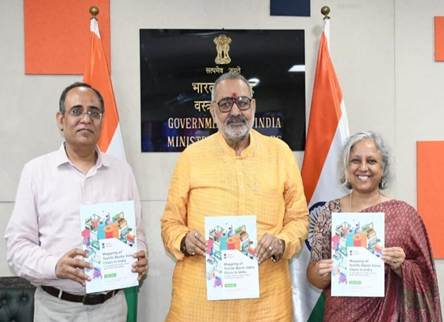
Information placed in the Rajya Sabha on March 13 by Giriraj Singh, Minister for Textiles, highlighted that the Indian textile industry remains one of the largest in the world with a strong raw material base and manufacturing capacity spanning the entire value chain from fibre to fabric to garments.
The sector benefits from the availability of natural fibres including cotton, silk, wool and jute as well as man made fibres, while domestic demand has also expanded significantly over the years.
To strengthen the industry’s competitiveness and boost exports, the government is implementing several major schemes and initiatives.
Among them, the PM Mega Integrated Textile Regions and Apparel Parks Scheme aims to create modern integrated textile infrastructure with world class facilities. The Production Linked Incentive Scheme focuses on man made fibre fabric, man made fibre apparel and technical textiles to encourage large scale manufacturing and improve global competitiveness.
The National Technical Textiles Mission supports research, innovation and market development in technical textiles. The SAMARTH Scheme for Capacity Building in Textile Sector focuses on demand driven and placement oriented skill development programmes for the workforce.
Other initiatives include Silk Samagra 2 for comprehensive development of the sericulture value chain, the National Handloom Development Programme to support the handloom sector and the National Handicrafts Development Programme along with the Comprehensive Handicrafts Cluster Development Scheme to promote handicraft industries.
Export competitiveness is also supported through fiscal incentives. The Rebate of State and Central Taxes and Levies scheme for apparel, garments and made ups aims to enhance competitiveness by implementing the principle of zero rated exports. Textile products not covered under this scheme are supported through the Remissions of Duties and Taxes on Exported Products scheme.
In addition, the government has launched an Export Promotion Mission with an outlay of 25,060 crore rupees for the period from 2025 to 2026 to 2030 to 2031. The mission aims to strengthen India’s export ecosystem through financial and non financial support.
The mission operates through two key components.
Niryat Protsahan focuses on improving access to affordable trade finance for micro, small and medium enterprises. Measures include interest subvention, export factoring, collateral guarantees, credit cards for e commerce exporters and credit enhancement support to help exporters expand into new markets.
Niryat Disha focuses on improving export readiness and competitiveness through non financial support such as assistance for quality compliance, international branding, packaging, participation in trade fairs, export warehousing and logistics, trade intelligence and capacity building initiatives.
Separately, the government informed Parliament that the Silk Samagra 2 scheme is being implemented to enhance silk production, productivity and quality across the country.
The total financial outlay under the scheme from 2021 to 2022 to January 2026 is 4,424.90 crore rupees, out of which 4,390.68 crore rupees has been released. Out of the total funds released, 1,374.44 crore rupees has been allocated to states based on proposals received for implementation of beneficiary oriented components.
The Central Silk Board under the Ministry of Textiles maintains consolidated data on beneficiaries supported under the scheme. From 2021 to 2022 to February 2026, a total of 1,12,385 beneficiaries have been supported, including sericulture farmers and reeling units.
Category wise beneficiaries supported under Silk Samagra 2
Category Number of Beneficiaries
General 81,554
Scheduled Caste 13,505
Scheduled Tribes 17,326
Total 1,12,385
Among the beneficiaries, 65,566 are sericulture farmers while 6,141 are reeling and re reeling units including automatic reeling machines, multi end reeling units and other small and vanya reeling units.
State and Union Territory wise funds allocated under Silk Samagra 2
(2021 to 2022 to 2025 to 2026 up to January 2026)
S No State or Union Territory Funds Allocated or Released ₹ crore
1 Karnataka 307.64
2 Andhra Pradesh 87.59
3 Telangana 40.92
4 Tamil Nadu 190.69
5 Maharashtra 26.59
6 Kerala 2.44
7 Uttar Pradesh 89.05
8 Madhya Pradesh 2.93
9 Chhattisgarh 66.75
10 West Bengal 25.46
11 Bihar 51.82
12 Jharkhand 7.61
13 Odisha 4.43
14 Jammu and Kashmir 30.37
15 Himachal Pradesh 18.06
16 Uttarakhand 29.51
17 Haryana 4.16
18 Punjab 13.95
19 Assam 89.35
20 Arunachal Pradesh 67.32
21 Manipur 32.49
22 Meghalaya 24.67
23 Mizoram 59.74
24 Nagaland 74.54
25 Sikkim 10.36
26 Tripura 16.00
Total 1,374.44
The government said the combined impact of export promotion policies, manufacturing incentives and targeted sectoral schemes is aimed at strengthening India’s textile ecosystem, expanding global market share and improving income opportunities for farmers, artisans and workers across the textile value chain.