
The Union Budget 2026–27 has announced a comprehensive and forward-looking strategy to revitalise and expand India’s labour-intensive textile sector, recognising its central role in employment generation, export growth, rural livelihoods and sustainable industrial development. The Budget outlines an integrated policy framework designed to strengthen the entire textile value chain, spanning fibres, manufacturing, skills, infrastructure, sustainability and global market access.
At the core of the announcement is an Integrated Programme for the Textile Sector, aimed at enhancing competitiveness, promoting self-reliance and generating large-scale employment across traditional and modern segments of the industry. The programme brings together multiple targeted interventions to address long-standing structural challenges while unlocking new growth opportunities.
A key pillar of the integrated approach is the National Fibre Scheme, which seeks to achieve self-reliance across the full spectrum of textile fibres. The scheme will support natural fibres such as silk, wool and jute, alongside man-made and new-age fibres. By strengthening domestic fibre availability and encouraging innovation in advanced textile materials, the initiative aims to reduce import dependence and improve supply chain resilience.
The Textile Expansion and Employment Scheme will focus on modernising traditional textile clusters through capital support for machinery, technology upgradation and the creation of common testing and certification centres. This intervention is expected to raise productivity, improve quality compliance with international standards and generate sustained employment, particularly in small towns and semi-urban regions where textile clusters are concentrated.
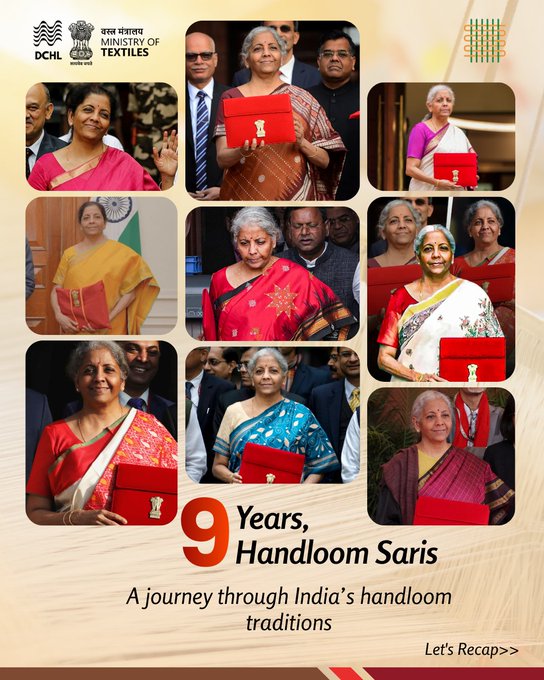
To provide focused support to artisans and weavers, existing handloom and handicraft schemes will be consolidated under a unified National Handloom and Handicraft Programme. This integration is intended to ensure more targeted assistance, improve income security for artisans and preserve India’s rich textile heritage while aligning it with contemporary market requirements.
The Tex Eco Initiative has been proposed to promote environmentally sustainable and globally competitive textile and apparel manufacturing. By aligning production practices with international sustainability norms, the initiative aims to position Indian textiles favourably in green and responsible supply chains, which are increasingly shaping global consumer and buyer preferences.
Skill development will receive a renewed push through Samarth 2.0, the upgraded textile skilling programme. The initiative will modernise the skills ecosystem by deepening collaboration with industry and academic institutions, ensuring the availability of industry-ready manpower across the textile value chain, from fibre processing and manufacturing to design and technical textiles.
In addition to programme-based interventions, the Budget has announced the establishment of Mega Textile Parks through a challenge-based approach. These parks will offer integrated infrastructure, promote scale efficiencies and facilitate higher value addition. A specific focus will be placed on technical textiles, a high-growth segment with applications in industry, healthcare, defence and infrastructure, thereby expanding the sector’s technological and export potential.
The Mahatma Gandhi Gram Swaraj Initiative will be launched to strengthen khadi, handloom and handicrafts. The initiative will focus on global market linkages, branding, streamlined training, skilling, quality enhancement and process modernisation. It is expected to benefit weavers, village industries and rural youth, while also supporting the One District One Product initiative.
To boost exports in textiles and allied sectors, including leather and marine products, the Budget has extended the export obligation period from six months to twelve months for exporters using duty-free imported inputs. This measure is aimed at providing greater operational flexibility, easing compliance requirements and improving working capital management for exporters.
Recognising liquidity constraints faced by textile MSMEs, the Budget has announced measures to strengthen the Trade Receivables Discounting System. These include mandatory use of the platform by central public sector enterprises for MSME procurement, credit guarantee support for invoice discounting, linkage of the Government e Marketplace with the system to enable faster financing, and the introduction of receivables as asset-backed securities to deepen secondary markets. The system has already facilitated transactions exceeding seven lakh crore rupees.
Further reinforcing support for enterprise growth, a dedicated ten thousand crore rupee SME Growth Fund has been introduced to create future Champion SMEs, incentivising high-performing enterprises based on defined criteria.
Taken together, the measures outlined in the Union Budget 2026–27 signal a clear strategic intent to position India as a global hub for textile manufacturing and exports. By combining infrastructure creation, technology upgradation, sustainability, skilling, export facilitation and targeted MSME support, the Budget seeks to ensure inclusive growth, large-scale job creation and long-term competitiveness of the textile sector. Implementation will be undertaken in close coordination with State governments, industry stakeholders, MSMEs, artisans and skilling institutions to translate the announced initiatives into tangible outcomes on the ground.