
The Union Budget 2026–27 has placed Micro Small and Medium Enterprises at the core of India’s growth strategy, unveiling a comprehensive three pronged framework aimed at building globally competitive champion enterprises through enhanced equity support, improved liquidity and structured professional assistance.
Recognised as engines of growth and socio economic transformation, MSMEs account for approximately 35.4 percent of India’s manufacturing output, 48.58 percent of exports and 31.1 percent of Gross Domestic Product. With more than 7.47 crore enterprises employing over 32.82 crore persons, the sector remains the second largest employer after agriculture and a critical driver of employment generation in rural and backward regions.
The Budget outlines three overarching Kartavyas: accelerating and sustaining economic growth, fulfilling the aspirations of citizens and building capacities to ensure equitable access to resources and opportunities across families, communities and regions. Under the first Kartavya, the Government has articulated a targeted strategy to help MSMEs scale up and integrate into global value chains.
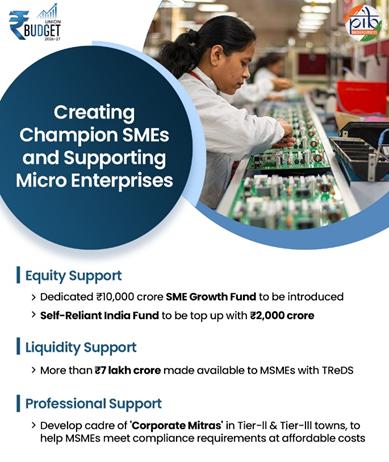
Equity Support To Create Future Champions
To catalyse growth capital, the Budget has announced a dedicated ₹10,000 crore SME Growth Fund aimed at incentivising eligible enterprises to expand operations and upgrade capabilities. In addition, the Self Reliant India Fund established in 2021 will receive an infusion of ₹2,000 crore to sustain risk capital support for micro and small enterprises.
As of November 30, 2025, the SRI Fund has assisted 682 MSMEs with investments worth ₹15,442 crore, signalling increasing institutional backing for growth oriented enterprises. The enhanced equity framework is designed to nurture innovation driven firms capable of competing in domestic and international markets.
Liquidity Measures To Deepen Credit Access
Liquidity support has been strengthened through the Trade Receivables Discounting System platform, which has already unlocked more than ₹7 lakh crore for MSMEs. To further deepen its impact, four major measures have been introduced.
First, TReDS will be mandated as the settlement platform for all purchases from MSMEs by Central Public Sector Enterprises, establishing a benchmark for private corporates. Second, credit guarantee backing under the Credit Guarantee Trust for Micro and Small Enterprises will be extended to invoice discounting on TReDS. Third, the Government e Marketplace will be integrated with TReDS to facilitate seamless information sharing with financiers, enabling faster and lower cost credit. Fourth, TReDS receivables will be introduced as asset backed securities to develop a secondary market, improve liquidity and expedite settlements.
TReDS is an electronic platform that facilitates financing and discounting of trade receivables of MSMEs through multiple financiers. Receivables may arise from corporates, government departments and public sector undertakings.
Professional Support Through Corporate Mitras
The third pillar focuses on professional capacity building. Professional institutions including ICAI, ICSI and ICMAI will design short term modular courses and practical tools to create a cadre of accredited para professionals known as Corporate Mitras. These professionals, particularly in Tier II and Tier III towns, will assist MSMEs in meeting compliance requirements at affordable costs, thereby strengthening governance standards and operational efficiency.
Tax Reform To Boost Courier Exports
To unlock global markets for small businesses, artisans and startups, the Budget proposes complete removal of the existing ₹10 lakh per consignment value cap on courier exports. This measure is expected to reduce friction in cross border business to consumer trade and support e commerce driven exports. Technology based systems will also improve tracking and management of rejected or returned consignments, enhancing trade efficiency.
Digital Formalisation Gains Momentum
Digital formalisation has accelerated through the Udyam Registration Portal launched in 2020 and the Udyam Assist Platform introduced in January 2023 to bring Informal Micro Enterprises into the formal ecosystem and enable access to Priority Sector Lending benefits. Between July 1, 2020 and December 2025, over 7.30 crore enterprises have registered across both platforms, including 4.37 crore registrations on the Udyam Portal and 2.92 crore on the Udyam Assist Platform.
Entrepreneurship And Employment Generation
The Prime Minister Employment Generation Programme continues to expand. Since its inception in financial year 2008–09 through December 2025, more than 10.71 lakh micro enterprises have been assisted with margin money subsidy disbursements of ₹29,249.43 crore, generating estimated employment for over 87 lakh persons. The scheme now covers higher project costs and a broader range of activities.
The MSME Champions Scheme remains central to improving competitiveness. Through its three components MSME Sustainable Zero Defect Zero Effect, MSME Competitive Lean and MSME Innovative covering incubation design and intellectual property rights, the scheme promotes quality standards, productivity improvements and institutionalised innovation.
A total of 2,71,373 MSMEs have registered under the ZED Certification Scheme, with 1,92,689 enterprises certified. Under the Lean Scheme, 32,077 MSMEs registered and 31,987 enterprises took the Lean pledge, committing to productivity enhancing practices.
Strengthening Digital Commerce And Dispute Resolution
The expansion of the Open Network for Digital Commerce and the Trade Enablement and Marketing Initiative targeting onboarding of five lakh MSMEs are facilitating integration into formal e commerce and supply chains at reduced transaction costs.
The Online Dispute Resolution portal launched on June 27, 2025 on MSME Day establishes a structured pre adjudication mechanism for resolving delayed payment disputes under the MSMED Act 2006. The framework promotes dialogue based settlements between buyers and sellers, enabling efficient recovery of dues while preserving business relationships.
Credit Guarantee And Inclusive Provisions
The Credit Guarantee Scheme for Micro and Small Enterprises marked 25 years in 2025, crossing one crore guarantees since August 2000. Between January 1 and November 30, 2025, 29.03 lakh guarantees worth ₹3.77 lakh crore were approved. The ceiling of guarantee coverage has been enhanced to ₹10 crore from ₹5 crore. A special provision introduced from March 1, 2025 offers transgender entrepreneurs a 10 percent concession in guarantee fees and enhanced coverage of 85 percent.
PM Vishwakarma Expands Artisan Support
Launched in September 2023, the PM Vishwakarma Scheme provides end to end support to artisans and craftspeople across 18 trades. As of December 1, 2025, 30 lakh beneficiaries have registered and 23.09 lakh have completed training. In 2025 alone, ₹2,257 crore was sanctioned to 2.62 lakh beneficiaries through collateral free loans, and 6.7 lakh beneficiaries were digitally enabled. More than 30,000 beneficiaries have been onboarded on the Government e Marketplace to expand institutional sales channels.
Labour Reforms To Ease Compliance
The Labour Codes aim to modernise India’s labour ecosystem through digitisation, formalisation and simplified compliance. By rationalising thresholds, reducing inspections and ensuring predictable timelines, the reforms are designed to reduce compliance burdens on MSMEs while strengthening worker welfare and social security.
With sustained fiscal support, structural reforms and digital integration, the Union Budget 2026–27 positions MSMEs as the fulcrum of India’s next phase of industrial growth. The sector’s scale, resilience and diversity are expected to play a decisive role in advancing manufacturing momentum, expanding exports and deepening India’s integration into global value chains.