
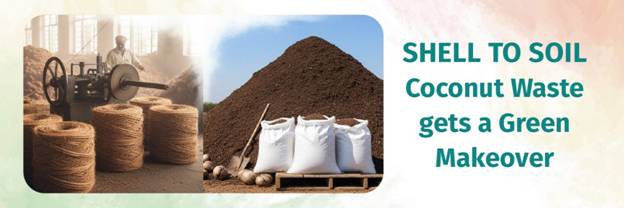
Across India’s coastal and temple cities, coconut waste once posed a persistent civic and environmental challenge. Under the Swachh Bharat Mission Urban 2.0, that challenge is being converted into an opportunity as urban local bodies systematically transform discarded coconut shells and husks into valuable products, sustainable livelihoods and circular economy gains.
Driven by rising urbanisation and tourism, coconut consumption has surged, particularly in coastal belts and pilgrimage centres. What earlier resulted in heaps of waste choking drains and landfills is now being addressed through organised segregation, scientific processing and market-driven recycling. Coconut waste, which accounts for about three to five percent of urban wet waste nationally and up to eight percent in coastal cities, is increasingly being diverted from landfills and reborn as coir fibre, cocopeat and organic compost.
India’s leadership in coconut production has provided a strong foundation for this transition. With national production crossing 21,000 million units annually and southern states contributing nearly ninety percent of output, the waste to wealth value chain is gaining economic and environmental significance. The global coir and cocopeat market, estimated at over one billion dollars, has positioned India as a dominant exporter, supported by rising demand from Europe, the United States and East Asia.
Urban local bodies, with policy and financial support from the Ministry of Housing and Urban Affairs, have set up material recovery facilities and dedicated coconut waste processing units. Central financial assistance ranging from twenty five to fifty percent under Swachh Bharat Mission Urban 2.0, along with subsidies under the Coir Udyami Yojana and support from the GOBARdhan scheme, has accelerated the adoption of decentralised processing models.
Several cities have emerged as benchmarks. Mysuru and Madurai have achieved complete recycling of coconut waste. In Bengaluru, Mangaluru, Chennai, Coimbatore, Kochi and Thiruvananthapuram, daily volumes running into hundreds of tonnes are being converted into ropes, mats, cocopeat blocks and manure. Religious centres such as Puri, Varanasi and Tirupati have established specialised facilities to process temple generated coconut waste, ensuring cleaner premises and sustainable reuse of offerings.
Innovative city level models underline the scale of impact. In Bhubaneswar, temple coconut waste collected from vendors is processed into coir fibre and compost, generating steady income for self help group members and sanitation workers while producing marketable products. In Kerala’s Kunnamkulam, farmers now earn directly by supplying husks to a green de fibering unit that produces odour free compost and fibre, supported by microbe enriched aerobic composting. Greater Chennai has operationalised long term public private partnership units that have already processed over one lakh metric tonnes of coconut waste into coir and compost, supplying multiple industrial and agricultural buyers.
Indore has integrated coconut waste processing with its bio CNG infrastructure, converting husks into cocopeat and fibre while supporting daily revenue generation and skilled employment. Patna’s zero cost model in Danapur diverts coconut waste from landfills and produces coir products and organic compost for urban and peri urban agriculture.
Beyond waste management, the initiative has a strong social dimension. Around seven and a half lakh people, a majority of them women, are engaged in the coir sector nationwide, supported by more than fifteen thousand processing units. By preventing long term decomposition and open burning of coconut waste, cities are also cutting methane emissions and improving local air quality.
From sacred offerings to soil enhancers, India’s urban coconut waste transformation reflects a broader shift in governance where sustainability, livelihoods and innovation converge. As cities continue to scale up decentralised processing and market linkages, coconut waste is no longer seen as refuse but as a renewable resource powering cleaner cities and greener growth.