
The role of women in the Indian Armed Forces continues to expand significantly, with increasing representation in operational, leadership and strategic roles across the Army, Navy and Air Force. Marking International Women’s Day on 8 March 2026, the evolving participation of women in the defence services highlights a major transformation in India’s military institutions and reflects the country’s growing commitment to gender inclusion and equal opportunity in national security.
Over the past decade, the number of women officers in the Indian Armed Forces has risen sharply from around 3,000 in 2014 to more than 11,000 today. This increase has been supported by policy reforms, expanded training opportunities and greater institutional integration of women across operational, technical and leadership positions.
Women officers are now undertaking commanding responsibilities, operational deployments and senior leadership roles that were historically limited or unavailable. Their participation is now visible in a wide spectrum of military activities ranging from combat aviation and warship deployment to peacekeeping missions and strategic planning.
The journey of women in India’s defence services reflects a steady historical progression. Initially, women were inducted primarily into medical and nursing services. A significant milestone occurred in 1958 when women doctors were granted Regular Commissions in the Army Medical Corps under the same terms as men. This marked the first major institutional recognition of women’s long term roles in the military.
A transformative shift occurred in 1992 when officer level entry for women was formally opened in the Indian Armed Forces. The Indian Army introduced the Women Special Entry Scheme allowing women to be commissioned in several non combat branches. The policy also allowed widows of soldiers who had been killed in action to join the Army as officers as a compassionate measure.
The same year witnessed parallel developments in the other services. The Indian Navy inducted women officers for the first time while the Indian Air Force began commissioning women as Short Service Commission officers in flying, technical and non technical branches. These reforms laid the foundation for a gradual but steady expansion of opportunities for women in the armed forces.
In recent years, further reforms have significantly expanded career pathways for women officers. Women are now eligible for promotion to senior ranks including Colonel in select grade and are being considered for command appointments across multiple arms and services. Policy changes have also introduced waivers and transitional measures to ensure that earlier limitations in career progression do not adversely affect promotion opportunities for women officers.
In the Indian Army, women officers are now being granted Permanent Commission in 12 arms and services, in addition to the Army Medical Corps, Army Dental Corps and the Military Nursing Service. Permanent Commission provides long term career stability and enables women officers to hold senior leadership roles within the force.
The Indian Navy has also expanded operational integration of women officers. Women are now deployed on board warships in afloat appointments and are serving as pilots and Naval Air Operations officers. The Navy has opened all officer branches and specialisations to women except submarines and has also integrated women into recruitment under the Agnipath scheme as Agniveers.
Women officers in the Navy are also serving in advanced aviation roles. They are eligible to join the Remotely Piloted Aircraft stream, with the first officer joining an RPA squadron in 2021. In addition, women cadets have been made eligible for induction through the 10 plus 2 B Tech entry scheme at the Indian Naval Academy beginning in January 2024.
The Indian Air Force has played a pioneering role in expanding opportunities for women in aviation and combat operations. Women were first inducted as pilots in the 1990s in combat support roles. A major milestone occurred in 2015 when women were inducted into fighter pilot streams on an experimental basis. In 2022 the policy was made permanent, formally opening fighter and other combat streams to women on equal terms.
The Air Force has also expanded recruitment pathways for women through the National Cadet Corps Special Entry scheme and through the National Defence Academy. Since December 2023 women have also joined the Air Force under the Agniveer Vayu programme, reflecting the service’s commitment to inclusive recruitment.
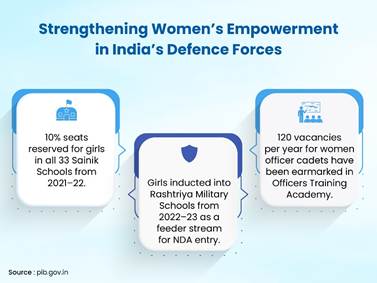
The National Defence Academy has become a key institution in shaping the future leadership of women officers in the armed forces. Since women were first inducted into the academy in 2022, participation has steadily increased. In 2025, 17 women cadets graduated from the academy in May and 15 more graduated in November.
As of early 2026, a total of 158 women cadets have joined the National Defence Academy. Haryana has recorded the highest number of women cadets at the academy with 35 cadets, followed by Uttar Pradesh with 28 and Rajasthan with 13. The Indian Army has also increased the annual intake of women cadets from 80 to 144 vacancies in 2024, representing an increase of 80 percent.
Women officers have also demonstrated leadership and operational excellence through major military achievements and deployments. A notable example was the tri services all women sailing expedition in 2025, where eleven officers from the Army, Navy and Air Force completed a 1,800 nautical mile voyage to Seychelles aboard the indigenous vessel Triveni. The expedition highlighted joint service cooperation and showcased the operational competence of women officers.
Women have also taken on historic leadership roles within the armed forces. Sadhna Saxena Nair became Director General Medical Services Army, becoming the first woman to hold the top position in the Army’s medical wing.
Colonel Ponung Doming became the first woman officer to command the world’s highest Border Task Force located above 15,000 feet in the northern sector, marking another milestone in operational leadership.
In the Indian Air Force, Bhawana Kanth became the first woman fighter pilot qualified to undertake day time combat missions and was also the first woman fighter pilot to participate in the Republic Day Parade. She later participated in the Republic Day flypast in 2024 as part of the elite fighter pilot formation.
Women officers have also broken barriers in aviation across services. Hansja Sharma became the first woman pilot to fly the Rudra armed helicopter in the Indian Army. Aastha Poonia became the first woman pilot to be streamed into the fighter stream of Naval Aviation and received the Wings of Gold during the Basic Hawk Conversion Course at INS Dega.
Avani Chaturvedi became the first Indian woman fighter pilot to participate in an international aerial wargame, flying the Su 30 MKI as part of an Indian Air Force contingent in a major air combat exercise with the Japan Air Self Defense Force.
Shivangi Singh achieved another historic milestone by becoming India’s first woman Rafale fighter pilot, representing the next generation of combat aviation leadership in the Indian Air Force.
Women officers have also represented India in international military diplomacy. Anjali Singh became the first Indian woman military diplomat posted overseas as Deputy Air Attaché at the Embassy of India in Russia.
In the Indian Navy, Dilna K and Roopa A completed a remarkable 25,600 nautical mile circumnavigation of the globe aboard the vessel Tarini during the Navika Sagar Parikrama II expedition. The 238 day voyage demonstrated extraordinary endurance and maritime leadership.
Women officers have also earned international recognition for their contributions to peacekeeping and humanitarian missions. Swathi Shanthakumar received the United Nations Secretary General Gender Award in 2025 for her work promoting gender responsive peacekeeping under the Equal Partners Lasting Peace initiative during her deployment in the United Nations Mission in South Sudan.
Radhika Sen was also honoured by the United Nations as Military Gender Advocate of the Year for her contributions to gender inclusive peacekeeping operations.
India’s participation in United Nations peacekeeping missions has increasingly included women personnel. As of mid 2025 more than 154 Indian women were serving in six United Nations peacekeeping operations. India has achieved approximately 22 percent representation of women in the staff officer and observer category, aligning with the United Nations Gender Parity Strategy.
Institutional recognition of women’s growing role is also reflected in domestic honours. At the Army Day Awards in January 2025 the NCC Girls Contingent received an Army award for the first time for their participation in the Army Day Parade.
The expanding participation of women in the Indian Armed Forces reflects a broader transformation in India’s defence institutions. Through policy reforms, expanded training opportunities and progressive recruitment policies, women are increasingly taking on operational, command and leadership roles.
With increasing intake through the National Defence Academy, expanded permanent commissions and new recruitment schemes, the future trajectory suggests even greater participation of women in India’s military services.
As the armed forces continue to evolve, women officers are expected to play an increasingly prominent role in shaping India’s defence leadership, strengthening operational capabilities and contributing to national security.