
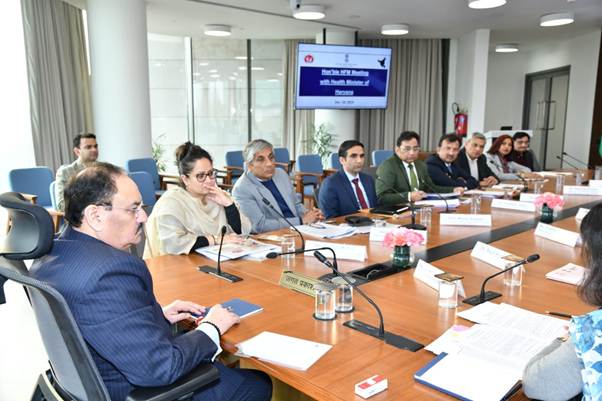
The Union Health Minister convened a high-level review meeting with the Health Minister of Haryana and senior state and central officials to assess the progress of healthcare reforms and intensify efforts towards eliminating tuberculosis as a public health challenge. The meeting focused on strengthening public health systems, improving patient-centric care, enforcing strict drug regulation, expanding diagnostic services, and accelerating the mission to achieve a TB-free India through coordinated Centre–State action.
During the review, the Union Health Minister emphasised that continuous and rigorous monitoring across the pharmaceutical supply chain is essential to ensure the quality, safety, and efficacy of medicines. He stressed that drug regulation must be pursued in mission mode, with institutionalised best practices, stronger compliance mechanisms, and accountability at every level. Enhancing patient satisfaction and regulatory oversight, he said, should be treated as a sustained priority rather than a one-time intervention.
The Minister highlighted the importance of robust supply-chain management under the Free Drugs and Free Diagnostics schemes, noting that uninterrupted availability of essential medicines and diagnostic services is fundamental to equitable healthcare delivery. He underlined the need for professional hospital administration and stronger oversight of blood banks, laboratories, and safety standards. State officials were advised to establish reliable systems to ensure the continuous supply of laboratory reagents and consumables so that diagnostic services at public health facilities remain uninterrupted.
A key announcement during the meeting was the directive to set up AMRIT retail pharmacy stores in every district hospital in Haryana. These pharmacies will offer branded medicines at discounts of up to 50 percent, significantly reducing out-of-pocket expenditure for patients and improving access to affordable treatment.
The Union Health Minister also stressed the role of technology-driven healthcare solutions, particularly telemedicine, in bridging gaps in access to quality healthcare in remote and underserved areas. He appreciated Haryana’s effective adoption of telemedicine services and encouraged further expansion to ensure timely consultations and specialist care for all sections of the population.
On tuberculosis elimination, the Minister reaffirmed the government’s commitment to achieving TB Mukt Bharat through targeted, district-level interventions. He highlighted the deployment of AI-enabled handheld X-ray machines to strengthen community-level screening and the availability of NAAT machines at block levels for early detection, including drug-resistant TB. Emphasis was laid on treatment adherence, nutritional support, and close monitoring at district and block levels to ensure measurable outcomes.
The importance of community participation was underscored through the Ni-kshay Mitra initiative, with over 350 MY Bharat volunteers from Haryana already engaged in supporting TB patients. The Minister stressed the need to strengthen linkages between volunteers and patients to provide sustained psychosocial support and raise community awareness, reinforcing that TB elimination must be pursued as a people’s movement.
To enhance governance and accountability, the Union Health Minister called for sensitisation workshops for legislators to promote regular engagement with district administrations, Zilla Parishads, and Chief Medical Officers. He emphasised that Jan Bhagidari, or people’s participation, is critical to improving healthcare outcomes, strengthening review mechanisms, and building public trust in health programmes.
The Haryana Health Minister assured full cooperation with the Union Ministry, reiterating the state’s commitment to closely work with central authorities to strengthen implementation and deliver improved health outcomes. The meeting concluded with a shared resolve to advance healthcare reforms, professionalise hospital administration, expand medical education capacity, and accelerate progress towards TB elimination, reflecting the spirit of cooperative federalism in public health.