
The Ministry of Jal Shakti conducted a comprehensive review of groundwater management initiatives across 124 over exploited and critical districts identified in the 2024 national groundwater assessment, with a renewed focus on strengthening long term water security in the country’s most water stressed regions.
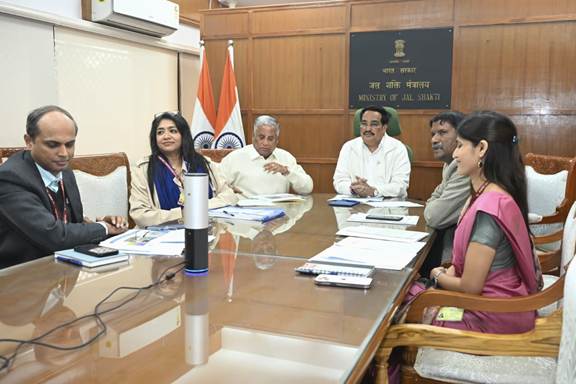
The review meeting was chaired by the Union Minister for Jal Shakti and brought together District Collectors and District Development Officers from the identified districts, along with Ministers of State, senior officials from the Ministry of Jal Shakti, the Ministry of Rural Development, and technical agencies involved in groundwater management. The interaction aimed at assessing on ground progress and removing implementation bottlenecks under Jal Sanchay Jan Bhagidari 2.0, the national programme designed to address groundwater depletion through large scale public participation.
During the review, emphasis was placed on the mission target of creating one crore artificial groundwater recharge and storage structures by May 31 2026. District administrations were directed to fast track water conservation works, particularly in over exploited and critical blocks, to enhance source sustainability and ensure resilience against recurring water stress.
The Minister highlighted that 65 percent of MGNREGA funds in over exploited and critical blocks have been earmarked specifically for water related works. To further strengthen recharge efforts, 15 additional water conservation and groundwater recharge activities have been permitted under MGNREGA exclusively for over exploited, critical and semi critical districts. These include construction of recharge shafts, injection wells, filtration ponds, artificial wetlands, renovation of traditional water bodies and spring collection chambers, significantly expanding the toolkit available to district administrations.
Districts were advised to adopt scientific planning approaches by using BISAG based feasibility maps, leveraging technical guidance from the Central Ground Water Board and ensuring convergence of multiple schemes for faster execution. The importance of outcome based monitoring, timely reporting and measurable impact on groundwater levels was stressed during the interaction.
Best practices from top performing districts under Jal Sanchay Jan Bhagidari 2.0 were also shared during the review. Banaskantha in Gujarat, Salem in Tamil Nadu and Barmer in Rajasthan presented their experiences, highlighting the role of community participation, scientific site selection and rapid execution in achieving tangible results on the ground.
The Ministry reiterated that Jal Sanchay Jan Bhagidari 2.0 represents a whole of government and whole of society approach to water conservation. By combining public participation, scientific planning and focused funding support, the initiative seeks to reverse groundwater depletion trends and build sustainable water security across India’s most vulnerable districts.