
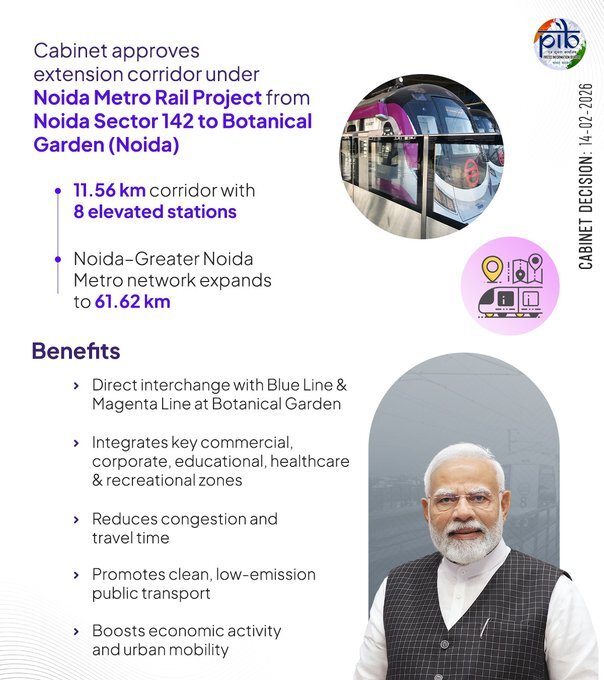
The Union Cabinet chaired by the Prime Minister Shri Narendra Modi has approved the extension corridor of the Noida Metro Rail Project from Noida Sector 142 to Botanical Garden for a length of 11.56 kilometres with eight elevated stations.
With the operationalisation of this corridor, the total active Metro Rail network in Noida and Greater Noida will expand to 61.62 kilometres, marking a significant milestone in the region’s urban transport infrastructure.
The approved extension represents a major expansion of the existing metro network and is expected to strengthen intra-city connectivity while integrating high-demand corridors. The corridor will provide direct interchange connectivity at Botanical Garden with the Blue Line and the Magenta Line, enhancing seamless travel options for commuters.
The new stretch will connect several key commercial, institutional and residential zones of Noida. Among the major commercial hubs to benefit are Advant Business Park at Sector 142, Skymark One Mall at Sector 98 and Mall of Noida at Sector 93. Prominent multinational corporations and IT hubs located along the alignment include Microsoft at Sector 145, TCS at Sector 157, Havells at Sector 126, Infosys and Adobe at Sector 132, Cognizant at Sector 135 and Oracle at Sector 127.
Educational institutions such as Amity University at Sector 125, Panchsheel Balak Inter College at Sector 91 and Mahamaya Balika Inter College at Sector 44 will gain improved metro access. The corridor will also serve critical healthcare infrastructure, notably Max Super Specialty Hospital at Sector 128, along with major public spaces and attractions including Botanical Garden and Sector 93 Park.
By bridging these vital nodes, the extension is expected to ease urban mobility for residents, students, employees and business commuters, while supporting employment, education and general transit needs.
The expansion is projected to reduce traffic congestion by offering an efficient alternative to road transport. A shift from private vehicles to metro travel is expected to lead to smoother vehicular movement, shorter travel times and improved road safety across Noida and Greater Noida.
Environmental benefits are also anticipated. The addition of 11.56 kilometres of metro rail infrastructure is expected to reduce carbon emissions by decreasing reliance on fossil fuel-based transport systems.
The project is also seen as a catalyst for economic growth. Improved access to various parts of the city and connectivity to major transportation hubs such as Delhi’s airport, railway stations and bus depots is likely to enhance productivity and stimulate local business activity. Areas surrounding new metro stations are expected to witness increased investment and development.
From a social perspective, the extension will improve equitable access to public transport across socio-economic groups, reducing transport disparities and contributing to a higher quality of life through reduced commute times and improved access to essential services.
The Noida Metro extension from Sector 142 to Botanical Garden is positioned as a transformative urban infrastructure initiative aimed at strengthening connectivity, promoting sustainable transport and supporting long-term regional development.