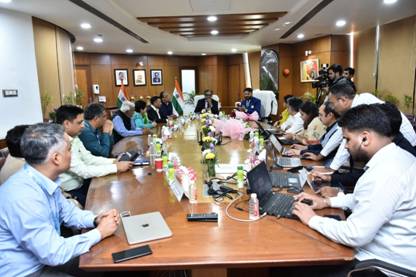

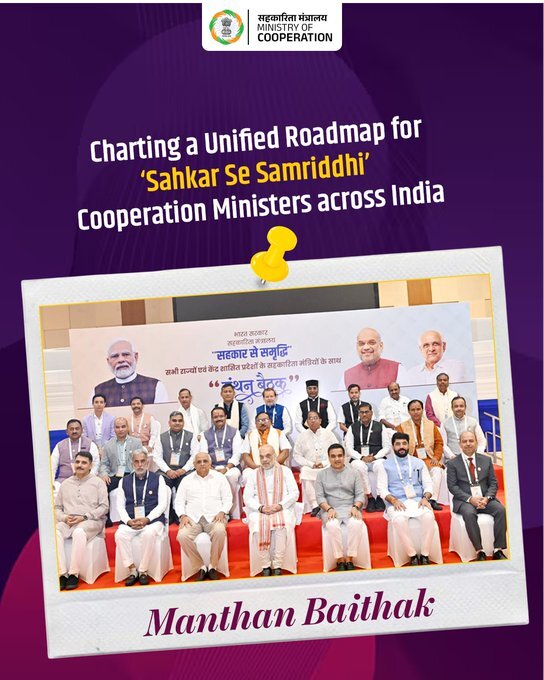
Union Home and Cooperation Minister Shri Amit Shah chaired a Manthan Meeting with the Cooperation Ministers of all States and Union Territories in Gandhinagar, Gujarat, under the theme Sahkar se Samriddhi. The meeting focused on strengthening the cooperative sector as a key pillar in achieving a fully developed India by 2047.
During the Manthan Meeting, Shri Amit Shah inaugurated and laid the foundation stone of projects worth ₹265 crore related to ethanol, energy, organic potash, warehouses and protein powder plants. He also visited an exhibition and released a report on best practices in cooperatives and the International Year of Cooperatives. Union Minister of State for Cooperation Shri Krishan Pal Gurjar, Shri Murlidhar Mohol, Secretary, Ministry of Cooperation, and several other dignitaries were present.
In his address, Shri Amit Shah said that under the leadership of Prime Minister Shri Narendra Modi, India is advancing in every sector and taking a pioneering role in areas that will shape the global economy over the next twenty-five years. He stated that the objective of the Manthan Meeting is to further enhance the role of cooperatives in building a fully developed India by 2047.
He emphasised that mere economic figures do not define a developed nation. A fully developed India, he said, is one in which 140 crore people can live with dignity. According to him, cooperatives can serve as the most effective medium to ensure that every family and individual in the country achieves economic security and social dignity.
Shri Amit Shah underlined that comprehensive national development is not possible without strengthening agriculture, rural development and animal husbandry. He said that over the past four years, the Modi Government has advanced the cooperative sector in a scientific manner, and positive results have begun to emerge.
On food grain storage, he said that in comparison to production, storage capacity in the country needs to be increased nearly threefold in the coming days, with twofold expansion to be undertaken by the cooperative sector. He stressed that responsibility should not rest solely on Primary Agricultural Credit Societies. Tehsil level cooperative dairies, state level marketing federations, district cooperative banks through financing, and district sales purchase unions should construct large warehouses.
He noted that about 70 percent of food grains are procured from North India, particularly Punjab and Haryana. Aligning procurement, storage and distribution regionally, he said, could reduce transportation costs by 30 to 40 percent. A universally accessible storage system across the country, he added, can be established only by the cooperative sector.
Shri Amit Shah called upon all States to make efforts to restart closed sugar mills. Referring to the formation of a national level cooperative, he said financially weak sugar mills can diversify into fertiliser and gas production, and that successful experiments have shown that up to eleven different products can be produced from sugar mills. He informed that an operational framework would be finalised in the first week of March and urged States to adopt flexible policies to facilitate diversification.
He advised every State to send teams from their Dairy and Cooperation Departments to visit Banas Dairy to study its initiatives and operational model.
Emphasising Cooperation Amongst Cooperatives, or Sahkarita mein Sahkar, he said all cooperative institutions should maintain their bank accounts with District Cooperative Banks. He stated that the Government of India has decided that Cooperative Banks can be made nodal agencies for all Government of India schemes. State Governments, he said, should ensure that funds under schemes such as PM Kisan and old age pensions are routed through these banks.
Shri Amit Shah further stated that in the coming days, cooperatives will also be formed for retail workers, carpenters, plumbers and electricians to ensure fair and dignified remuneration. He said that more than 40 percent of the country’s population will be associated with the cooperative sector in the future.
He also announced that Bharat Taxi services will, in a very short time, reach every Municipal Corporation city. More than 3 lakh drivers have already joined the initiative, which he said will benefit both drivers and passengers.
The meeting reviewed progress, achievements and future action plans related to cooperatives. Discussions covered the establishment of 2 lakh new multipurpose Primary Agricultural Credit Societies, dairy and fisheries cooperative societies to accelerate the rural economy, and the expansion of a nationwide network of modern warehouses under the world’s largest grain storage scheme to ensure better storage, price stability and improved market access for farmers.
States were urged to actively participate in newly formed national cooperative institutions including National Cooperative Exports Limited, National Cooperative Organics Limited and Bharatiya Beej Sahkari Samiti Limited to promote exports, organic farming and quality seed supply through cooperatives.
The meeting also discussed time appropriate reforms in State cooperative laws, adoption of the Model Act in line with the 97th Constitutional Amendment, improving the economic viability and profitability of cooperative sugar mills, promoting circularity and sustainability in the dairy sector, and formation of new dairy cooperative societies in collaboration with Amul and NDDB.
Detailed presentations were made on promoting pulses and maize production, addressing challenges faced by cooperative banks, strengthening Shared Service Entities and umbrella structures, expanding membership and awareness campaigns, and developing an effective media and communication strategy. Expectations from States were also outlined regarding computerisation of Primary Agricultural Credit Societies and Registrar of Cooperative Societies offices, utilisation of the National Cooperative Database, human resource development and training, and improved implementation of National Cooperative Development Corporation schemes.