

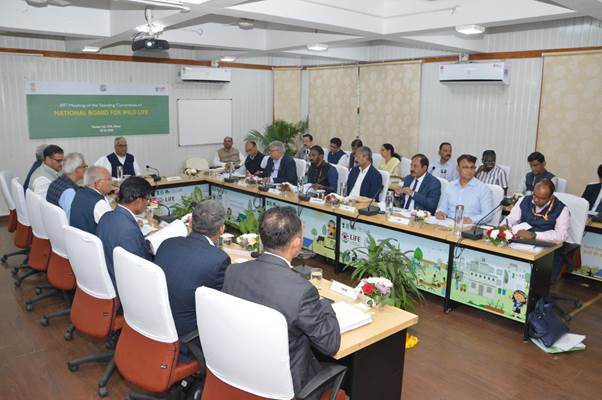
Bhupender Yadav chaired the 89th meeting of the Standing Committee of the National Board for Wildlife in Bhopal on February 28, 2026, with deliberations centred on key policy issues concerning wildlife conservation and scrutiny of development proposals in ecologically sensitive regions.
The meeting reviewed proposals related to wildlife conservation and development projects located in and around Protected Areas, Wildlife Sanctuaries, Tiger Reserves and Eco Sensitive Zones, in accordance with the provisions of the Wildlife Protection Act 1972. Each proposal was examined with due regard to ecological sensitivity, statutory compliance and prescribed mitigation measures.
A total of 58 fresh proposals from sectors including communication infrastructure, optical fibre cables, power transmission lines, road construction, drinking water supply, thermal power, defence, irrigation and other infrastructure projects were considered by the Committee.
In addition to project clearances, the Committee deliberated on several significant policy issues. These included the ecological importance of maintaining environmental flows in the Chambal River to safeguard aquatic fauna such as dolphins and gharials, the social, economic and ecological status of villages located inside Tiger Reserves, the role of grasslands in effective wildlife management, and strategies to address emerging challenges in the human leopard interface.
The meeting underscored the importance of involving scientific and technical institutions to strengthen evidence based policymaking and inter sectoral coordination. Institutions highlighted for their role in supporting conservation efforts included the Wildlife Institute of India, the Indian Council of Forestry Research and Education and the Central Water Commission.
The Standing Committee of the National Board for Wildlife is a statutory body constituted under the Wildlife Protection Act 1972. It is mandated to advise the government on matters relating to conservation and protection of wildlife and forests, while ensuring that development activities in and around Protected Areas are carried out in a sustainable and balanced manner.