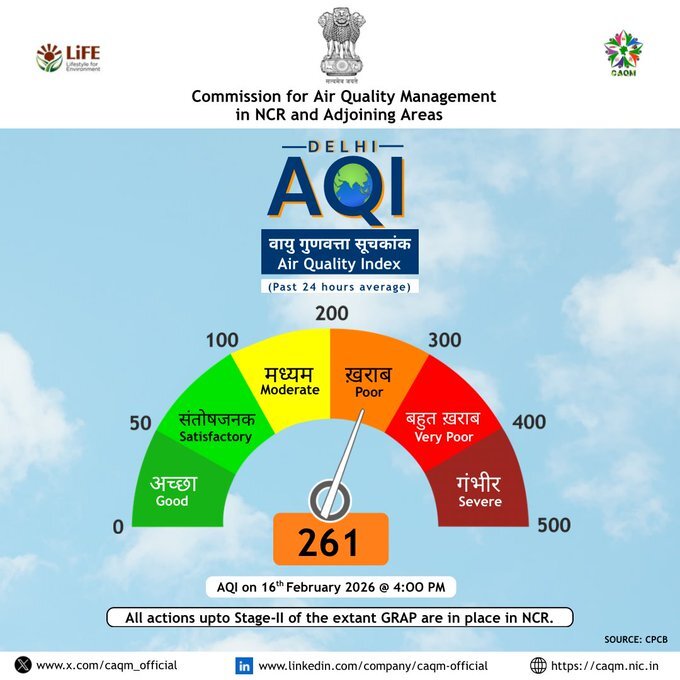


The Commission for Air Quality Management in NCR and Adjoining Areas reviewed a Supreme Court-mandated expert report at its 27th Full Commission meeting and identified PM2.5 as the dominant pollutant driving the Air Quality Index in Delhi. The Commission also approved the establishment of 46 new Continuous Ambient Air Quality Monitoring Stations across the National Capital Region and stricter particulate emission norms for industries.
The meeting considered a comprehensive meta-analysis of source apportionment studies conducted between 2015 and 2025, prepared by a panel of 33 domain experts pursuant to directions of the Supreme Court in W.P. C No. 1135 of 2020. The expert group comprised specialists from Indian Institutes of Technology, academic institutions, research organisations, non-governmental organisations and other reputed institutes.
The report concluded that PM2.5 remains the principal pollutant impacting Delhi’s AQI, with significant contributions from both local emission sources and transboundary movement of pollutants across the larger regional airshed.
According to the findings, winter months witness higher contributions from secondary particulates at 27 percent, formed through chemical transformation of gaseous emissions from transport, industries, power plants and biomass burning. Transport contributes 23 percent, biomass burning 20 percent, dust 15 percent and industry including thermal power plants 9 percent during winter.
In contrast, summer months see dust emerging as the dominant contributor at 27 percent, followed by transport at 19 percent, secondary particulates at 17 percent, industry at 14 percent and biomass burning at 12 percent. Public suggestions received on the expert report are currently under consideration.
To strengthen air quality monitoring, the Commission approved expansion of the Continuous Ambient Air Quality Monitoring System network using grid-based spatial coverage, urban contiguity, land use patterns, secondary particulate formation and population density as key criteria. A total of 46 additional stations will be established, including 14 in Delhi, 16 in Haryana, one in Rajasthan and 15 in Uttar Pradesh. With this augmentation, the total number of monitoring stations in Delhi NCR will rise to 157, enhancing regional pollutant tracking and baseline air quality assessment.
The Commission also approved directions to stipulate stricter particulate matter emission standards for industries across Delhi NCR. It emphasised improved management of construction and demolition waste and strengthened dust mitigation protocols as critical structural measures.
The CAQM took note of Direction No. 96 dated February 13, 2026, mandating coordinated and time-bound implementation of State Action Plans to prevent and eliminate wheat stubble burning during 2026. It also deliberated on a report submitted to the Supreme Court regarding congestion at Municipal Corporation of Delhi toll plazas and stressed the urgent need for implementing barrier-free Multi Lane Free Flow systems integrated with RFID and ANPR technologies to reduce vehicular congestion and associated emissions.
State-Level and City Annual Action Plans for 2026 prepared by NCR States, Municipal Corporations and Development Authorities were reviewed. These plans focus on sustained structural interventions in transport, industrial emissions, dust control, waste management and biomass burning. The Commission reiterated that progress under these plans would be subject to regular monitoring.
The status of Enforcement Task Force actions, including closure and resumption of industrial units, was reviewed. The Commission also took note of Graded Response Action Plan orders issued since the previous Full Commission meeting held on December 22, 2025.
During the meeting, the re-appointment of S D Attri as Full Time Technical Member of CAQM was acknowledged pursuant to orders issued by the Ministry of Environment Forest and Climate Change.
The Commission reiterated the need for strict vigilance, coordinated enforcement and effective implementation of statutory directions. Implementing agencies committed to continuous review and firm action across sectors to ensure sustained improvement in air quality across Delhi NCR.