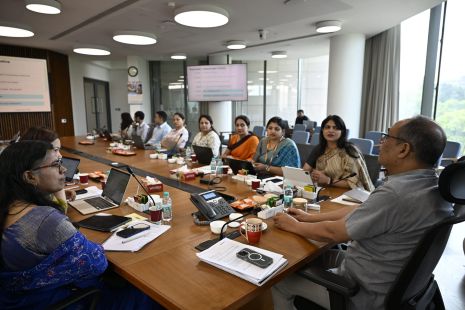

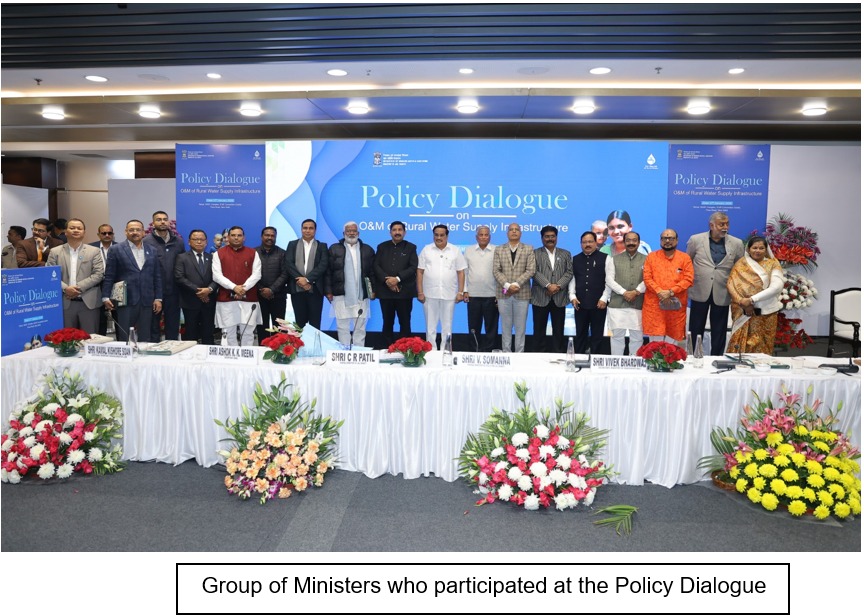
The Department of Drinking Water and Sanitation under the Ministry of Jal Shakti organised a Minister-level Policy Dialogue on Sustainable Operation and Maintenance of Rural Drinking Water Services under the Jal Jeevan Mission in New Delhi, bringing together Union and State Ministers, senior officials and sector experts to deliberate on ensuring the long-term sustainability of rural piped water supply systems across the country.
The dialogue marked a critical milestone in the restructured phase of the Jal Jeevan Mission, where the national focus is transitioning from infrastructure creation to reliable, citizen-centric drinking water service delivery. Deliberations underscored that sustained provision of safe and adequate drinking water requires strong institutional frameworks, predictable financing, empowered local governments and robust digital monitoring systems. The discussions reaffirmed that drinking water governance under the Mission aligns with India’s constitutional framework, placing Gram Panchayats and community institutions at the centre of long-term service delivery.
The Policy Dialogue saw wide-ranging participation, including Deputy Chief Ministers, Ministers of Public Health Engineering, Panchayati Raj and Rural Development, Additional Chief Secretaries, Principal Secretaries, Secretaries and Mission Directors from States and Union Territories. More than 150 participants from Public Health Engineering Departments, Panchayati Raj and Rural Development Departments took part, ensuring strong inter-departmental coordination and shared ownership of outcomes.
Addressing the gathering, Rajiv Ranjan Singh alias Lalan Singh, Minister of Panchayati Raj, emphasised that while the Jal Jeevan Mission has enabled access to safe drinking water across rural India, the emphasis must now shift decisively towards sustained operation and maintenance. He highlighted the need for a long-term O&M framework with Gram Panchayats at the core, and stressed that operational requirements of the Mission should be formally addressed during the 16th Finance Commission cycle. He underscored the importance of strengthening Village Water and Sanitation Committees, integrating drinking water services into Gram Panchayat Development Plans, and ensuring transparency through digital financial systems and Gram Sabha oversight. He noted that villages’ willingness to pay user charges reflects growing trust in reliable water services.
Union Minister for Jal Shakti C R Patil highlighted the importance of financial discipline and implementation rigour in the next phase of the Mission. He stated that fund releases to States would be linked to signed MoUs, unique Scheme IDs and demonstrated continuity of water supply. He directed States to rationalise oversized detailed project reports and clarified that only schemes sanctioned on or before 31 March 2024 would be considered. He also stressed that funds under the G-RAMG framework should be utilised for source strengthening, water conservation and recharge, and appreciated best practices such as Assam’s ITI-based skill training model and Tripura’s preparedness for Panchayat-led O&M.
Minister of State for Jal Shakti V Somanna underlined the need to evolve monitoring systems from a centrally driven approach to state-centred frameworks, with increased use of IoT-based tools for real-time performance tracking. He noted that growing local ownership of water supply schemes is a positive trend that strengthens accountability and long-term sustainability.
Setting the context, Ashok K K Meena, Secretary, Department of Drinking Water and Sanitation, stated that operation and maintenance is now central to water governance under the Jal Jeevan Mission. He identified key challenges faced by States, including limited technical capacity at the Gram Panchayat level, weak financial planning, inadequate real-time monitoring and insufficient administrative oversight of source sustainability. He stressed the need for robust policy, legal and regulatory frameworks that formally recognise Village Water and Sanitation Committees, vest ownership of in-village water supply assets with Gram Panchayats and enable local bodies to levy and ring-fence user charges to meet O&M costs.
Vivek Bharadwaj, Secretary, Ministry of Panchayati Raj, highlighted that sustainable O&M cannot be achieved through departmental efforts alone and requires active leadership by Panchayats and elected representatives. He expressed hope that the 16th Finance Commission would earmark dedicated resources to support Panchayat-led management of rural water supply systems.
The dialogue highlighted national initiatives aimed at institutionalising sustainable O&M practices, including Jal Arpan for structured asset handover and annual maintenance, Jal Utsav and Jal Mahotsav for community engagement, Jal Seva Aankalan for Gram Panchayat-led service assessment, convergence for source sustainability and GIS-based asset mapping aligned with PM GatiShakti.
Additional Secretary and Mission Director, National Jal Jeevan Mission, Kamal Kishore Soan, highlighted the 19-point advisory on O&M reforms issued by the Government of India, noting that only a few States have adopted it so far. He emphasised that the advisory forms an interdependent reform architecture covering policy, institutions, human resources, financial sustainability, service standards, asset management, digital systems and grievance redressal.
State representatives shared diverse experiences and best practices, reflecting varied geographical and socio-economic contexts. Karnataka showcased its Cabinet-approved O&M policy adopted by more than 5,500 Gram Panchayats, highlighting volumetric billing, progress towards round-the-clock water supply and end-to-end digital monitoring, supported by the World Bank-assisted Karnataka Sustainable Rural Water Supply Programme.
The dialogue concluded with a shared commitment to move beyond infrastructure creation towards sustainable, community-owned and citizen-centric water service delivery. It reaffirmed that accountability for drinking water services rests with public institutions, with Gram Panchayats and Village Water and Sanitation Committees playing a central role in day-to-day operations, ensuring reliability, transparency and long-term water security for rural India.