

The government has reinforced fertilizer availability for the upcoming Kharif 2026 season through a combination of increased domestic production and diversified global sourcing, ensuring that Indian farmers remain insulated from disruptions arising out of developments in West Asia.
The Department of Fertilizers has implemented a multi pronged strategy that includes enhanced gas supply to urea plants, advance global procurement and strengthened stock positions, resulting in improved readiness ahead of the sowing season.
Gas Supply Boost Drives Urea Production
A key intervention has been the successful conclusion of natural gas procurement through the Empowered Pool Management Committee bidding process. The government secured an additional 7.31 million metric standard cubic meters per day of gas on a spot basis.
This has increased total gas supply to urea plants from 32 MMSCMD to 39.31 MMSCMD, marking a 23 percent rise. As a result, domestic urea production is projected to increase significantly from 54500 metric tonnes per day to 67000 metric tonnes per day, also reflecting a 23 percent jump.
The improved supply has raised gas availability to 76 percent of the plants’ average requirement, compared to 62 percent earlier, enabling higher operational efficiency and output across fertilizer units.
Strong Stock Position Ahead Of Kharif 2026
The government’s proactive approach is reflected in robust fertilizer stock levels, which are higher across most categories compared to the same period last year, providing a strong buffer for agricultural demand.
Fertiliser Stock Position
Product Stock as on 19 March 2026 LMT Stock as on 19 March 2025 LMT
Urea 61.14 55.22
DAP 24.24 11.85
NPKs 57.21 34.44
SSP 24.80 23.15
MOP 12.65 14.13
Stocks of Di Ammonium Phosphate have more than doubled, while NPK fertilisers have also seen a substantial increase, strengthening overall nutrient availability for farmers.
Diversified Imports Ensure Supply Stability
The government has also adopted a diversified procurement strategy by issuing global tenders in advance and securing supplies from multiple international sources. This approach has mitigated risks associated with geopolitical uncertainties and supply chain disruptions.
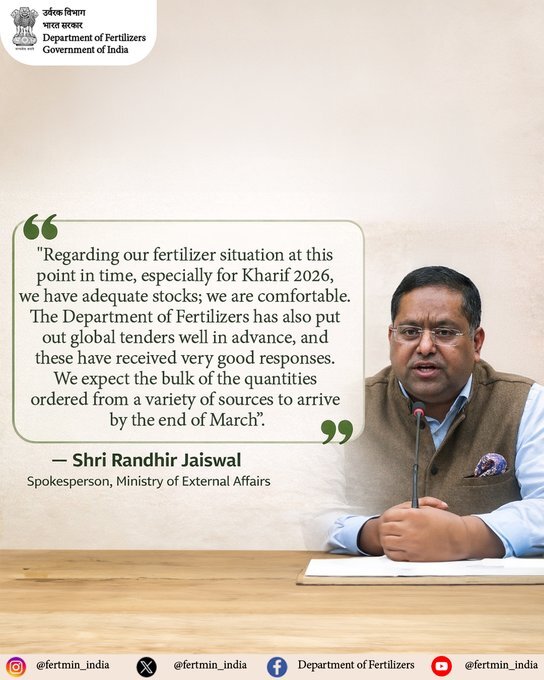
Randhir Jaiswal Spokesperson Ministry of External Affairs highlighted that India remains in a comfortable position with adequate fertilizer stocks and strong procurement pipelines. He noted that global tenders have received positive responses and that bulk quantities are expected to reach Indian warehouses before the end of March.
The diversification of import sources, supported by ongoing diplomatic engagement with multiple countries, has ensured continuity of supply and reduced dependence on any single region.
Timely Availability To Support Farmers
Officials indicated that the bulk of imported fertilizers will be available in the country before the end of March, ensuring timely distribution ahead of the Kharif sowing cycle.
The combined impact of increased domestic production and strategic imports is expected to stabilise market conditions, maintain price balance and ensure uninterrupted availability of fertilizers across states.
The government’s approach underscores a focus on pre emptive planning, supply chain resilience and farmer centric policy execution to safeguard agricultural productivity amid global uncertainties.