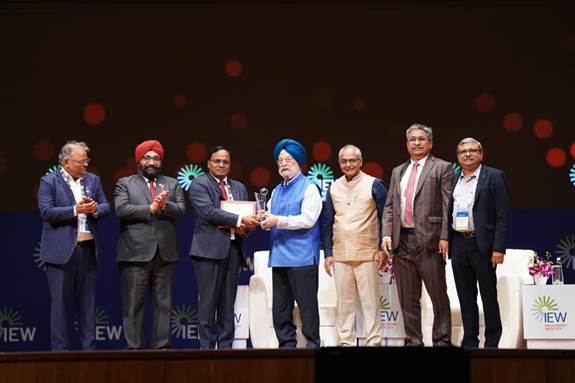

A high level panel discussion on accelerating clean energy solutions in New Delhi on February 27, 2026 brought together global and national leaders to examine the urgent need to speed up the energy transition through stronger multilateral cooperation, empowered subnational action and equitable access to clean energy.
Global Energy Transition “Far Off Track,” but Economics of Clean Power Remain Strong
Opening the session, Ambassador Arne Walther, Former Secretary General of the International Energy Forum, warned of the complex political realities shaping the global energy agenda. “Governments face an energy dilemma — to deliver energy security, energy affordability, and energy sustainability,” he said, adding that vested interests in fossil energy systems and policy uncertainties continue to slow progress. He stressed the need for alignment between national and subnational governments: “They are two sides of a cooperative coin.”
Ita Kettleborough, Director of the Energy Transitions Commission, offered a sobering reality check alongside cautious optimism. “We reached 1.5 degrees Celsius for the first time last year,” she noted, but underscored that clean energy economics remain resilient. “We have the technologies we need to deliver global warming well under two degrees in line with Paris,” she said, estimating the investment required at “around one to two percent of global GDP per year — far less than we are already spending on the cost of climate damage.”
On India’s opportunity, she highlighted that Indian renewable energy auctions last year were “60% cheaper than UK auctions,” and pointed to electric mobility, clean power system design, and agri-photovoltaics as three frontier areas where India can lead globally.
Cities on the Frontline: Portugal’s Matosinhos Targets Carbon Neutrality by 2030
Mayor Luísa Salgueiro of Matosinhos, Portugal, described her city’s commitment to carbon neutrality by 2030 — a full 20 years ahead of the EU’s 2050 target — as “not a symbolic declaration but a political choice.” Drawing on recent crises, including a nationwide blackout and severe storms that left hundreds of thousands without power, she emphasized that energy resilience is inseparable from decarbonization. “Centralized systems alone are not enough,” she said. Her city’s strategy rests on distributed renewable generation, energy communities, municipal capacity building, and multi-level governance. “Resilience and decarbonization are not parallel tracks. They are the same road.”
She also issued a clear call to national governments: “National plans must include cities. Financing must be predictable. Data must be interoperable. And dialogue must be permanent. Multi-level governance is not a theory — it is the architecture of delivery.”
India’s Land Question Takes Center Stage
Anjali Acharya, Managing Director of The Nature Conservancy India, brought the focus back to the ground-level challenges of India’s clean energy ambition. “India is targeting 500 GW of non-fossil fuel capacity by 2030 — adding 50 GW every year — and land is no longer a secondary issue. Land is now a defining issue,” she said. She highlighted The Nature Conservancy’s science-based geospatial tool Siteright, currently deployed across nine Indian states with plans to expand to nineteen, which helps identify low-conflict land parcels for renewable siting while integrating a social value index to ensure community inclusion. She also spotlighted the “Mining the Sun” initiative — repurposing abandoned coal mines for solar energy development — as a “win-win-win” for energy, environmental revitalization, and just transition.