
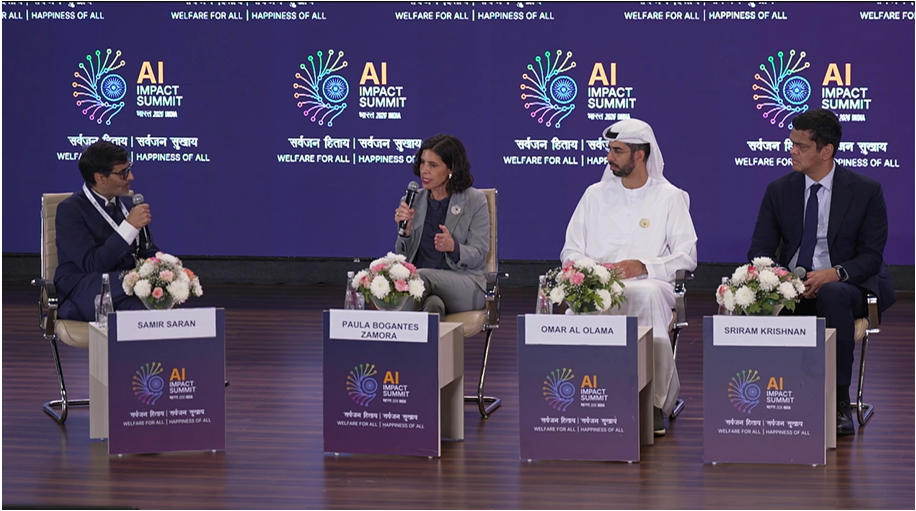
Senior policymakers from the United States, United Arab Emirates and Costa Rica joined strategic experts at the India AI Impact Summit 2026 to deliberate on artificial intelligence diffusion, national infrastructure priorities and the evolving architecture of global AI governance. The high-level panel underscored that infrastructure readiness, innovation ecosystems, responsible regulation and multilateral cooperation will determine whether AI delivers equitable benefits at scale.
The session featured Paula Bogantes Zamora, Minister of Science, Innovation, Technology and Telecommunications of Costa Rica; Omar Al Olama, Minister of State for Artificial Intelligence, Digital Economy and Remote Work Applications of the United Arab Emirates; Sriram Krishnan, Senior Policy Advisor for AI at the White House; and Samir Saran, President of the Observer Research Foundation, who moderated the discussion.
Sriram Krishnan outlined the United States’ national AI strategy around three foundational pillars: world-class infrastructure, innovation acceleration and strategic partnerships. He emphasised that expanding data centre capacity, compute availability and advanced semiconductor ecosystems is essential for maintaining global competitiveness. At the same time, he stressed the need to ensure affordability and energy sustainability as AI workloads scale.
Krishnan highlighted that innovation thrives when entrepreneurs and technology builders operate within predictable regulatory frameworks. He cautioned against excessive bureaucracy that could impede experimentation and growth. However, he underscored that regulatory clarity is indispensable, particularly in areas such as child protection, intellectual property rights and national security. He also emphasised the importance of secure supply chains and technology partnerships among allies to strengthen collective AI capabilities and resilience.
Omar Al Olama presented the United Arab Emirates’ perspective, positioning AI as a societal enabler rather than merely a technological advancement. He said that AI diffusion must extend beyond elite institutions and technology hubs to reach broader society through digital infrastructure, AI literacy and responsible deployment frameworks.
Drawing from the UAE’s early institutionalisation of AI governance, he emphasised the value of sustained global dialogue and platforms that foster collaboration. He warned against regulatory extremes that oscillate between overregulation and laissez-faire approaches. Instead, he advocated gradual, adaptive and consultative regulatory models that evolve alongside technological change. He noted that AI governance must remain inclusive to ensure that no country is excluded from shaping or benefiting from the global AI ecosystem.
Paula Bogantes Zamora offered the viewpoint of smaller and developing economies navigating rapid technological change. She stated that AI forces nations to undertake an honest assessment of digital readiness. Foundational enablers such as nationwide connectivity, 5G deployment, national AI strategies, data governance frameworks and research investment are prerequisites for meaningful participation.
Bogantes Zamora highlighted disparities in digital infrastructure and innovation spending across regions. She argued that regulatory models cannot be uniform across all economies and must reflect varying stages of development. She called for stronger regional cooperation and alliances among like-minded countries to amplify negotiating power and ensure equitable access to emerging AI tools. Emphasising data as a strategic asset, she advocated deeper global dialogue on data value, cross-border governance and capacity building mechanisms that allow countries to develop foundational capabilities before scaling advanced AI systems.
Samir Saran framed the discussion around the themes of impact, diffusion and multilateralism. He emphasised that AI governance must balance innovation with restraint, integrating safety guardrails and human-centric design principles. He observed that partnerships—whether regional, thematic or values-based—are essential to maintaining inclusivity and responsiveness as AI systems become increasingly integrated into economic and social structures.
Throughout the discussion, speakers converged on a central conclusion: AI is not merely a technological breakthrough but a systemic transformation influencing infrastructure, economic competitiveness, social equity and geopolitical alignment. Ensuring that AI benefits humanity at scale requires coordinated infrastructure investment, policy coherence, innovation enablement and sustained international cooperation.
The session reinforced the India AI Impact Summit 2026 as a global convening platform where strategic, regulatory and developmental perspectives converge to shape forward-looking, inclusive and responsible AI governance frameworks.