
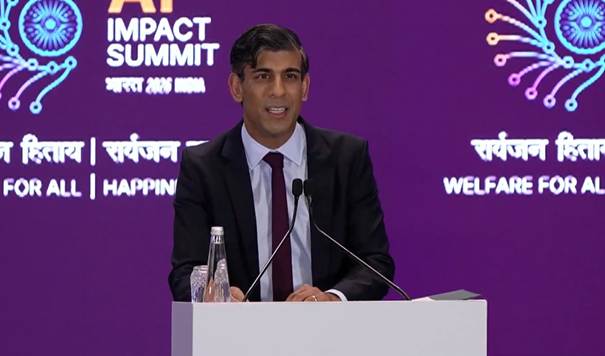
The India AI Impact Summit 2026, inaugurated earlier in the day by Narendra Modi at Bharat Mandapam, witnessed two keynote addresses that framed artificial intelligence as the defining force reshaping economies, governance systems and the human experience. Former United Kingdom Prime Minister Rishi Sunak and Surya Ganguli, Professor of AI, Neuroscience, and Physics at Stanford University, offered complementary perspectives on the global trajectory of AI — one focused on governance and societal adoption, the other on scientific frontiers and foundational research.
Rishi Sunak opened the session by reflecting on the unprecedented speed at which artificial intelligence is advancing. Drawing from his experience hosting the first AI Safety Summit at Bletchley Park, he stressed that the acceleration of capability must be matched by a commitment to safety and accountability.
“Artificial intelligence can do many things,” he said, “but it will never replace the wonder of human experience.” At the same time, he underlined the extraordinary pace of adoption. While the telephone took 75 years to reach 100 million users, and the internet took around seven years, ChatGPT reached that milestone in just two months, he noted. The implication, he argued, is that societies must adapt governance frameworks at a speed never before required in technological history.
Sunak highlighted India’s distinctive position in the global AI transformation. With its digital public infrastructure — including Aadhaar, UPI and digital health accounts — India has built scalable platforms capable of serving 1.4 billion people. These foundational systems, he said, create a unique opportunity to deploy AI at population scale.
He pointed to India’s rapidly growing startup ecosystem, its expanding base of unicorns and innovations such as Sarvam AI as evidence that the competitive frontier in artificial intelligence is not limited to laboratory breakthroughs. “The real race,” he suggested, lies in widespread adoption and real world integration — embedding AI into agriculture, healthcare, financial inclusion and education systems in ways that tangibly improve lives.
Addressing global challenges such as food security, healthcare access and educational inequities, Sunak argued that AI has the potential to “raise the floor for humanity.” By supporting farmers with predictive analytics, enabling maternal healthcare interventions and delivering personalised learning at scale, AI could create a more level playing field across societies, he said.
The summit’s scientific dimension was deepened by Surya Ganguli, who provided a research driven roadmap for advancing intelligence itself. He began by noting a paradox at the heart of current AI systems: they are growing rapidly in capability, yet researchers still lack a fundamental theoretical understanding of how and why they work as effectively as they do.
At the same time, he contrasted modern AI systems with the human brain, which has evolved over approximately 500 million years. The brain operates on roughly 20 watts of energy, while advanced AI systems can require millions of watts to train and deploy. This disparity, he said, underscores the need to rethink the technological stack from first principles.
Ganguli identified three frontiers that will define the next phase of intelligence research: data efficiency, energy efficiency and the melding of brains and machines.
On data efficiency, he presented new theoretical insights into neural scaling laws — empirical relationships long observed in AI performance but not fully understood. Recent research from his team demonstrates that intelligent data selection and training strategies can dramatically accelerate learning, transforming slow power law improvements into much faster exponential gains. This, he suggested, could reduce the dependence on ever larger datasets and compute budgets.
On energy efficiency, Ganguli argued that lessons from biology could inspire new computational architectures. By studying how neural circuits align computation with physical constraints, researchers can design systems that are more aligned with energy realities. He described the emerging field of quantum neuromorphic computing as a potential pathway — integrating quantum principles with brain inspired architectures to achieve breakthroughs in efficiency and performance.
The most forward looking dimension of his address concerned brain machine integration. By building digital twins of neural circuits, researchers can decode patterns of perception, simulate disease states and potentially write precise neural activity patterns back into the brain. Experiments decoding visual perception in animal models and controlling epileptic seizures illustrate the therapeutic promise of combining AI with neuroscience, he said.
Together, the two keynote addresses framed artificial intelligence as both a governance challenge and a scientific frontier. Sunak emphasised global cooperation, safety and inclusive adoption. Ganguli focused on the theoretical and biological foundations necessary to push beyond current limitations.
The convergence of these perspectives underscored a central message emerging from the India AI Impact Summit 2026: artificial intelligence is no longer a distant abstraction. It is an immediate force reshaping policy, infrastructure, research and human potential. India, with its digital foundations and scale, stands uniquely positioned to shape how this transformation unfolds.