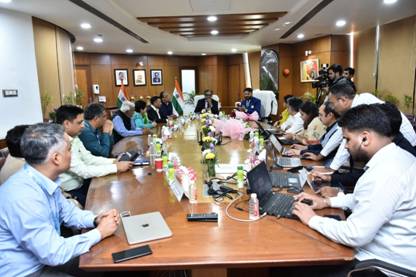

The Government has launched the Gyan Bharatam Mission to systematically survey, document, conserve, digitize and provide wider access to India’s vast manuscript heritage preserved in institutions and private collections across the country.
Union Minister for Culture and Tourism Gajendra Singh Shekhawat informed the Lok Sabha in a written reply that the initiative, implemented under the Ministry of Culture, seeks to create a nationwide framework for the protection, digitization and long term preservation of manuscripts representing India’s intellectual, cultural and literary traditions.
The Standing Finance Committee has sanctioned ₹491.66 crore for the implementation of the mission for the period 2025 to 2031. The funding will support large scale activities including surveying manuscripts, scientific conservation, digitization, creation of digital infrastructure and nationwide coordination mechanisms.
The mission has been designed to identify and preserve manuscripts located in academic institutions, museums, libraries and private collections across India. The initiative aims to bring together scattered manuscript resources under a coordinated national framework while ensuring that the knowledge contained in these manuscripts becomes accessible to researchers and the public.
As part of the implementation strategy, the mission will establish a nationwide network of Cluster Centers and Independent Centers responsible for carrying out manuscript related activities including documentation, preservation and digitization.
More than 40 Cluster Centers and Independent Centers have already been onboarded across the country to support the implementation of the mission. In addition, 28 States and Union Territories have been brought on board to act as Nodal Coordinating Authorities responsible for implementing the mission at the state or union territory level.
These nodal agencies will coordinate with cultural institutions, universities, libraries and private custodians of manuscripts to facilitate surveys, documentation and conservation work.
The mission has also engaged multiple technical partners responsible for key operational components such as metadata creation, integration of digital records with the National Digital Repository, deployment of digitization equipment, development of artificial intelligence enabled digital platforms and long term digital storage systems.
The Gyan Bharatam Mission aims to undertake manuscript related activities on a large and intensive scale across the country. The government has estimated that India may possess approximately one crore manuscripts distributed across various institutions and private collections. The mission seeks to locate and document this manuscript wealth irrespective of region, language, script or community.
Officials noted that the initiative will adopt a systematic and technology driven framework to safeguard India’s manuscript heritage. Scientific conservation and restoration will be carried out through both preventive and curative conservation techniques to protect fragile manuscripts from deterioration.
High standard digitization processes will be used to create accurate digital copies of manuscripts. These digital records will then be integrated into the National Digital Repository which will function as a centralized digital archive for manuscripts and related cultural records.
The digital infrastructure being developed under the mission includes secure long term data storage systems using LTO 9 magnetic tape technology along with cloud based storage and disaster recovery systems to ensure the safety and preservation of digitized data.
Each digitized manuscript will be accompanied by detailed metadata, cataloguing and documentation. This process will ensure authenticity, traceability and proper identification of the original source material.
The National Digital Repository will allow researchers, scholars and institutions to access digitized manuscripts through a centralized digital platform, significantly improving access to India’s historical knowledge resources.
Parallel to this initiative, the National Archives of India has also undertaken extensive digitization programmes to create high resolution digital copies of historical records.
In order to maintain the authenticity and integrity of digitized records, a checksum is generated for each digital image created during the digitization process. This verification mechanism ensures that any alteration or tampering with digital records can be detected, thereby preserving the reliability of archival materials.
The government’s initiative under the Gyan Bharatam Mission is expected to significantly strengthen efforts to protect India’s manuscript heritage while expanding access to valuable historical knowledge preserved in manuscripts across the country.