
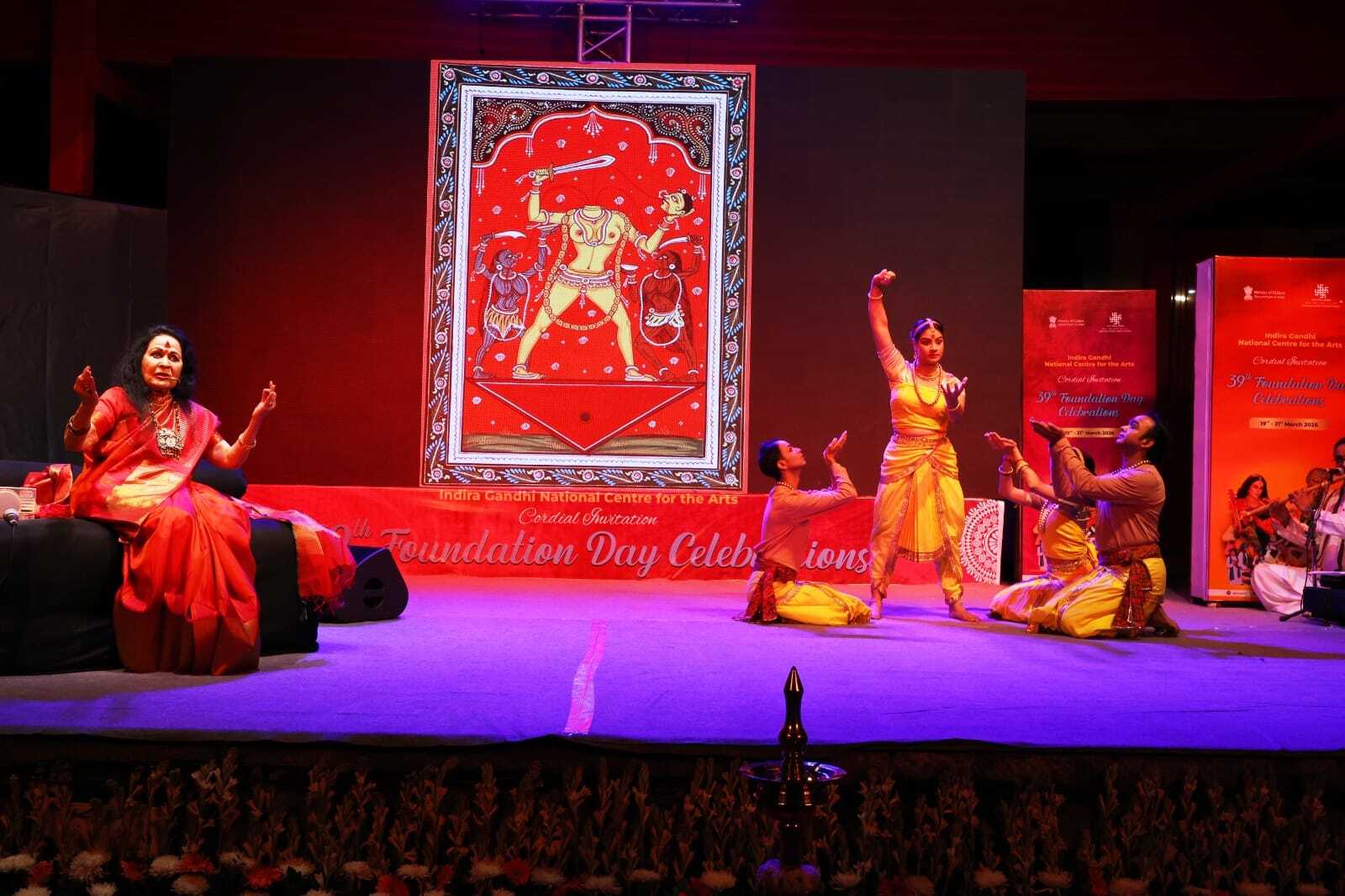
The Indira Gandhi National Centre for the Arts marked its 39th Foundation Day with a three-day cultural celebration that brought together classical refinement and folk vitality, culminating in a rich showcase of India’s diverse artistic traditions. Held from March 19 to March 21, the event featured an expansive range of performances, exhibitions and cultural expressions that highlighted the continuum of India’s artistic heritage.
The concluding day on March 21 was dedicated to folk traditions, presenting a vibrant array of performances that captured regional diversity and community spirit. The evening commenced with the Bagurumba dance of Assam, performed by Swagata Sarma and her group, offering a graceful depiction of nature-inspired movements and indigenous rhythms. This was followed by the Nati dance of Himachal Pradesh, presented by Prem Chand Bounali and his troupe, reflecting the celebratory ethos and simplicity of hill culture.
The programme gathered momentum with the Talwar Raas of Gujarat, performed by Nilesh Parmar and his group, delivering a powerful display of synchronised movements and martial vigour rooted in traditional storytelling. The audience was further captivated by a presentation of Kerala’s ancient martial art Kalaripayattu by Krishnadas Gurukkal and the Vallabhatta Kalari group, which combined physical agility, discipline and cultural heritage in a compelling performance.
The evening segment transitioned into devotional and spiritual expressions. Bheru Singh Chouhan from Madhya Pradesh presented Kabir bhajans, drawing listeners into a contemplative and introspective space through soulful renditions. The celebrations concluded with a performance by Mamta Joshi, who presented Sufi and Kabir compositions, creating an atmosphere of mysticism and spiritual resonance.
The first two days of the celebration were dedicated to classical traditions, reinforcing the philosophical and aesthetic depth of Indian performing arts. On the opening day, Sonal Mansingh, noted Nritya Guru, cultural scholar and former Member of Parliament Rajya Sabha, presented Natya Katha Devi. Her performance, marked by expressive intensity and deep-rooted classical discipline, left a lasting impact on the audience.
The second day featured Padma Subrahmanyam, who presented a dance drama based on the Bhagavad Gita. The performance seamlessly integrated dance, music and philosophy, offering an immersive artistic experience. At 83 years of age, her uninterrupted performance of nearly two hours stood out for its endurance, precision and emotional depth. Her expressive facial movements brought each verse of the Gita to life, demonstrating mastery and devotion to the art form.
In addition to the performances, several exhibitions organised within the IGNCA premises drew significant public engagement. The photographic exhibition Kaladrishti A Decade of Vision traced the institution’s creative journey over the years. Aakhyan Breathing Hides The Soul of Andhra Puppetry showcased the intricate traditions of puppetry from Andhra Pradesh, highlighting its narrative richness and craftsmanship. The Thewa exhibition introduced visitors to a distinctive art form from Rajasthan, known for its intricate gold work on glass.
The three-day celebration emerged as a cohesive cultural narrative that bridged the classical and the folk, the philosophical and the lived, the traditional and the evolving. While classical performances articulated the intellectual and spiritual dimensions of Indian art, folk presentations brought forward the vibrancy, spontaneity and diversity of everyday cultural life.
The event reaffirmed the role of the Indira Gandhi National Centre for the Arts as a custodian of India’s cultural heritage, committed to preserving, documenting and promoting artistic traditions across the country. By presenting a unified platform for diverse art forms, the Foundation Day celebrations underscored the enduring relevance of cultural institutions in sustaining India’s rich and pluralistic identity.