
India’s pharmaceutical sector has consolidated its position as a cornerstone of both public health delivery and economic development, emerging as a globally trusted supplier of affordable, high-quality medicines while strengthening its contribution to national growth. The industry’s evolution from a domestic-focused manufacturing base to a globally integrated healthcare powerhouse reflects a combination of policy support, scientific capability, and expanding international demand.
The pharmaceutical sector operates at the intersection of healthcare and economic progress, playing a dual role in improving health outcomes and generating employment, investments, and supply chain resilience. By ensuring the availability of essential medicines and vaccines at scale, the sector contributes significantly to societal welfare while reinforcing India’s broader development trajectory.
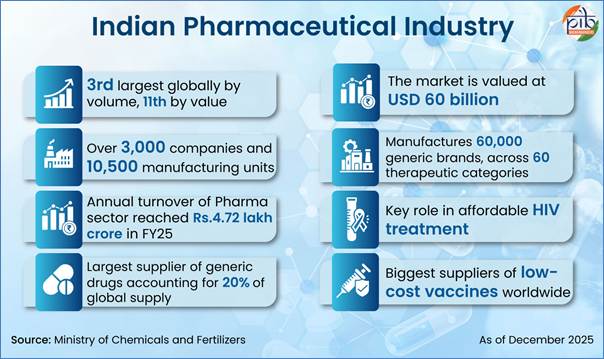
India today ranks third globally in pharmaceutical production by volume and eleventh by value, supported by a vast ecosystem of more than 3,000 companies and over 10,500 manufacturing units. The domestic pharmaceutical market, currently valued at approximately USD 60 billion, is projected to expand to USD 130 billion by 2030, reflecting sustained growth momentum driven by rising demand, innovation, and export expansion.
According to the Economic Survey 2025-26, the sector recorded an annual turnover of Rs 4.72 lakh crore in FY25, with exports growing at a compound annual growth rate of 7 percent over the past decade. India’s status as the “Pharmacy of the World” is underpinned by its ability to combine cost-efficient manufacturing with globally benchmarked quality standards. The country supplies nearly 20 percent of the world’s generic medicines, producing around 60,000 generic brands across 60 therapeutic categories.
India’s pharmaceutical manufacturing base is further strengthened by its global regulatory credibility. The country hosts the highest number of United States Food and Drug Administration approved manufacturing facilities outside the United States, reinforcing confidence in the safety and quality of Indian medicines. In addition, approximately 500 active pharmaceutical ingredient manufacturers contribute nearly 8 percent of global API production, highlighting India’s role in the upstream pharmaceutical supply chain.
India’s global footprint in vaccines is particularly significant. The country is a leading supplier of vaccines for diseases such as diphtheria, tetanus, pertussis, tuberculosis and measles. Indian manufacturers account for about 60 percent of vaccine supplies to UNICEF, meet 40 to 70 percent of global demand for DPT and BCG vaccines, and supply nearly 90 percent of the World Health Organization’s measles vaccine requirements. This extensive global reach underscores India’s central role in international public health programmes.
Pharmaceutical exports have witnessed substantial growth over the past two decades. In 2024-25, exports reached USD 30.5 billion, representing a nearly sixteen-fold increase from USD 1.9 billion in 2000-01. Indian pharmaceutical products are now exported to 191 countries, with approximately 50 percent directed to highly regulated markets such as the United States and Europe. Monthly export trends remain positive, with shipments rising from USD 2.59 billion in January 2025 to USD 2.66 billion in January 2026.
The sector has also expanded into non-traditional and emerging markets, including Nigeria, Mexico, the United Republic of Tanzania, the Netherlands, France, Brazil, Sri Lanka, Saudi Arabia and Spain. This diversification strategy has enhanced export resilience and reduced dependence on specific geographies.
Medical device exports have also gained traction, increasing from USD 2.5 billion in 2020-21 to USD 4.1 billion in 2024-25, with shipments reaching 187 countries. This growth reflects the sector’s expanding capabilities beyond pharmaceuticals into integrated healthcare manufacturing.
Foreign direct investment continues to flow strongly into the sector, positioning it among the top ten industries attracting investment in India. In the current financial year 2025-26, foreign investment inflows in pharmaceuticals reached Rs 13,193 crore up to September, indicating sustained investor confidence driven by regulatory stability, production capacity expansion and global demand.
India’s growing network of trade agreements is further enhancing market access for pharmaceutical and medical device exports. The recently concluded India European Union Free Trade Agreement is expected to open access to a market valued at approximately USD 572.3 billion, boosting exports of pharmaceutical products and medical technologies. Manufacturing hubs in Maharashtra, Gujarat, Telangana, Karnataka and Andhra Pradesh are expected to benefit significantly from increased export opportunities and investment inflows.
The India United Kingdom Comprehensive Economic and Trade Agreement signed in July 2025 provides zero duty access for 56 pharmaceutical tariff lines, improving the competitiveness of Indian generics in the UK market. The agreement also enables duty-free access for key medical devices, including diagnostic equipment and surgical instruments.
Similarly, the India New Zealand Free Trade Agreement concluded in December 2025 provides zero duty access across around 90 pharmaceutical tariff lines, further strengthening export prospects.
Government policy interventions have played a critical role in strengthening domestic manufacturing and reducing import dependence. The Production Linked Incentive schemes for pharmaceuticals, bulk drugs and medical devices have driven investments, increased production capacity and supported employment generation.
Under the PLI scheme for pharmaceuticals, investments have reached Rs 40,890 crore against a target of Rs 17,274.96 crore as of September 2025. The scheme has generated total sales of Rs 3,16,797 crore, including exports worth Rs 2,03,730 crore, and created employment for approximately 97,000 individuals.
The PLI scheme for bulk drugs has established a manufacturing capacity of 55,100 metric tonnes per year for critical APIs and intermediates, with cumulative sales of Rs 2,313.16 crore and investments of Rs 4,763.34 crore. The initiative has also generated employment for 4,929 people.
The PLI scheme for medical devices has recorded cumulative sales of Rs 12,344.37 crore, including exports worth Rs 5,869.36 crore, and attracted investments of Rs 1,093.69 crore.
Infrastructure development has been supported through bulk drug parks in Andhra Pradesh, Gujarat and Himachal Pradesh, with a combined project cost exceeding Rs 6,306.68 crore. Medical device parks in Uttar Pradesh, Madhya Pradesh and Tamil Nadu are also advancing, with 199 manufacturers allotted land and 34 units already under construction.
Innovation and research are being strengthened through the Promotion of Research and Innovation in Pharma MedTech initiative. Seven Centres of Excellence have been established, supporting over 111 research projects, resulting in published research and patent filings. The initiative also promotes collaboration between academia and industry to drive high-value pharmaceutical innovation.
Access to affordable medicines has been significantly expanded through the Pradhan Mantri Bhartiya Janaushadhi Pariyojana. As of March 2026, more than 18,646 Jan Aushadhi Kendras are operational, offering over 2,110 medicines and 315 medical devices at affordable prices. The scheme has delivered substantial savings to citizens, with Rs 8,000 crore saved in 2024-25 alone.
The government has also proposed the Biopharma SHAKTI initiative with an outlay of Rs 10,000 crore over five years to strengthen India’s biopharmaceutical ecosystem. The programme will establish new institutional networks, upgrade National Institutes of Pharmaceutical Education and Research, and create over 1,000 clinical trial sites to support advanced research and development.
India’s pharmaceutical ecosystem is supported by a robust regulatory framework. The Central Drugs Standard Control Organisation ensures the safety and efficacy of drugs and medical devices, while the National Pharmaceutical Pricing Authority regulates prices and ensures availability of essential medicines. The Indian Pharmacopoeia Commission maintains drug quality standards, which are recognised internationally.
The sector’s transformation reflects a strategic shift from import dependence to self-reliance, innovation and global competitiveness. With strong manufacturing capabilities, expanding exports, rising investments and supportive policy frameworks, India is well positioned to strengthen its role as a global healthcare provider while contributing significantly to economic growth.