
Indian Railways is executing some of the most ambitious infrastructure projects of the 21st century, reshaping connectivity, strengthening national integration, and accelerating economic growth across the country. From record-breaking bridges in challenging terrains to dedicated freight corridors and high-speed rail, these projects reflect India’s expanding engineering capability and long-term development vision.
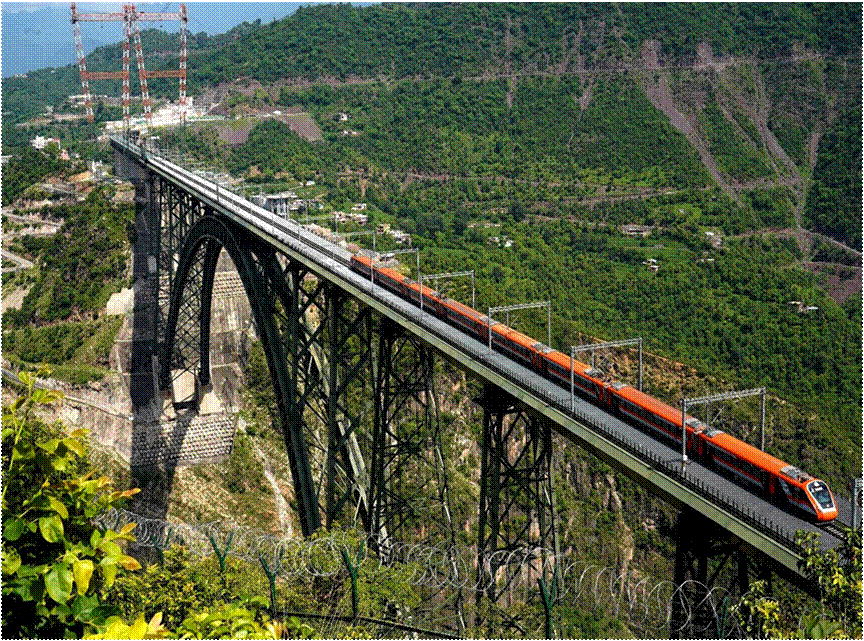
One of the most strategically significant initiatives is the Udhampur Srinagar Baramula Rail Link, a 272 kilometre project constructed at an approximate cost of ₹44,000 crore to provide all-weather rail connectivity to the Kashmir Valley. Passing through the Himalayan region, the project includes the Chenab Rail Bridge, the world’s highest railway arch bridge, standing 359 metres above the river and extending 1,315 metres in length. Engineered to withstand high seismic activity and extreme wind conditions, the bridge is a landmark in global railway engineering. The project also features the Anji Rail Bridge, India’s first cable-stayed railway bridge, along with 36 tunnels spanning 119 kilometres and 943 bridges, significantly improving mobility, tourism, and economic activity in Jammu and Kashmir.
In southern India, the New Pamban Railway Bridge in Tamil Nadu represents another major engineering achievement. India’s first vertical-lift sea railway bridge, the 2.08 kilometre structure has been built at a cost of about ₹550 crore. It consists of 100 spans, including a central 72.5 metre lift span, and is supported by an extensive substructure of 333 piles and 101 pile caps. Designed to endure harsh marine conditions, the bridge incorporates an advanced corrosion protection system that extends its service life up to 38 years without maintenance and up to 58 years with minimal upkeep. The bridge ensures uninterrupted rail connectivity to Rameswaram, a major pilgrimage and tourism destination, and has received the Steel Structures and Metal Buildings Award 2024 for bridge design.
Indian Railways has also made transformative progress in the North Eastern region, long constrained by connectivity challenges. Since 2014, more than 1,679 kilometres of railway tracks have been laid in the region, over 2,500 route kilometres electrified, and more than 470 road overbridges and underbridges constructed. The commissioning of the Bairabi Sairang new line has connected Aizawl to the national rail network for the first time, making it the fourth state capital in the North East to gain rail connectivity. Sixty stations across the region are currently being redeveloped under the Amrit Bharat Station Scheme, while major projects such as Sivok Rangpo, Dimapur Kohima, and Jiribam Imphal continue to advance, improving social and economic integration.
On the freight front, Indian Railways is transforming logistics through the Dedicated Freight Corridor programme. The Eastern Dedicated Freight Corridor from Ludhiana to Sonnagar, spanning 1,337 kilometres, has been fully commissioned. The Western Dedicated Freight Corridor, stretching 1,506 kilometres between Jawaharlal Nehru Port Terminal and Dadri, has achieved over 93 percent commissioning. Together, the two corridors cover 2,843 kilometres, with more than 96 percent of the network operational. These corridors are reducing congestion on passenger routes, cutting transit times, lowering logistics costs, and enhancing reliability for industries and ports.
High-speed rail development is also progressing steadily. The Mumbai Ahmedabad High Speed Rail Project has completed 331 kilometres of viaduct work out of a total alignment of 508 kilometres, with pier construction finished for 410 kilometres. Several river, prestressed concrete, and steel bridges have been completed, alongside substantial progress in track bed construction, overhead electrification, and tunnelling. The project is set to introduce world-class high-speed rail technology, significantly reducing travel time between two major economic hubs.
Collectively, these landmark projects underline Indian Railways’ pivotal role in national development. By combining large-scale investment, advanced engineering, and strategic planning, Indian Railways is expanding modern connectivity, strengthening economic growth, and reinforcing national unity across regions.