
From UNFCCC CoP 31 Antalya, Türkiye, 17 November 2026
The ISA-iSUN global design challenge was launched on 31 August 2026. The challenge focuses on Small Island Developing States (SIDS), inviting architectural and engineering academic institutions worldwide to design climate-resilient resorts that bring together architecture and solar technology in select SIDS nations. The challenge is hosted by the International Solar Alliance (ISA), powered by the ISA Multi Donor Trust Fund (MDTF) and the Global Energy Alliance for People and Planet (GEAPP), executed by GRIHA Council, with the support of The Energy and Resources Institute (TERI) and the Royal Institute of British Architects (RIBA).
Since its global launch, the ISA-iSUN Design Challenge has been presented on various platforms, both nationally and internationally. Recently, a delegation from GRIHA Council and TERI, led by Sanjay Seth, Vice President & CEO, GRIHA Council and Executive Director-Strategy & Partnerships, TERI and joined by Shabnam Bassi, Deputy CEO & Secretary, GRIHA Council and Director, Sustainable Buildings, TERI, and Akash Deep, Deputy General Manager & Treasurer, GRIHA Council, participated in CoP 31 to spread the message of energising the frontlines by building climate resilience in SIDS.
At the high-level ministerial event during CoP31, Dr Bhupendra Yadav, Hon’ble Minister, Ministry of Environment, Forests and Climate Change, Government of India, emphasised strengthening partnerships between India and SIDS based on technology cooperation, knowledge transfer, capacity building and practical cooperation. This is essential to build resilient coastlines and healthy oceans, which are fundamental to strengthening economic security, ecological stability and human well-being.
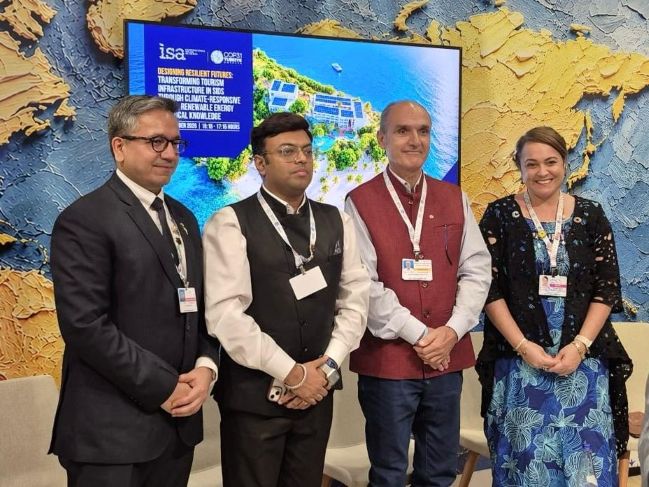
In line with the message and the ongoing ISA-iSUN global architectural design challenge, the ISA and GRIHA Council jointly hosted a session centred around “Designing Resilient Futures: Transforming Tourism Infrastructure in SIDS through Climate-Responsive Design, Renewable Energy and Local Knowledge.” Bringing the challenge of building resilience into the global climate dialogue, the panel set out to reframe tourism infrastructure in SIDS as a driver of climate action. It examined how hotels and resorts can be planned from the outset to reduce energy demand and withstand climate hazards, thereby making them resilient. The panel also stressed that resilient tourism must benefit island communities by creating local jobs, sustaining traditional craftsmanship and strengthening local supply chains.
Akash Deep, Deputy General Manager & Treasurer, GRIHA Council moderated the session and opened by describing tourism infrastructure as the key point for building climate resilience in SIDS. He said, “Hospitality that is both inclusive and resilient starts with passive design, local building materials and traditional knowledge. We must integrate renewable energy, building-integrated and rooftop photovoltaics and battery storage at the earliest design stage, rather than adding it later.”
Setting the context, Karan Mangotra, Chief of Strategy & New Initiatives, International Solar Alliance, said, “For almost 2/3 small island states, the tourism sector generates more than a 5th of GDP, and its resilience depends on how its buildings are designed. Through the ISA SIDS Platform, ISA and GRIHA Council are bringing climate-responsive design, solar energy and local knowledge together in the ISA–iSUN Design Challenge, to create a net zero model resort that island governments and investors can replicate.”
Speaking on the panel, Ruth Cross Kwansing, Minister of Women, Youth, Sport and Social Affairs, Government of Kiribati, said, “In the Pacific, we are drawing the red line at 1.5 degrees, and solar and renewables are 100 per cent the way to go. We thank ISA for bringing this conversation forward, so we can integrate solar technologies into our architecture and our homes and use the beautiful sun to save the planet.”
Golo Pilz, Principal Adviser, Renewable Energy, Brahma Kumaris Environment Initiative, said, “The technologies, the strategies and the money are all there to move to solar now. The good news is that solar is already cheaper than fossil fuels. We have to bring everybody on board, especially our younger generation, and help them see this crisis as a chance for transformation.”
The session drew a diverse audience of policymakers, practitioners, industry experts, and civil society representatives, who shared their perspectives and ideas to support the development of a new generation of climate-resilient tourism infrastructure.